Artificial intelligence is no longer a futuristic concept — it’s reshaping how brands attract, convert, and retain customers. Yet as artificial intelligence in marketing expands, so does confusion around technical language. Marketers now encounter terms like machine learning, algorithmic bidding, NLP in marketing, and predictive analytics in marketing almost daily.
That’s why a structured ai marketing glossary is essential. Whether you’re a marketing manager, founder, agency strategist, student, or performance advertiser, this guide will help you understand key AI marketing terms clearly and confidently.
This article breaks down the most important definitions in simple language, provides real marketing examples, and explains why each concept matters.
Short Answer: What Is an AI Marketing Glossary?
An ai marketing glossary is a structured collection of AI marketing terms and definitions used in modern digital marketing. It explains concepts related to:
- Machine learning marketing definitions
- Marketing automation terminology
- Predictive analytics in marketing
- Generative AI marketing terms
- AI-driven personalization
- Algorithmic marketing
- Data science and analytics
It helps marketers understand how artificial intelligence tools work, align with technical teams, evaluate AI vendors, and make informed strategy decisions.
Why Marketers Need an AI Marketing Glossary in 2026
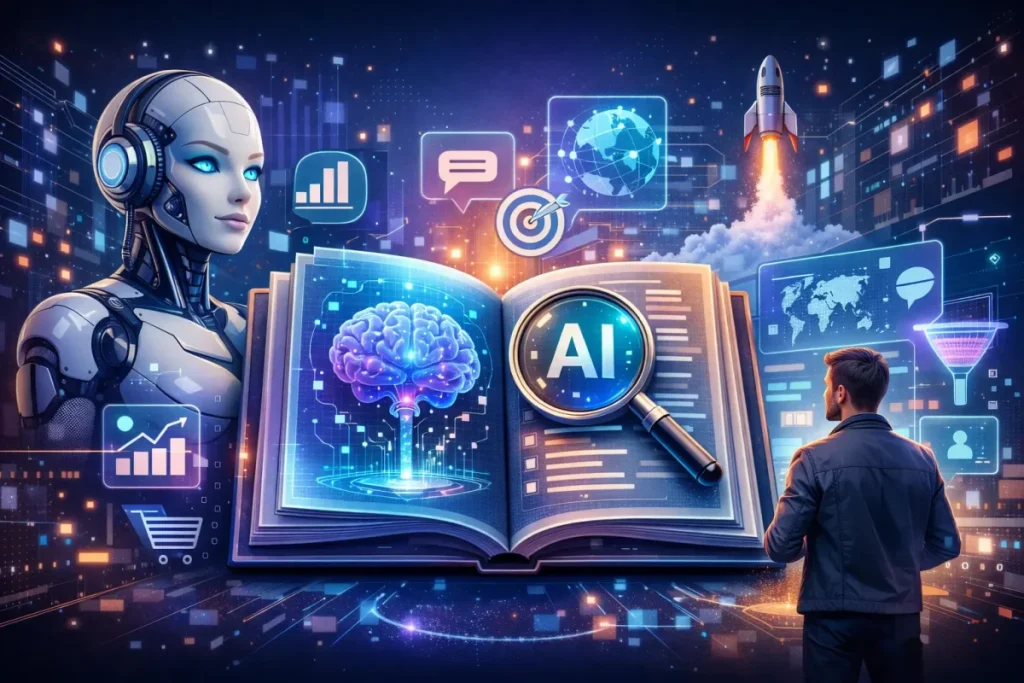
Explosion of AI Tools for Marketers
The number of AI tools for marketers has grown exponentially. From AI content generation platforms to predictive CRM systems and AI-powered ad optimization engines, the marketing tech stack is evolving rapidly. According to industry reports from sources like McKinsey & Company, AI adoption in marketing continues to accelerate year over year.
Without a clear glossary, teams struggle to evaluate tools objectively.
Complexity of Machine Learning Terminology
Terms like supervised learning, neural networks, and large language models can sound intimidating. However, understanding these machine learning marketing definitions helps marketers:
- Assess vendor claims
- Interpret performance data
- Communicate with data teams
Alignment Between Marketing & Technical Teams
Marketing and data science teams often speak different languages. A shared ai marketing glossary bridges that gap, enabling collaboration in:
- Predictive modeling projects
- Marketing automation implementation
- AI-driven personalization initiatives
Competitive Advantage Through AI Literacy
AI literacy is becoming a core marketing skill. Professionals who understand AI advertising vocabulary can:
- Launch smarter campaigns
- Optimize spend using algorithmic marketing
- Interpret predictive insights correctly
Avoiding Buzzword Confusion
AI is full of hype. Clear definitions prevent confusion between:
- Generative AI vs. automation
- Machine learning vs. rule-based systems
- Predictive analytics vs. simple reporting
Clarity protects budgets and strategic decisions.
Core AI & Machine Learning Terms (Foundational Concepts)
Below are essential foundational AI marketing terms every marketer should understand.
Artificial Intelligence (AI)
Definition: AI refers to computer systems that perform tasks normally requiring human intelligence.
Marketing Example: AI analyzes customer behavior to recommend products.
Why It Matters: It powers automation, personalization, and predictive insights.
Machine Learning (ML)
Definition: A subset of AI where systems learn from data and improve over time.
Marketing Example: Email platforms optimizing send times based on past engagement.
Why It Matters: ML drives predictive analytics in marketing.
Deep Learning
Definition: Advanced ML using neural networks with multiple layers.
Marketing Example: Image recognition in social media ads.
Why It Matters: Enables advanced AI content generation and computer vision.
Neural Networks
Definition: AI systems inspired by the human brain.
Marketing Example: Product recommendation engines.
Why It Matters: Core technology behind personalization.
Natural Language Processing (NLP)
Definition: AI that understands and generates human language.
Marketing Example: Sentiment analysis in social listening tools.
Why It Matters: NLP in marketing powers chatbots and AI copywriting.
Large Language Models (LLMs)
Definition: Advanced NLP models trained on vast datasets.
Marketing Example: AI-generated blog posts and ad copy.
Why It Matters: Backbone of generative AI marketing terms.
Computer Vision
Definition: AI that interprets visual content.
Marketing Example: Analyzing user-generated images for brand mentions.
Why It Matters: Enhances visual ad targeting.
Supervised Learning
Definition: Training AI with labeled data.
Marketing Example: Spam detection in email campaigns.
Why It Matters: Improves accuracy of marketing models.
Unsupervised Learning
Definition: AI identifies patterns without labeled data.
Marketing Example: Audience segmentation.
Why It Matters: Discovers hidden customer insights.
Reinforcement Learning
Definition: AI learns through rewards and penalties.
Marketing Example: Algorithmic bidding optimization.
Why It Matters: Improves real-time ad performance.
AI Marketing Automation Terminology
Understanding marketing automation terminology is crucial for scalable growth.
Marketing Automation
Software that automates campaigns and workflows.
Example: Automated email nurture sequences.
Programmatic Advertising
Automated ad buying using AI.
Example: Real-time ad placement based on user behavior.
Dynamic Creative Optimization (DCO)
AI customizes ad creatives for individuals.
Example: Different banner images based on browsing history.
Predictive Lead Scoring
AI ranks leads by conversion probability.
Improves sales alignment and ROI.
Customer Data Platform (CDP)
Centralized customer data system.
Enables AI-driven personalization across channels.
AI-Driven Personalization
Real-time content adaptation based on user behavior.
Example: Personalized homepage experiences.
Chatbots
Automated messaging systems.
Improve customer support efficiency.
Conversational AI
Advanced chatbot systems using NLP.
Enables natural conversations.
Customer Journey Mapping (AI-Powered)
AI tracks and optimizes touchpoints across channels.
Generative AI Marketing Terms
Generative AI marketing terms are reshaping creative production.
Generative AI
AI that creates new content.
Used in AI content generation for blogs and ads.
AI Content Generation
Automated creation of text, images, and videos.
Improves speed and scalability.
Prompt Engineering
Crafting effective AI instructions.
Improves output quality in AI tools for marketers.
Text-to-Image AI
Generates images from text prompts.
Used for ad visuals.
AI Video Generation
Creates marketing videos automatically.
Synthetic Media
AI-generated audio, video, or images.
AI Copywriting
Automated ad and email copy creation.
AI Brand Voice Modeling
Training AI to replicate brand tone consistently.
AI Advertising & Performance Marketing Vocabulary
Algorithmic Bidding
AI automatically adjusts ad bids in real time.
Lookalike Modeling
AI finds users similar to existing customers.
Predictive Analytics in Marketing
Uses historical data to forecast behavior.
Conversion Rate Optimization (AI-Powered)
AI tests variations automatically.
Real-Time Bidding
Instant ad auction system.
Attribution Modeling (AI-Enhanced)
AI assigns conversion credit across channels.
Audience Segmentation (AI-Driven)
AI clusters users by behavior patterns.
Data & Analytics Terms in AI Marketing
Big Data
Massive datasets used for insights.
Data Mining
Extracting patterns from data.
Behavioral Analytics
Tracking user actions.
Sentiment Analysis
Using NLP in marketing to analyze emotions.
A/B Testing (AI-Optimized)
AI automatically refines experiments.
Marketing Data Science
Combines analytics, statistics, and AI.
Data Enrichment
Enhancing customer profiles.
Zero-Party Data
Data voluntarily shared by customers.
AI Ethics & Compliance Terms in Marketing
As AI grows, compliance becomes critical. Organizations like the European Commission emphasize responsible AI.
AI Bias
Unfair outcomes caused by flawed training data.
Explainable AI (XAI)
Models that can justify decisions.
Data Privacy in AI
Protection of personal data.
GDPR & AI Marketing
European data protection regulation.
Model Transparency
Clear documentation of AI processes.
Responsible AI
Ethical development and deployment.
Human-in-the-Loop
Human oversight in AI decisions.
AI Marketing Glossary A–Z Quick Reference Table
| Term | Simple Definition | Marketing Use Case |
|---|---|---|
| AI | Machines simulating intelligence | Personalized ads |
| ML | Systems that learn from data | Email optimization |
| NLP | AI language processing | Chatbots |
| LLM | Advanced language models | Blog writing |
| DCO | Dynamic ad customization | Display ads |
| CDP | Unified customer data | Cross-channel targeting |
| Chatbot | Automated messaging | Support |
| Algorithmic Bidding | AI adjusts bids | Paid ads |
| Predictive Analytics | Forecasting outcomes | Lead scoring |
| Data Mining | Pattern discovery | Segmentation |
| Sentiment Analysis | Emotion detection | Social listening |
| Generative AI | Content creation AI | Copywriting |
| Prompt Engineering | Writing AI inputs | Content accuracy |
| Zero-Party Data | User-provided data | Preference targeting |
| XAI | Explainable AI | Compliance |
| Deep Learning | Advanced neural networks | Image recognition |
| Lookalike Modeling | Similar audience finding | Acquisition |
| Reinforcement Learning | Learning via rewards | Ad optimization |
| Behavioral Analytics | Tracking behavior | Funnel optimization |
| AI Copywriting | Automated text | Email campaigns |
How to Use an AI Marketing Glossary in Your Strategy
Team Onboarding
Provide new hires with your internal ai marketing glossary to accelerate understanding.
Client Education
Use glossary terms in proposals to build authority.
Vendor Evaluation
Compare AI tools using standardized definitions.
Tool Selection
Avoid buzzwords and focus on functional capabilities.
Internal Documentation
Align marketing, data science, and IT teams.
For deeper strategic integration, see this guide.
FAQs About AI Marketing Glossary
What is the difference between AI and machine learning in marketing?
AI is the broad concept of intelligent systems. Machine learning is a subset that allows systems to learn from data.
Why do marketers need to understand AI terminology?
It improves vendor evaluation, campaign performance, and cross-team collaboration.
Is generative AI the same as marketing automation?
No. Generative AI creates content, while automation executes workflows.
What are the most important AI marketing terms to know?
AI, ML, NLP, predictive analytics, personalization, algorithmic bidding, and CDP.
How often should an AI marketing glossary be updated?
At least annually, since AI evolves rapidly.
Can beginners use an AI marketing glossary?
Yes. A well-written glossary simplifies complex AI advertising vocabulary for all skill levels.
Final Thoughts – Mastering AI Marketing Vocabulary for Competitive Advantage
The rise of artificial intelligence in marketing isn’t slowing down. From AI-driven personalization to predictive analytics in marketing, the terminology will continue to evolve.
A structured ai marketing glossary is more than a reference tool — it’s a strategic asset. It empowers marketers to cut through hype, collaborate with technical teams, and confidently adopt AI tools for marketers.
The future belongs to professionals who understand both creativity and marketing data science terms. Master the language, and you master the strategy.