AI SEO for ecommerce is transforming how online stores attract traffic, optimize product pages, and convert visitors into buyers. As artificial intelligence becomes deeply integrated into search engines and marketing platforms, ecommerce brands must adapt or risk falling behind.
From AI-powered keyword research to automated product descriptions and predictive analytics, modern SEO is no longer manual guesswork. Instead, it’s data-driven, scalable, and algorithmically optimized.
In this guide, you’ll learn how artificial intelligence in marketing is reshaping ecommerce SEO, which AI tools for marketers are worth using, and how to build a sustainable, high-ranking store in 2026 and beyond.
Short Answer: What Is AI SEO for Ecommerce?
AI SEO for ecommerce refers to the use of artificial intelligence technologies to improve search engine rankings, optimize product pages, automate keyword research, enhance content generation, and increase organic conversions for online stores.
It includes:
- Machine learning-driven keyword clustering
- AI content generation for product descriptions
- Predictive analytics for search trends
- AI-driven personalization
- Automated technical SEO optimization
- Smart internal linking and schema markup
AI SEO helps ecommerce brands scale organic growth efficiently and competitively.
Why AI SEO for Ecommerce Matters More Than Ever
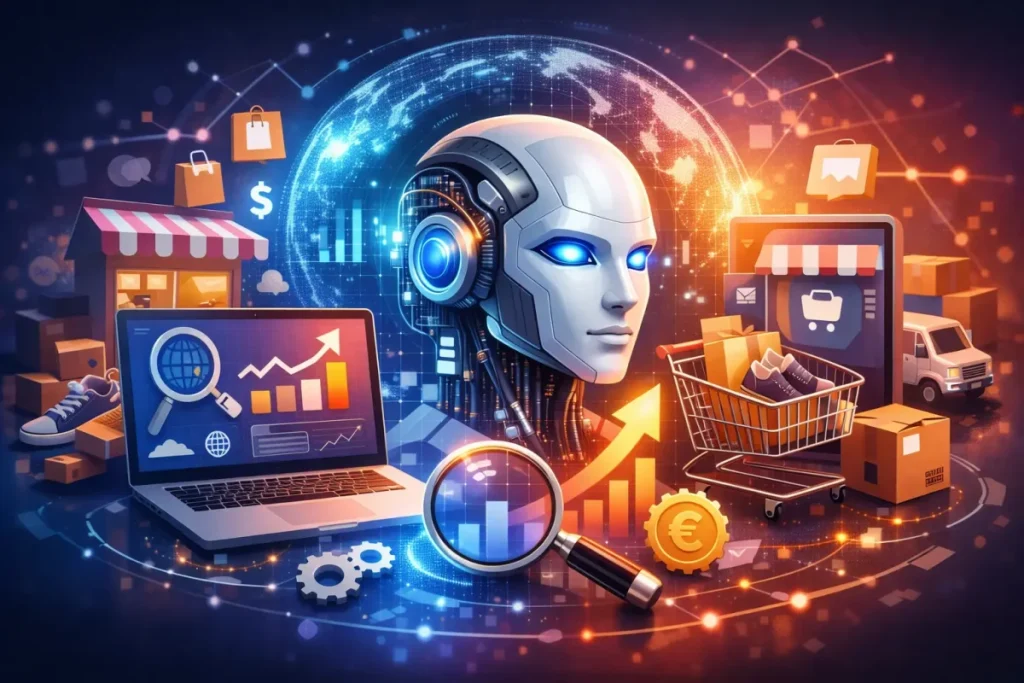
Search engines now rely heavily on machine learning models. Google’s ranking systems, powered by advanced AI and NLP, prioritize relevance, intent, and experience over keyword stuffing.
For ecommerce businesses, this means:
- Smarter competition
- Higher content expectations
- Increased personalization
- Algorithmic ranking shifts
Without AI-enhanced strategies, scaling SEO across hundreds or thousands of product pages becomes nearly impossible.
How Artificial Intelligence in Marketing Impacts Ecommerce SEO
Artificial intelligence in marketing influences ecommerce in several powerful ways:
1. Smarter Search Intent Matching
AI understands context and user behavior, not just keywords.
2. Automated Content Optimization
AI analyzes competitor content and suggests improvements in structure, semantics, and depth.
3. Predictive Analytics in Marketing
Forecasts trending products and seasonal demand shifts.
4. Algorithmic Marketing Decisions
AI determines which pages need optimization priority.
Core Components of AI SEO for Ecommerce
1. AI-Powered Keyword Research
Modern AI tools cluster thousands of keywords by search intent. Instead of manually selecting keywords, machine learning marketing definitions enable:
- Topic modeling
- Long-tail keyword grouping
- Search volume forecasting
This ensures complete topical authority.
2. AI Content Generation for Product Pages
AI content generation tools help ecommerce brands:
- Create optimized product descriptions
- Write SEO-friendly category pages
- Generate meta descriptions
- Produce FAQ content
When combined with human editing, AI improves scalability while maintaining quality.
3. AI-Driven Personalization
AI-driven personalization enhances SEO indirectly by improving:
- User engagement
- Time on page
- Conversion rates
- Repeat visits
Search engines reward positive engagement signals.
4. Technical SEO Automation
AI tools can detect:
- Broken links
- Duplicate content
- Crawl issues
- Schema markup gaps
Automation ensures consistent site health across large inventories.
Generative AI Marketing Terms in Ecommerce SEO
Generative AI marketing terms are increasingly relevant to ecommerce SEO:
Generative AI
Creates unique product copy, blog posts, and landing pages.
Prompt Engineering
Crafting optimized instructions for AI to generate conversion-focused product descriptions.
AI Brand Voice Modeling
Ensures consistent tone across thousands of SKUs.
Text-to-Image AI
Creates unique product imagery variations.
AI Advertising Vocabulary That Impacts Organic SEO
Paid and organic strategies are increasingly integrated.
Algorithmic Bidding
AI adjusts ad spend based on performance data.
Lookalike Modeling
Identifies audiences similar to high-value customers.
Conversion Rate Optimization (AI-Powered)
Improves UX signals that influence SEO rankings.
Using Predictive Analytics in Marketing for Ecommerce Growth
Predictive analytics in marketing helps ecommerce brands:
- Forecast trending products
- Anticipate search spikes
- Adjust inventory based on demand
- Optimize seasonal campaigns
Data-driven SEO reduces guesswork and improves ROI.
NLP in Marketing and Ecommerce SEO
Natural Language Processing (NLP in marketing) helps search engines interpret:
- Product relevance
- Contextual intent
- Semantic relationships
To optimize for NLP:
- Use natural language product descriptions
- Add FAQs
- Include structured data
- Answer user intent clearly
Marketing Data Science Terms Ecommerce Teams Should Know

Understanding marketing data science terms improves AI adoption.
Big Data
Large datasets used to optimize campaigns.
Data Mining
Extracting patterns from search behavior.
Behavioral Analytics
Tracking onsite user interactions.
A/B Testing (AI-Optimized)
Automated experimentation at scale.
AI Tools for Marketers in Ecommerce SEO
Popular AI tools help with:
- Content optimization
- Internal linking
- Schema automation
- Keyword clustering
- Predictive demand modeling
Look for tools offering:
- Transparent reporting
- AI explainability
- Scalable integrations
For industry research, explore resources like the Search Engine Journal.
AI SEO for Ecommerce: Step-by-Step Implementation Strategy
Step 1: Audit Your Current SEO
Identify content gaps, technical issues, and keyword cannibalization.
Step 2: Deploy AI Keyword Clustering
Build topic silos around commercial intent.
Step 3: Automate Product Content Creation
Use AI content generation responsibly with human review.
Step 4: Optimize Technical SEO with Automation
Run weekly AI audits.
Step 5: Implement AI-Driven Personalization
Improve engagement metrics.
Step 6: Track & Predict Trends
Leverage predictive analytics in marketing.
Common Mistakes in AI SEO for Ecommerce
- Over-automating without human oversight
- Publishing unedited AI content
- Ignoring technical SEO
- Failing to monitor AI bias
- Relying solely on tools without strategy
AI is an accelerator — not a replacement for strategy.
Future Trends in AI SEO for Ecommerce (2026 and Beyond)
- AI-powered voice commerce optimization
- Visual search integration
- Real-time SEO personalization
- AI-driven competitor intelligence
- Hyper-automated content production
Brands that combine human expertise with AI efficiency will dominate organic search.
FAQs About AI SEO for Ecommerce
What is AI SEO for ecommerce?
It is the use of artificial intelligence to automate, optimize, and scale SEO efforts for online stores.
Is AI-generated content safe for ecommerce SEO?
Yes, when reviewed, optimized, and aligned with user intent.
How does AI improve product page rankings?
Through keyword clustering, semantic optimization, and engagement improvements.
What are the best AI tools for ecommerce SEO?
Tools offering AI content generation, predictive analytics, and technical SEO automation.
Does AI replace traditional SEO?
No. It enhances and accelerates traditional SEO practices.
Is AI SEO expensive?
It can reduce long-term costs by automating manual tasks.
Final Thoughts: Scaling Smarter with AI SEO for Ecommerce
AI SEO for ecommerce isn’t optional anymore — it’s essential. As search engines evolve and competition intensifies, ecommerce brands must adopt artificial intelligence in marketing to remain visible and profitable.
The future of SEO belongs to businesses that understand AI marketing terms, leverage machine learning marketing definitions effectively, and combine automation with strategy.
Start small, test consistently, and scale intelligently. The earlier you integrate AI into your ecommerce SEO strategy, the stronger your competitive advantage will be.