
Artificial intelligence is transforming industries at a pace few professionals have ever experienced—and mechanical engineering is no exception. From generative design tools that can create optimized components in seconds to AI-powered simulations that drastically reduce testing time, the question many engineers and students are asking is simple: is mechanical engineering safe from AI, or is it at risk of automation?
The short answer is more nuanced than most headlines suggest. Mechanical engineering is not immune to AI disruption, but it is also far from being replaced. Instead of eliminating entire jobs, AI is primarily reshaping how engineers work by automating repetitive tasks while amplifying high-level problem-solving, system design, and decision-making.
This distinction is critical. Unlike fields that rely heavily on purely digital and repeatable workflows, mechanical engineering operates at the intersection of physics, real-world constraints, and complex systems. That makes full automation significantly harder—but not impossible in certain areas.
In this article, you’ll get a clear, evidence-based answer to the question “is mechanical engineering safe from AI?” by breaking the topic down into practical, real-world insights:
- What AI can already do in mechanical engineering today
- Which tasks are most vulnerable to automation—and which are not
- Why many engineering roles remain resilient despite rapid AI progress
- Real industry case studies across automotive, aerospace, and manufacturing
- A realistic timeline of how AI will impact engineering jobs
- Actionable strategies to future-proof your career
Whether you are a student choosing a degree, a junior engineer worried about job security, or an experienced professional planning your next move, this guide will help you understand not just the risks—but the opportunities AI is creating in mechanical engineering.
Short Answer: Is Mechanical Engineering Safe from AI?
Mechanical engineering is moderately safe from AI, but not unaffected. Artificial intelligence is expected to automate routine and repetitive tasks, such as basic CAD modeling or standard simulations, while enhancing—not replacing—core engineering roles that require creativity, physical understanding, and complex decision-making.
Engineers who rely heavily on repetitive, rule-based work face the highest risk. In contrast, those who develop skills in systems engineering, interdisciplinary thinking, and AI collaboration are likely to become even more valuable in the job market.
Quick Risk Snapshot
| Area | Risk Level | Why |
|---|---|---|
| CAD drafting & basic modeling | High | Highly repetitive and rule-based |
| Simulation setup & preprocessing | Medium | Increasingly automated but still needs oversight |
| System design & integration | Low | Requires complex trade-offs and context |
| Field engineering & troubleshooting | Very Low | Physical, unpredictable, and experience-driven |
Key Takeaway
AI is not replacing mechanical engineers—it is changing the nature of their work. The safest careers will not be those that avoid AI, but those that leverage it effectively.
The Current State of AI in Mechanical Engineering
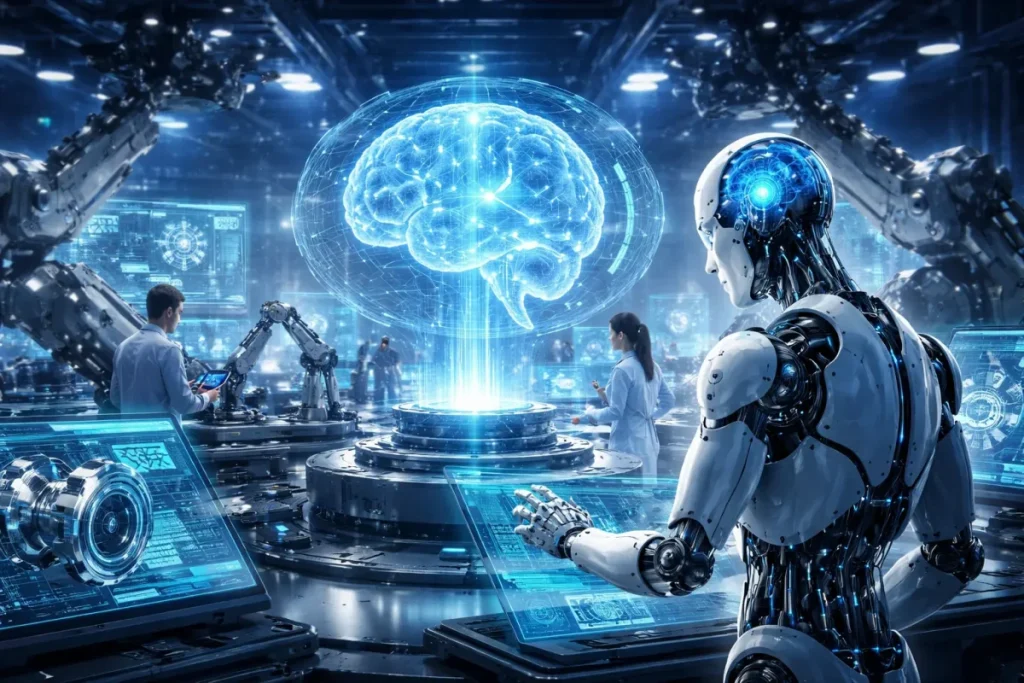
Artificial intelligence is already deeply embedded in modern engineering workflows. However, its role is often misunderstood. Rather than acting as a full replacement for engineers, AI currently functions as a powerful augmentation layer—speeding up processes, improving accuracy, and enabling new forms of design exploration.
What AI Means in a Mechanical Engineering Context
In mechanical engineering, AI is not a single tool but a combination of technologies that enhance different stages of the engineering lifecycle:
- Machine learning (ML) for pattern recognition and predictive modeling
- Generative design algorithms for automated geometry creation
- Digital twins for real-time system simulation and optimization
- Robotics and automation systems for manufacturing and testing
- AI-enhanced simulation tools (e.g., accelerated CFD and FEM)
These technologies are already being integrated into daily workflows across industries.
What AI Can Already Do Today
AI has reached a level where it can handle several traditionally time-consuming engineering tasks with high efficiency:
Generative Design
AI can generate thousands of design variations based on constraints such as weight, material, and load conditions. Engineers then select and refine the best options.
Simulation Acceleration
Machine learning models can approximate simulation results (e.g., CFD or FEA), reducing computation time from hours or days to minutes.
Predictive Maintenance
AI analyzes sensor data from machines to predict failures before they occur, allowing engineers to optimize maintenance schedules.
Design Optimization
AI can iteratively improve designs based on performance criteria, often discovering non-intuitive solutions that humans might miss.
Human vs AI Capabilities in Engineering
| Capability | Human Engineers | AI Systems |
|---|---|---|
| Creativity & innovation | High | Medium |
| Speed & iteration | Medium | Very High |
| Context understanding | High | Low |
| Handling uncertainty | High | Low |
| Data processing | Medium | Very High |
Where AI Is Already Being Adopted
AI adoption in mechanical engineering is strongest in industries with:
- High data availability
- Strong financial incentives for optimization
- Complex systems requiring simulation
Leading Industries
- Automotive (e.g., lightweight design, autonomous systems)
- Aerospace (e.g., structural optimization, simulation)
- Manufacturing (e.g., predictive maintenance, robotics)
- Energy (e.g., system optimization, grid efficiency)
Real-World Adoption Snapshot
- Automotive companies use generative design to reduce component weight while maintaining strength
- Aerospace firms apply AI-driven simulations to accelerate testing cycles
- Manufacturing plants deploy AI systems to predict equipment failures and reduce downtime
Key Insight
AI is already transforming mechanical engineering—but primarily by automating tasks, not replacing roles. The engineers who benefit the most are those who understand both the engineering fundamentals and how to integrate AI into their workflows.
In the next section, we will break down exactly which tasks are most vulnerable to automation—and why.
Which Tasks Are Vulnerable to AI in Mechanical Engineering?
To understand whether mechanical engineering is safe from AI, you need to look beyond job titles and focus on tasks. AI does not replace entire professions overnight—it replaces specific, repeatable activities within those roles.
A Simple Framework to Assess Automation Risk
Tasks in mechanical engineering can be evaluated based on four key factors:
- Repetitiveness — How often is the task repeated with similar inputs?
- Rule-based logic — Can the task be clearly defined with rules or constraints?
- Data availability — Is there enough historical data to train AI models?
- Physical interaction required — Does the task involve real-world unpredictability?
The more a task scores high on the first three and low on the last, the more likely it is to be automated.
Task Automation Score Overview
| Task | Automation Score (1–10) | Risk Level |
|---|---|---|
| CAD drafting (parametric) | 9 | High |
| Standard simulation setup | 8 | High |
| Routine calculations | 9 | High |
| Design optimization loops | 7 | Medium |
| Predictive maintenance analysis | 6 | Medium |
| Conceptual system design | 3 | Low |
| Field troubleshooting | 2 | Very Low |
High-Risk Tasks (Most Likely to Be Automated)
These tasks are already being heavily automated or augmented by AI tools:
CAD Drafting and Parametric Modeling
Basic geometry creation, dimensioning, and repetitive modeling tasks can now be partially or fully automated using generative design and parametric templates.
Routine Engineering Calculations
Standardized calculations—such as stress, thermal loads, or basic sizing—are increasingly handled by AI-assisted tools or embedded software.
Simulation Setup and Preprocessing
Setting boundary conditions, meshing, and running predefined simulations are becoming more automated, especially in cloud-based platforms.
Documentation and Reporting
Generating standard reports, compliance documents, and technical summaries can be automated using AI-powered writing and data tools.
Medium-Risk Tasks (Augmented, Not Replaced)
These tasks are evolving into human-AI collaboration zones:
Design Optimization
AI can generate and test multiple design iterations, but engineers are still needed to interpret results and apply real-world constraints.
Predictive Maintenance Decisions
AI can suggest when a machine might fail, but engineers must validate recommendations and decide on operational actions.
Preliminary Design Synthesis
AI can propose initial layouts or configurations, but these often require human refinement and feasibility checks.
Low-Risk Tasks (Human-Dominant)
These are the areas where mechanical engineers remain essential:
Conceptual and Creative Design
Early-stage problem solving, ideation, and innovation require intuition, experience, and cross-domain thinking—areas where AI still struggles.
Multidisciplinary System Integration
Modern engineering systems involve electrical, software, and mechanical components. Coordinating these requires holistic understanding beyond current AI capabilities.
Stakeholder Communication
Explaining trade-offs, negotiating constraints, and aligning teams are inherently human activities.
Field Engineering and Troubleshooting
Real-world environments are unpredictable. Engineers must adapt to unexpected failures, incomplete data, and physical constraints that AI cannot fully model.
Key Insight
The biggest risk is not that mechanical engineering disappears—but that certain roles shrink or evolve. Engineers who focus only on high-risk tasks may find their roles increasingly automated, while those who expand into low-risk, high-value activities will remain in strong demand.
In the next section, we’ll explore why mechanical engineering as a field is more resilient than many other professions—and what makes it uniquely difficult to fully automate.
Why Many Mechanical Engineering Roles Are Resilient to AI
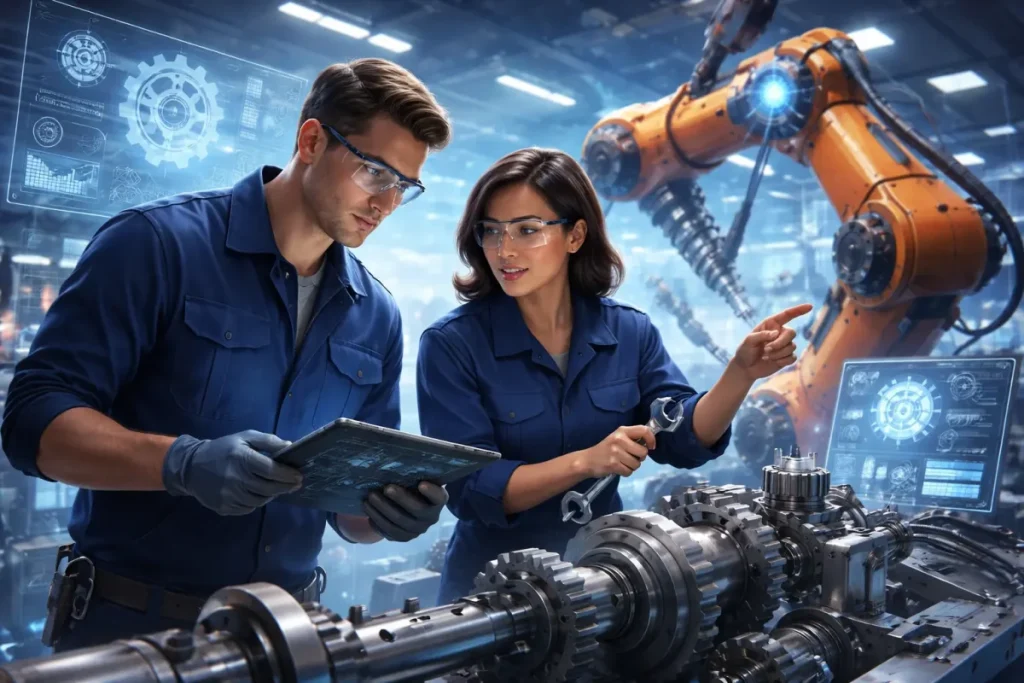
While AI is rapidly advancing, mechanical engineering remains one of the more resilient professions. The reason lies in the nature of the work itself: it combines physical reality, complex systems, and human judgment in ways that are difficult to fully automate.
Complexity of Real-World Systems
Mechanical systems rarely exist in isolation. Engineers must consider:
- Interactions between mechanical, electrical, and software components
- Environmental factors such as temperature, vibration, and wear
- Manufacturing constraints and cost trade-offs
AI systems excel in controlled environments with clear objectives, but struggle when multiple competing variables must be balanced simultaneously.
Tacit Knowledge and Hands-On Experience
A significant portion of engineering expertise is not written in manuals or datasets—it is learned through experience:
- Recognizing subtle failure patterns
- Understanding how materials behave in real conditions
- Adapting designs based on practical limitations
This type of tacit knowledge is extremely difficult to encode into AI models.
Regulatory, Safety, and Liability Constraints
Mechanical engineering often involves high-stakes systems:
- Aircraft components
- Automotive safety systems
- Industrial machinery
In these contexts, decisions must be traceable, explainable, and accountable. Even if AI assists in design or analysis, a human engineer is typically required to:
- Validate results
- Sign off on designs
- Take legal responsibility
This creates a strong barrier against full automation.
Human-in-the-Loop Engineering
Rather than replacing engineers, AI is increasingly used in human-in-the-loop systems, where:
- AI generates suggestions or optimizations
- Engineers review, validate, and refine outputs
- Final decisions remain human-controlled
This hybrid model is likely to dominate the future of engineering.
When Human Judgment Matters Most
There are many situations where human intervention is critical:
- Unexpected system failures with incomplete data
- Conflicting design requirements (e.g., cost vs. safety)
- Ethical decisions in safety-critical applications
- On-site problem solving under time pressure
In these cases, AI can assist—but not replace—the engineer.
Why Mechanical Engineering Is Safer Than Many Other Fields
Compared to purely digital professions, mechanical engineering has inherent advantages:
| Field | AI Risk Level | Reason |
|---|---|---|
| Content writing | Very High | Fully digital, pattern-based |
| Basic software development | Medium–High | Increasing automation via AI coding tools |
| Mechanical engineering | Medium–Low | Physical systems + complex constraints |
Fields that are fully digital and data-driven are easier to automate. Mechanical engineering, by contrast, operates in the physical world, where uncertainty and variability are much harder for AI to handle.
Key Insight
Mechanical engineering is not immune to AI—but it is structurally resistant to full automation. The combination of physical complexity, human responsibility, and real-world unpredictability ensures that engineers remain essential.
In the next section, we will look at real-world examples across industries to see how AI is actually being used today—and what role engineers still play.
Industry Use Cases & Case Studies
AI in mechanical engineering is no longer theoretical—it is actively used across multiple industries. However, what becomes clear in real-world applications is that AI augments engineers rather than replaces them. The most successful implementations combine computational power with human expertise.
Automotive Industry — Generative Design and Lightweighting
The automotive sector is one of the fastest adopters of AI in engineering.
Use Case Overview
- Problem: Reduce vehicle weight while maintaining structural integrity and safety
- AI Solution: Generative design algorithms create optimized geometries based on constraints
- Human Role: Engineers evaluate manufacturability, safety compliance, and real-world feasibility
- Outcome: Lighter components, improved fuel efficiency, and reduced material costs
Key Insight
AI can generate thousands of design options—but engineers are still required to select, validate, and adapt designs for production realities.
Aerospace Industry — AI-Accelerated Simulation
Aerospace engineering involves highly complex simulations, often requiring significant computational resources.
Use Case Overview
- Problem: Long simulation times for CFD and structural analysis
- AI Solution: Machine learning models approximate simulation results, drastically reducing computation time
- Human Role: Engineers verify accuracy, interpret results, and ensure certification compliance
- Outcome: Faster design cycles without compromising safety standards
Key Insight
AI speeds up analysis, but certification and safety requirements ensure that human oversight remains mandatory.
Manufacturing — Predictive Maintenance and Digital Twins
Manufacturing environments generate large volumes of operational data, making them ideal for AI applications.
Use Case Overview
- Problem: Unexpected machine failures leading to downtime
- AI Solution: Predictive maintenance models analyze sensor data to forecast failures
- Human Role: Engineers interpret predictions and decide on maintenance actions
- Outcome: Reduced downtime, lower maintenance costs, improved efficiency
Digital Twin Integration
AI-powered digital twins simulate entire production systems in real time, allowing engineers to:
- Test changes virtually before implementation
- Optimize processes continuously
- Detect inefficiencies early
Key Insight
AI provides insights—but engineers remain responsible for decision-making and implementation.
Energy & HVAC — System Optimization
Energy systems and HVAC applications benefit from AI-driven optimization.
Use Case Overview
- Problem: Inefficient energy usage and complex system tuning
- AI Solution: AI models optimize control parameters and system performance
- Human Role: Engineers adapt solutions to site-specific constraints and regulations
- Outcome: Energy savings, improved sustainability, and system reliability
Key Insight
AI can optimize systems mathematically, but real-world deployment requires engineering judgment and customization.
Mini Case Studies (Real-World Patterns)
Case Study 1 — Generative Bracket Design
- Problem: Reduce weight of a structural bracket
- AI Solution: Generated multiple optimized geometries
- Human Role: Selected design based on manufacturability and cost
- Outcome: 30–50% weight reduction
- Lesson: AI expands possibilities, but humans decide what is practical
Case Study 2 — Predictive Maintenance in a Factory
- Problem: Frequent unexpected machine downtime
- AI Solution: Failure prediction using sensor data
- Human Role: Validated alerts and scheduled interventions
- Outcome: Significant reduction in downtime
- Lesson: AI predicts—but humans act
Case Study 3 — Simulation Acceleration
- Problem: Slow CFD simulations delaying projects
- AI Solution: Surrogate models approximating results
- Human Role: Verified accuracy and applied engineering judgment
- Outcome: Faster iteration cycles
- Lesson: Speed increases, responsibility remains human
Cross-Industry Pattern
Across all industries, a consistent pattern emerges:
| Aspect | AI Role | Human Role |
|---|---|---|
| Data processing | High | Low |
| Optimization | High | Medium |
| Decision-making | Medium | High |
| Accountability | None | Full |
Key Insight
AI is already transforming mechanical engineering—but not by replacing engineers. Instead, it is shifting their role upward:
- Less time on repetitive tasks
- More time on decision-making and system-level thinking
In the next section, we will explore how this transformation is likely to evolve over time—and what the future might look like for mechanical engineers.
Timeline and Probability Scenarios
Understanding whether mechanical engineering is safe from AI requires looking at when and how strongly different changes are likely to occur. AI adoption does not happen overnight—it follows a gradual curve shaped by technology, regulation, and industry inertia.
Short-Term Outlook (1–5 Years)
In the near future, AI will primarily act as an efficiency multiplier.
Expected Developments
- Increased automation of routine tasks (CAD, simulations, documentation)
- Wider adoption of AI-assisted design tools
- Integration of AI into existing engineering software (CAD/CAE platforms)
- Growing demand for engineers who can work alongside AI tools
Impact on Jobs
- Junior roles may shift significantly
- Engineers spend less time on repetitive work
- Productivity expectations increase
Probability Assessment
| Factor | Likelihood | Confidence |
|---|---|---|
| Routine task automation | High | High |
| Full job replacement | Low | High |
| AI-human collaboration dominance | Very High | High |
Medium-Term Outlook (5–15 Years)
This phase will see deeper integration of AI into engineering workflows.
Expected Developments
- Advanced generative design becoming standard
- AI-driven simulation replacing many traditional workflows
- Stronger reliance on digital twins and real-time optimization
- Emergence of hybrid roles combining engineering + data/AI skills
Impact on Jobs
- Many entry-level tasks become automated
- Engineers shift toward system-level thinking
- Demand increases for interdisciplinary expertise
Risk by Experience Level
| Role Level | Risk Level | Reason |
|---|---|---|
| Intern / Junior | High | Routine tasks automated |
| Mid-career | Medium | Requires adaptation |
| Senior / Systems | Low | Strategic and complex work |
Probability Assessment
| Factor | Likelihood | Confidence |
|---|---|---|
| Widespread AI integration | High | Medium |
| Significant job transformation | Medium–High | Medium |
| Reduction in entry-level roles | Medium | Medium |
Long-Term Outlook (15+ Years)
Long-term predictions are inherently uncertain, but some trends are likely.
Expected Developments
- Highly automated engineering workflows in well-defined domains
- Advanced AI systems capable of handling complex design constraints
- Increased reliance on autonomous systems in controlled environments
Limitations That Will Persist
- Physical world unpredictability
- Regulatory and safety constraints
- Need for accountability and ethical oversight
Impact on Jobs
- Some specialized roles may decline
- New roles will emerge (AI-integrated engineering, system orchestration)
- Human engineers remain essential in high-stakes and novel scenarios
Probability Assessment
| Factor | Likelihood | Confidence |
|---|---|---|
| High automation in constrained domains | Medium | Low |
| Full replacement of engineers | Very Low | Low |
| Continued human oversight | Very High | Medium |
Biggest Uncertainty Factors
Several variables will influence how fast and how far AI progresses in mechanical engineering:
Regulation and Certification
Safety-critical industries (e.g., aerospace, automotive) require strict validation processes that slow down full automation.
Hardware and Physical Constraints
AI can simulate systems—but real-world testing and physical constraints remain limiting factors.
Data Availability
AI performance depends on high-quality data, which is not always available in engineering contexts.
Economic Incentives
Companies will adopt AI where it reduces costs—but not at the expense of safety or reliability.
Key Insight
AI will reshape mechanical engineering gradually, not suddenly. The most significant impact will be:
- Automation of routine tasks
- Transformation of entry-level roles
- Increased value of high-level engineering skills
Mechanical engineering is not becoming obsolete—but it is evolving into a more advanced, AI-augmented discipline.
In the next section, we will focus on what this means for your career—and how you can position yourself to benefit from these changes.
How to Future-Proof Your Mechanical Engineering Career
The question is no longer just “is mechanical engineering safe from AI?”—it’s how you position yourself within it. Engineers who adapt will not only remain relevant, but often become more valuable than before. Those who do not risk being replaced at the task level.
The 3 Career Paths That Will Thrive in an AI-Driven World
Mechanical engineering is evolving into distinct paths. The following three are the most resilient:
1. AI-Enhanced Engineer
Engineers who actively use AI tools to improve productivity and decision-making.
- Work with generative design, simulation tools, and data-driven insights
- Automate parts of their workflow using scripts or APIs
- Interpret AI outputs and validate engineering feasibility
2. Systems Engineer
Engineers who focus on big-picture integration across disciplines.
- Coordinate mechanical, electrical, and software components
- Make trade-offs between performance, cost, and safety
- Lead complex, multidisciplinary projects
3. Field & Operations Engineer
Engineers working in real-world environments where unpredictability is high.
- On-site troubleshooting and commissioning
- Adapting systems to real operating conditions
- Handling failures that cannot be simulated accurately
These roles are difficult to automate because they require context, judgment, and real-world interaction.
Technical Skills to Prioritize
To stay competitive, engineers should expand beyond traditional mechanical skills.
Core Technical Stack
| Skill | Priority | Why It Matters |
|---|---|---|
| Python programming | High | Automates workflows and integrates tools |
| Data analysis | High | Enables collaboration with AI systems |
| Simulation tools (CFD/FEA) | High | Still fundamental, now AI-enhanced |
| Digital twins | Medium–High | Growing importance in industry |
| Control systems | Medium–High | Critical for automation and robotics |
| Basic machine learning | Medium | Understanding AI capabilities and limits |
Key Insight
You don’t need to become a full AI expert—but you must understand how AI works and how to use it effectively.
Human Skills That Will Become More Valuable
As technical tasks become automated, human-centric skills increase in importance:
- Complex problem framing
- Cross-functional communication
- Decision-making under uncertainty
- Project leadership
- Ethical and regulatory awareness
These are the areas where AI remains weakest—and where engineers can differentiate themselves.
What NOT to Focus On
Some career paths are becoming increasingly risky:
- Roles focused only on basic CAD drafting
- Purely repetitive documentation tasks
- Narrow specializations with low adaptability
Engineers who stay confined to these areas may face increasing automation pressure.
Education and Learning Path
Recommended Learning Approach
- Combine mechanical engineering fundamentals with software and data skills
- Take online courses in Python, data analysis, and basic machine learning
- Explore certifications in systems engineering or automation
Example Learning Projects
- Build a simple digital twin of a mechanical system
- Use Python to automate a simulation workflow
- Analyze a dataset for predictive maintenance
These projects demonstrate real-world adaptability, which is highly valued by employers.
Career Strategy in an AI Era
Role Selection
- Prioritize roles involving systems thinking, integration, or decision-making
- Avoid positions limited to repetitive execution
Workplace Strategy
- Volunteer for projects involving AI tools or automation
- Learn from cross-functional teams (software, data, electrical)
- Document and share knowledge to increase your visibility and value
Long-Term Positioning
The goal is to move toward roles where you:
- Define problems rather than just execute tasks
- Make decisions rather than follow instructions
- Integrate systems rather than work in isolation
Company-Level Strategy (For Context)
Organizations that succeed with AI typically:
- Use human-in-the-loop models
- Invest in employee upskilling
- Clearly define roles between AI systems and engineers
This means companies still need engineers—but with expanded capabilities.
Key Insight
Mechanical engineering is not becoming obsolete—it is becoming more demanding and more valuable. The safest path is not avoiding AI, but learning how to work with it and move toward higher-value roles.
In the next section, we will explore how these changes are influencing hiring, education systems, and policy decisions.
Hiring, Education, and Policy Implications
As AI continues to reshape mechanical engineering, its impact extends beyond individual careers. Hiring practices, university curricula, and regulatory frameworks are all evolving to reflect a more AI-integrated engineering landscape.
How Hiring in Mechanical Engineering Is Changing
Employers are no longer looking for purely traditional mechanical engineers. Instead, they increasingly prioritize hybrid profiles.
What Companies Are Looking For
- Engineers who can work with AI tools, not compete against them
- Candidates with basic programming and data skills
- Experience with modern engineering software ecosystems
- Ability to collaborate across disciplines (software, electrical, data science)
Shift in Job Descriptions
Traditional roles focused on execution are gradually being replaced or redefined:
- “CAD Engineer” → “Design Engineer with automation experience”
- “Simulation Engineer” → “AI-augmented analysis specialist”
- “Maintenance Engineer” → “Predictive maintenance and data-driven operations”
Key Insight
Hiring is shifting from tool-specific expertise to adaptability and systems thinking.
Will Entry-Level Jobs Disappear?
This is one of the most important and frequently asked questions.
Short Answer
Entry-level jobs will not disappear—but they will change significantly.
What Is Changing
- Routine tasks traditionally assigned to juniors are increasingly automated
- Expectations for entry-level engineers are rising
- Companies may hire fewer juniors—but expect higher skill levels
What Replaces Them
New entry-level roles are emerging:
- AI-assisted design roles
- Data-aware engineering positions
- Cross-functional junior roles combining mechanical + software
Key Insight
The barrier to entry is increasing—but so is the long-term value of skilled engineers.
How Universities Need to Adapt
Educational institutions are under pressure to modernize mechanical engineering programs.
Required Curriculum Changes
- Integration of programming (Python, MATLAB, APIs)
- Introduction to machine learning fundamentals
- Emphasis on systems engineering and interdisciplinary work
- More project-based learning involving real-world data
Traditional Strengths That Remain Critical
- Mechanics, thermodynamics, and materials science
- Hands-on labs and prototyping
- Engineering design fundamentals
Key Insight
The future curriculum is not replacing mechanical engineering fundamentals—it is expanding them.
Industry Training and Lifelong Learning
The pace of AI development makes continuous learning essential.
What Companies Are Doing
- Offering internal upskilling programs
- Providing access to online learning platforms
- Encouraging cross-functional training
What Engineers Should Do
- Regularly update their technical skills
- Stay informed about new tools and technologies
- Build a habit of continuous learning
Key Insight
A static skillset is becoming obsolete. Engineers must adopt a lifelong learning mindset.
Policy and Regulatory Considerations
AI introduces new challenges in safety-critical engineering environments.
Key Policy Areas
- Certification of AI-assisted designs
- Accountability and liability in AI-supported decisions
- Transparency and explainability of AI systems
Why This Matters
In industries like aerospace, automotive, and energy:
- Engineers must sign off on designs
- Safety standards are strict and legally binding
- AI cannot currently take responsibility
Key Insight
Regulation acts as a natural barrier to full automation, reinforcing the need for human engineers.
The Bigger Picture
The transformation of mechanical engineering is not about job loss—it is about role evolution:
- From execution → to decision-making
- From isolated work → to system integration
- From static knowledge → to continuous learning
Conclusion
Final Verdict: Is Mechanical Engineering Safe from AI?
Mechanical engineering is neither fully safe nor at risk of disappearing. Instead, it is undergoing a significant transformation driven by AI.
The reality is clear:
- AI will automate repetitive and rule-based tasks
- Core engineering activities—such as system design, problem-solving, and real-world decision-making—will remain human-driven
- Engineers who adapt will become more valuable, not less
Key Takeaways
- Risk is task-based, not job-based
- Entry-level roles will change, but not vanish
- The highest demand will be for hybrid engineers with both technical and digital skills
- Mechanical engineering remains one of the more resilient and future-proof fields
What You Should Do Next
- Learn how AI tools are used in your field
- Develop basic programming and data skills
- Focus on roles involving systems thinking and decision-making
- Stay adaptable and commit to continuous learning
Closing Thought
AI is not replacing mechanical engineers—it is raising the bar. Those who evolve with it will not only remain relevant but will help shape the future of engineering itself.
FAQs
Will AI replace mechanical engineers?
No, AI is unlikely to fully replace mechanical engineers. It will automate certain tasks, especially repetitive ones, but core engineering responsibilities—such as design decisions, system integration, and real-world problem solving—will remain human-driven.
Which mechanical engineering jobs are safest from AI?
Roles involving systems engineering, design leadership, field engineering, regulatory compliance, and research are among the safest. These positions require complex thinking, human judgment, and real-world interaction.
What skills should mechanical engineers learn to stay relevant?
Engineers should focus on data literacy, basic programming (e.g., Python), understanding AI tools, systems thinking, and cross-disciplinary collaboration. Human skills like communication and decision-making are also increasingly important.
How soon will AI impact mechanical engineering jobs?
AI is already impacting the field today, mainly by automating routine tasks. The most noticeable changes will occur over the next 5–15 years, with gradual transformation rather than sudden disruption.
Can students still pursue mechanical engineering as a career?
Yes, mechanical engineering remains a strong and viable career choice. Students should complement traditional engineering education with digital and interdisciplinary skills to increase their future resilience.
Are there ethical or safety concerns with AI in mechanical engineering?
Yes, especially in safety-critical industries. Issues include accountability, transparency, and certification of AI-assisted designs. Human oversight remains essential.
How can companies integrate AI without harming engineering careers?
Companies should adopt human-in-the-loop approaches, invest in employee upskilling, and clearly define the roles of AI and engineers. Responsible integration benefits both productivity and workforce stability.
Which engineering field is safest from AI?
Fields that involve physical systems, real-world interaction, and complex decision-making—such as mechanical and civil engineering—are generally safer than purely digital fields.
Will internships disappear due to AI?
Internships will likely evolve rather than disappear. They may involve more advanced tasks and require broader skillsets, but they will remain important for developing practical experience.
Can AI design machines better than humans?
AI can generate optimized designs and explore large solution spaces quickly. However, humans are still needed to interpret results, ensure feasibility, and make final decisions based on real-world constraints.
Will artificial intelligence replace mechanical engineers or is mechanical engineering safe from AI?
AI may automate specific tasks in the design process and ai in manufacturing, but it is unlikely to replace mechanical engineers entirely. Mechanical engineering professionals bring contextual engineering knowledge, creativity, ethical judgment and practical experience that ai struggles to replicate. Instead, ai technologies act as a powerful tool enabling engineers to focus on higher-level problem solving, innovation and system integration while ai-driven tools handle repetitive calculations, data-heavy simulations and optimization.
How will the future of mechanical engineering change with ai and ai-driven tools?
The future of mechanical engineering will be shaped by ai-powered predictive analytics, machine learning algorithms and automation in engineering and manufacturing. These technologies enhance workflows by processing amounts of data quickly, suggesting optimized design parameters, and detecting potential failures earlier. Mechanical engineers must embrace ai techniques to leverage ai tools, enabling engineers to focus on complex design choices, systems thinking and interdisciplinary collaboration rather than routine tasks.
What ai applications are most useful for mechanical design and CAD?
Common ai applications for mechanical design include generative design, topology optimization, ai-driven CAD automation, and ai in predictive maintenance for manufacturing equipment. AI tools for mechanical engineers can automatically propose design alternatives, evaluate structural performance across many scenarios, and streamline CAD modeling by auto-completing repetitive features. These ai-enabled capabilities help mechanical designers iterate faster and explore more innovative solutions.
Are engineering work and manufacturing at risk of being replaced by AI in the near term?
Some engineering work, especially repetitive simulation setups, standard calculations, and routine quality checks, may be done by AI or ai in manufacturing systems. However, ai will not realistically replace engineers who solve ambiguous problems, validate safety-critical systems, or coordinate complex projects. The impact of ai in mechanical fields is to augment engineers’ abilities rather than fully replace engineers, so mechanical engineers must develop skills that ai may find difficult to replicate.
How can mechanical engineers leverage ai tools to enhance mechanical design and production?
Engineers use ai tools to automate parameter sweeps, run data-driven optimization, and integrate ai-powered predictive maintenance into production lines. By leveraging ai tools and ai-driven mechanical workflows, teams can reduce time-to-market, lower costs and improve performance. Mechanical engineers should learn to collaborate with ai specialists and incorporate machine learning algorithms into their designs to get the most value from these technologies.
What new skills should mechanical engineering professionals develop so AI helps, not hurts, their careers?
Mechanical engineers must embrace data literacy, basic machine learning understanding, familiarity with ai tools for mechanical engineers, and the ability to interpret ai outputs. Engineers should focus on systems engineering, multidisciplinary collaboration, and ethical decision-making. These skills enable engineers to work alongside ai, guiding ai models with domain insights and validating ai-driven results rather than being sidelined by automation.
Which parts of the design process are most improved by ai and which remain human-driven?
AI enhances early-stage ideation through generative design, accelerates simulation and optimization, and improves manufacturing through ai in predictive maintenance. Tasks that involve massive data analysis or repetitive CAD edits are well-suited to ai. Human-driven aspects include setting requirements, resolving trade-offs, assessing safety and manufacturability, and applying engineering judgment—areas where engineering requires intuition, contextual knowledge and responsibility.
Can AI tools for mechanical engineers handle safety-critical systems and complex engineering challenges?
AI tools can support safety-critical system design by providing ai-powered predictive models and identifying potential failure modes early, but they cannot replace expert oversight. Engineers must validate ai outputs, perform rigorous testing, and ensure compliance with regulations. In practice, ai enables engineers to focus on higher-level validation and risk management while ai-driven tools carry out large-scale data analysis and scenario testing.
Is ai in manufacturing going to replace engineers?
AI in manufacturing will change many workflows, but ai will replace engineers entirely is unlikely in the near term. Instead, ai and automation automate repetitive design checks, predictive maintenance, and optimization tasks while engineers develop higher-level systems and make judgment calls. ai experts and experienced mechanical engineers will collaborate to integrate ai into mechanical engineering processes across various industries.
How can ai help mechanical engineers in day-to-day work?
There are many ways ai can be helping mechanical engineers: accelerating CAD software iterations, suggesting design optimizations, analyzing real-time data from sensors, and automating routine calculations. These tools help engineers with faster prototyping, improved reliability, and more time for creative problem solving, turning ai into an assistant rather than a replacement.
What is the role of ai in changing mechanical applications?
The role of ai in mechanical applications includes predictive maintenance, topology optimization, control systems, and adaptive manufacturing. AI plays an increasing part in interpreting sensor streams, enabling systems that adjust in real time. This technological advancement expands possibilities for complex systems design and deployment across various industries such as automotive, aerospace, and energy.
Should engineers fear ai taking their jobs or will ai complement them?
While ai taking certain jobs is possible for narrow, repetitive roles, ai will eventually complement most engineering careers by automating mundane tasks and augmenting human decision-making. Engineers with ai skills can focus on higher-value work—conceptual design, integration, ethics, and systems thinking—areas where human insight remains essential.
How will ai and automation affect mechanical engineering education and skills?
Education will shift to include data literacy, machine learning basics, and tool proficiency so students can see ai into mechanical engineering workflows. Helping mechanical engineers learn to use ai tools, understand model limitations, and validate outputs will be key. Programs will emphasize interdisciplinary training so graduates can work with ai experts and leverage technological advancement effectively.
Can ai improve product safety and reliability in mechanical systems?
Yes. By using real-time data and predictive analytics, ai can detect anomalies earlier, optimize maintenance schedules, and reduce failure rates. When paired with proper engineering oversight, ai and automation improve safety margins and help engineers design more reliable systems across various industries.
Will ai affect design tools like CAD software and how?
AI is already transforming CAD software by automating repetitive tasks, offering generative design alternatives, and suggesting optimized geometries based on performance criteria. These capabilities speed up iteration cycles and help engineers explore more innovative solutions, enabling better mechanical applications and more efficient workflows.
What should mechanical engineers do to stay relevant as ai advances?
Engineers should learn how ai plays into product lifecycles, gain familiarity with machine learning basics, and practice collaborating with ai experts. Upskilling in data analysis, simulation, and tool integration will let engineers develop systems that leverage ai while ensuring safety, ethics, and real-world applicability. Embracing ai as a partner will be the most effective way to remain competitive.