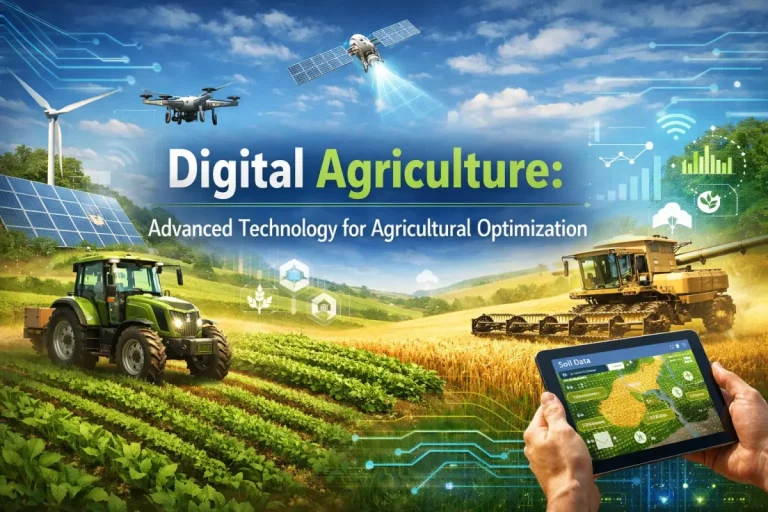
Agriculture must increase its production while reducing its significant environmental impact. Digital technologies can help it meet this challenge by leveraging existing data, simulating crop growth to account for various factors, and capitalizing on advancements in machinery with integrated computing. Modern agriculture faces a number of major challenges that will require the deployment of disruptive technologies to address them. On the one hand, the continued growth of the world’s population necessitates increasing agricultural production by at least 50% by 2050. To navigate these complexities, stakeholders are increasingly turning to digital farmer profiles and trends to better understand emerging patterns and consumer preferences. By harnessing this data, farmers can make more informed decisions regarding crop selection and resource allocation. Additionally, such insights empower agriculture businesses to innovate and adapt, ensuring sustainability while meeting the demands of a growing population. To achieve this, the industry is turning to digital agriculture technology advancements that include precision farming, automated systems, and data analytics. These innovations not only optimize land use but also enhance resource management, helping farmers adapt to the changing climate. As these technologies evolve, they promise to transform traditional farming practices, making them more efficient and sustainable.
More and more data at every link in the agri-food supply chain
On the other hand, the agricultural sector already exerts very strong pressure on the environment, being responsible for 32% of greenhouse gas emissions and consuming 70% of the planet’s water resources. In order to guarantee the sustainability of production, the agricultural sector must succeed in preserving natural resources and respecting environmental constraints by limiting inputs such as fertilizers or plant protection products. The agriculture of tomorrow will have to manage to produce much more while consuming and polluting much less. To achieve this, digital technologies represent a major opportunity for progress. These sources of progress rely on the one hand on advances in deep learnin,g which now make it possible to leverage the large amounts of data generated in the agroclimatic field, and on the other hand on plant growth simulation methods based on an understanding of biological processes.
MASSIVE DATA EXPLOITATION AON NEW AGRICULTURAL RESOURCE
A key aspect of the new agricultural revolution is the availability of ever-increasing amounts of data at all stages of the agri-food supply chain. This data comes from multiple and heterogeneous sources, which further complicates its processing. First, masses of historical data have been accumulated in large public bodies such as the U.S. Department of Agriculture (USDA) or via the CAP in Europe. Next, the various agricultural machines, typically including tractors, seeders, spreaders, robots, or processing tools, are now equipped with on-board sensors allowing real-time monitoring of agricultural work and production quality. Artificial intelligence in agriculture is poised to revolutionize how farmers analyze this data, enabling more efficient decision-making processes. By leveraging advanced algorithms, they can predict crop yields, optimize resource allocation, and even automate tasks that were once labor-intensive. This integration of technology not only enhances productivity but also supports sustainable farming practices by minimizing waste and maximizing output.
Modeling tools now make it possible to simulate the evolution of a crop’s growth
The rapid development of the Internet of Things in fields via low-energy LORA or Sigfox networks will also make it possible to deploy in situ sensor networks, allowing local monitoring of crop development as well as soil and climatic conditions. Finally, the opening up of data from satellite constellations, for example,le the European Union’s Sentinel program, will help to invent new economic models around intra-parcel modulation by precisely imaging the heterogeneities of development that we know are very important within the plots themselves. All of this data, historically underutilized, can now be processed together thanks to mathematical modeling and computing power, thus offering new perspectives for optimizing agricultural processes. The exploitation of this data can be achieved through two complementary approaches.
STATISTICAL LEARNING
The first approach is based on statistical processing and learning tools. One of the main difficulties in processing this data is related to its great heterogeneity: satellite images, climate data series, parcel information, economic data, etc. Mathematical dimensionality reduction methods make it possible to jointly process this data with machine learning algorithms. These algorithms are typically of two types and use data: either to calibrate “regression” models where one or more variables are predicted from a large number of covariates, such as yield from climate data and cropping itineraries, or to classify and identify relevant typologies, such as recognizing different crops fra om series of satellite images. The difficulty of calibrating these models, due to the complexity of their architecture, is now overcome thanks to recent progress in algorithms and computing power, thus opening the doors to their training on very large databases.
SIMULATE PLANT GROWTH
Alongside data modeling, work has been carried out for about thirty years to integrate knowledge acquired in agronomy, biology, and botany into coherent mathematical formalisms. These modeling tools now make it possible to simulate the evolution of crop growth, integrated into its environment through coupling with soil and environmental modeling: nitrogen cycle, soil-plant-atmosphere energy flows, water balance These models are compared with data for calibration and validation, and it is then possible to work by numerical simulation on a number of factors of interest: estimating yield potential based on a given crop management practice, quantifying the impact of climate change on agricultural production By using modeling and simulation tools built either from knowledge extracted from databases or by injecting scientific knowledge on the soil-plant-atmosphere system, a large number of high value-added services can be provided at all stages of the plant life cycle, from varietal selection to the first processing of agricultural products.
A wide range of farming practices can be optimized through the use of digital services
This approach, generic and applicable across all agri-food sectors, relies on stochastic optimization methods that take into account the random nature of climate forecasts. These numerical methods are now operational thanks to very rapid progress in computing power. The advent of the cloud and, more recentl,y of HPC as a service offerings now opens a new window for economic models offering high-value-added online services while avoiding heavy investments in computing infrastructure. In this context, cloud technology in agriculture enables farmers to utilize sophisticated data analytics and machine learning tools without the need for extensive local computing resources. By leveraging real-time data and remote storage solutions, agricultural stakeholders can enhance decision-making processes, optimize resource management, and ultimately increase yields. Furthermore, the scalability of cloud solutions allows for seamless integration of innovative technologies, fostering greater resilience and sustainability in farming practices.
THE ENTIRE AGRI-FOOD SECTOR IS CONCERNED
The horizon of possibilities opened up by digital technologies in agriculture is broad and touches all successive stages of the agri-food supply chains. Starting with varietal selection in a very competitive market. Developing a new, higher-performing variety is a lengthy process (around ten years) and therefore expensive. Each year, seed companies conduct millions of trials in Latin plots, experimenting with new crosses in the hope of producing genetics with ever-improving traits. Digital technologies are introducing a true paradigm shift by promising to replace costly field testing with computer simulations, in the same way that the design of a car or an airplane was completely revolutionized by the introduction of digital simulation in the 1970s.
THE SCOPE IS EXPANDED
In terms of crop management, a wide range of farming practices can be optimized through the use of digital services. These services are relevant whether it involves intervening before the season, choosing suitable varieties, optimizing sowing density according to soil potential, or during the season: optimizing fertilization and irrigation practices according to the plant’s actual needs… An important point is the adaptation of management recommendations to plot heterogeneities by producing application maps modulated on the plot, adapting management according to differences in development and therefore the needs of the plant. Crop development is measured at the intra-plot scale in near real time using satellite remote sensing with revisit times reduced to five days, providing comprehensive coverage over the entire season. Another area for optimizing cultivation practices involves managing greenhouses for market gardening to regulate the internal climate and nutrient inputs to plants based on their stage of development and the external climate. Several sensors, connected via the Internet of Things, allow for real-time monitoring of crop progress, thus quantifying plant needs and the requirements for an optimal environment. All of these services, affecting all agri-food sectors and processes, are made possible today thanks to progress in algorithms and high-performance computing infrastructure. The deployment of these services is an unprecedented opportunity to ensure the competitiveness and sustainability of agricultural activities, while adapting to ever-increasing environmental constraints.