

Ziptie AI Search Analytics is designed to solve one of the most overlooked growth bottlenecks in digital products: underperforming search. Whether users are browsing an e-commerce store, navigating a SaaS dashboard, or searching a knowledge base, poor search relevance leads to missed conversions, frustration, and lost revenue.
This guide explains exactly what Ziptie AI Search Analytics is, how it works, and whether it’s worth implementing in 2026. You’ll learn how it improves search performance, what features it offers, and how businesses use it to turn search data into measurable growth.
What Is Ziptie AI Search Analytics? (Short Answer)
Ziptie AI Search Analytics is a cloud-based platform that uses machine learning and behavioral data to analyze, optimize, and improve search performance across websites and applications. It helps teams understand user intent, fix relevance issues, and increase conversions by transforming raw search queries into actionable insights.
Ziptie AI Search Analytics — Key Facts
| Category | Details |
|---|---|
| Platform Type | AI Search Analytics Platform |
| Core Function | Search performance optimization |
| Key Capabilities | Intent detection, ranking optimization, query analytics |
| Data Sources | Search logs, clickstream data, product/content catalogs |
| Integrations | Elasticsearch, Algolia, Shopify, BigQuery, Snowflake |
| Deployment | Cloud-native (API-first architecture) |
| Primary Users | Product teams, data analysts, e-commerce managers |
| Main Goal | Improve search relevance and conversion rates |
The Problem Ziptie AI Solves
Most digital platforms underestimate how much revenue and user experience depend on search quality. Even small inefficiencies in search relevance can lead to significant performance losses.
Typical issues include:
- Users not finding relevant results despite available content
- High “zero results” query rates
- Low search-to-conversion rates
- Lack of visibility into what users are actually searching for
- Manual relevance tuning that does not scale
These problems are not just UX issues—they directly impact revenue, retention, and operational efficiency.
| Problem Area | Impact on Business |
|---|---|
| Poor relevance | Lower conversions and engagement |
| Missing insights | Inability to optimize search effectively |
| High drop-off rates | Increased bounce and churn |
| Manual optimization | High maintenance cost and slow iteration |
Ziptie AI Search Analytics addresses these gaps by continuously analyzing search behavior and automatically identifying optimization opportunities.
Detailed Definition and Scope
Ziptie AI Search Analytics is not just a reporting tool—it is an intelligent optimization layer that sits on top of your existing search infrastructure.
At its core, the platform combines three main components: data collection, machine learning models, and actionable analytics. These components work together to transform raw search interactions into insights and automated improvements.
Core Capabilities
| Capability | Description |
|---|---|
| Query Analytics | Tracks what users search for and how they interact with results |
| Intent Detection | Identifies the underlying intent behind queries |
| Relevance Optimization | Improves ranking using behavioral signals |
| Anomaly Detection | Detects sudden drops in performance or unusual patterns |
| Personalization | Adjusts results based on user behavior and segments |
Scope and Integrations
Ziptie is designed to integrate with existing search and data ecosystems rather than replace them.
| Integration Type | Examples |
|---|---|
| Search Engines | Elasticsearch, Algolia, Solr |
| E-commerce Platforms | Shopify, Magento |
| Data Warehouses | BigQuery, Snowflake |
| CDPs & Analytics | Segment, custom pipelines |
This makes it flexible for both startups and enterprise environments.
Key Terminology Explained
Understanding the terminology behind AI search analytics is essential to fully grasp how Ziptie works.
| Term | Meaning |
|---|---|
| Search Analytics | Analysis of user queries and interactions to improve results |
| Relevance Tuning | Adjusting rankings to better match user intent |
| Query Intent | The goal or need behind a user’s search |
| Behavioral Signals | User actions such as clicks, dwell time, and conversions |
| Query Pipeline | The process from query input to ranked results |
These concepts form the foundation of modern AI-driven search optimization.
Key Features of Ziptie AI Search Analytics
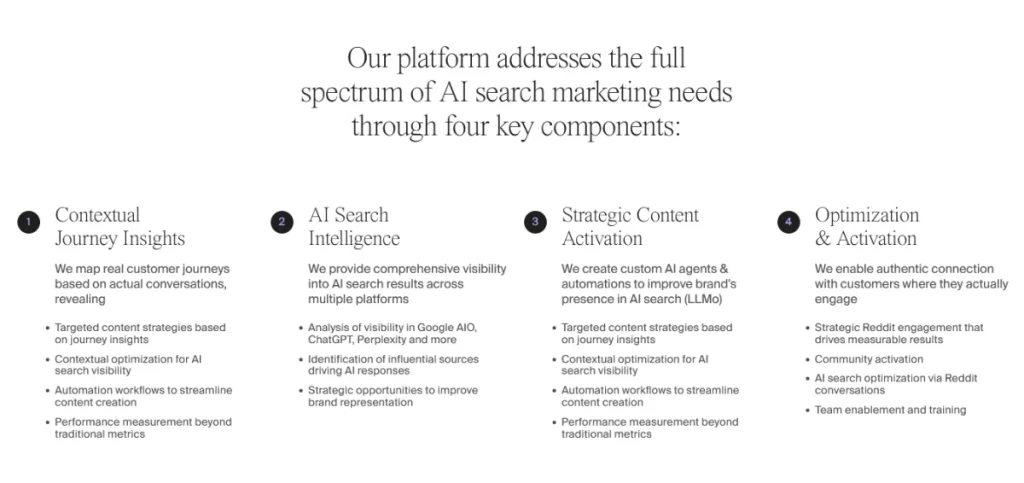
Ziptie AI offers a comprehensive feature set designed to cover the entire lifecycle of search optimization—from data collection to automated improvements.
Real-Time Query Analytics
Ziptie continuously tracks and analyzes search queries as they happen, allowing teams to react quickly to performance changes.
| Feature | Benefit |
|---|---|
| Live dashboards | Instant visibility into search performance |
| Query tracking | Understand what users are searching for |
| Session-level insights | Identify friction points in user journeys |
This enables near real-time decision-making instead of relying on delayed reports.
AI-Powered Intent Detection
One of the most powerful aspects of Ziptie is its ability to understand user intent beyond simple keyword matching.
The system uses machine learning models trained on behavioral data to classify queries into intent categories such as informational, transactional, or navigational.
| Approach | Description |
|---|---|
| Supervised learning | Uses labeled datasets for accuracy |
| Unsupervised learning | Detects patterns without predefined labels |
| Hybrid models | Combines both approaches for better performance |
This allows more accurate search results and better alignment with user expectations.
Relevance Tuning and Auto-Ranking
Ziptie automates what is traditionally a manual and time-consuming process: improving search rankings.
Instead of static rules, it uses feedback loops based on real user behavior.
| Mechanism | Function |
|---|---|
| Learning-to-rank models | Optimize result order dynamically |
| Feedback loops | Continuously improve based on user actions |
| A/B testing | Validate ranking changes before full rollout |
This significantly reduces manual effort while improving performance over time.
Personalization and Segmentation
Ziptie enables personalized search experiences by adapting results to different user segments.
| Personalization Type | Example |
|---|---|
| Behavioral | Returning users see tailored results |
| Contextual | Results vary by location or device |
| Cohort-based | Different rankings for user groups |
Even anonymous users can be grouped into behavioral cohorts, enabling effective personalization without requiring login data.
Anomaly and Trend Detection
Ziptie automatically identifies unusual patterns in search performance, helping teams act before issues escalate.
| Detection Type | Use Case |
|---|---|
| Sudden CTR drop | Identify broken relevance |
| Spike in zero-results | Detect missing content |
| Trending queries | Identify new opportunities |
This shifts search optimization from reactive to proactive.
Search Heatmaps and Funnel Analysis
Ziptie visualizes how users move from search queries to outcomes such as clicks or conversions.
| Insight Type | Value |
|---|---|
| Query-to-click flow | Understand engagement |
| Drop-off points | Identify friction |
| Conversion funnels | Optimize revenue paths |
These insights are critical for improving both UX and business metrics.
Synonym and Query Expansion Engine
Ziptie automatically expands queries to improve matching accuracy.
For example, it can detect that “running shoes” and “sneakers” should return similar results.
| Feature | Benefit |
|---|---|
| Automated synonyms | Reduce manual setup |
| Seasonal tuning | Adapt to trends |
| Query expansion | Improve recall |
This ensures users find relevant results even with imperfect queries.
Integrations and APIs
Ziptie is built with an API-first approach, making it easy to integrate into existing systems.
| Component | Description |
|---|---|
| Ingestion API | Collect search and behavioral data |
| Analytics API | Query performance metrics |
| Webhooks | Trigger real-time actions |
| Export formats | CSV, JSON, streaming |
This flexibility is especially valuable for teams with custom data pipelines.
Privacy, Compliance, and Data Governance
Ziptie includes built-in controls to handle user data responsibly.
| Area | Implementation |
|---|---|
| Data protection | Encryption in transit and at rest |
| Access control | Role-based permissions |
| Compliance | GDPR and CCPA-ready frameworks |
| Data retention | Configurable policies |
These features make it suitable for organizations with strict compliance requirements.
How Ziptie AI Search Analytics Works
Ziptie AI Search Analytics operates as a layered system that captures user interactions, processes behavioral data, and continuously improves search performance through machine learning models. Instead of relying on static rules, it builds a dynamic feedback loop between users and search results.
Data Ingestion Pipeline
The first step is collecting structured and unstructured data from multiple sources. This includes every interaction users have with search.
| Data Source | Examples |
|---|---|
| Search Logs | Queries, filters, refinements |
| Clickstream Data | Clicks, scroll depth, dwell time |
| Conversion Data | Purchases, sign-ups, downloads |
| Content Metadata | Product attributes, tags, categories |
Ziptie supports both batch and real-time ingestion, allowing companies to process historical data while simultaneously reacting to live user behavior.
Feature Engineering and Signal Processing
Once data is collected, Ziptie extracts meaningful signals that can be used to improve search relevance.
| Signal Type | Description |
|---|---|
| Click-through rate (CTR) | Measures engagement with results |
| Dwell time | Indicates content relevance |
| Conversion signals | Identifies high-value queries |
| Query reformulations | Reveals user frustration |
These signals are enriched with metadata such as taxonomy, product attributes, and user context, making the data more actionable.
Modeling Layer
Ziptie applies machine learning models to interpret user behavior and optimize search performance.
| Model Type | Function |
|---|---|
| Learning-to-rank models | Optimize result ordering |
| Intent classifiers | Understand user goals |
| Personalization models | Adapt results to user segments |
| Anomaly detection models | Identify performance issues |
Models are retrained regularly using fresh behavioral data, ensuring that search relevance continuously improves over time.
Serving Layer and Real-Time Optimization
The processed insights are then delivered through low-latency APIs that interact directly with the search system.
| Component | Purpose |
|---|---|
| Ranking API | Returns optimized results |
| Experimentation layer | Supports A/B testing |
| Caching | Ensures fast response times |
| Routing logic | Directs users into test groups |
This allows Ziptie to influence search results in real time without disrupting the user experience.
Storage and Scalability
Ziptie is built to handle large-scale data environments.
| Storage Type | Use Case |
|---|---|
| Time-series databases | Track performance metrics over time |
| Data warehouses | Store structured analytics data |
| Vector databases | Support semantic search capabilities |
Its distributed architecture ensures scalability across millions of queries and events.
Monitoring and Observability
Continuous monitoring ensures that both system performance and model accuracy remain stable.
| Monitoring Area | Example |
|---|---|
| Latency | API response times |
| Model performance | Ranking accuracy (NDCG, MRR) |
| Data quality | Missing or inconsistent signals |
| Drift detection | Changes in user behavior patterns |
This makes it possible to detect and fix issues before they impact users.
Business Benefits and ROI
Implementing Ziptie AI Search Analytics directly impacts key business metrics by improving how users interact with search.
Performance Improvements
| Metric | Expected Impact |
|---|---|
| Search CTR | Increase due to better relevance |
| Conversion rate | Higher due to improved matching |
| Revenue per search | Growth from optimized journeys |
| Search abandonment | Reduction through better results |
Even small improvements in these metrics can lead to significant revenue gains at scale.
Operational Efficiency
Ziptie reduces the need for manual search optimization by automating key processes.
| Area | Improvement |
|---|---|
| Relevance tuning | Automated instead of rule-based |
| Synonym management | AI-driven updates |
| Issue detection | Real-time alerts |
| Experimentation | Faster A/B testing cycles |
This allows teams to focus on strategy instead of maintenance.
Time-to-Insight
Traditional analytics tools often require manual analysis. Ziptie accelerates this process significantly.
| Process | Traditional | With Ziptie |
|---|---|---|
| Identifying issues | Days or weeks | Real-time |
| Testing changes | Manual setup | Automated |
| Understanding user intent | Limited | AI-driven |
This speed advantage is critical in competitive markets.
Before vs After Ziptie Implementation
| Metric | Before Ziptie | After Ziptie |
|---|---|---|
| Search CTR | Low / inconsistent | Higher and stable |
| Conversion rate | Suboptimal | Optimized |
| Zero-results queries | Frequent | Reduced |
| Insight generation | Slow | Real-time |
How to Quantify ROI
To evaluate the impact of Ziptie, companies should track specific KPIs:
| KPI | Description |
|---|---|
| CTR (Search) | Percentage of searches leading to clicks |
| Conversion per search | Revenue-driving searches |
| Revenue per search | Monetary value of search sessions |
| Search satisfaction score | User experience metric |
A simple ROI formula can be applied:
ROI = (Revenue uplift from search improvements – cost of implementation) ÷ cost of implementation
Use Cases and Industry Applications
Ziptie AI Search Analytics is applicable across multiple industries where search plays a critical role in user experience and revenue generation.
E-commerce
In e-commerce, search is directly tied to revenue. Ziptie helps optimize product discovery and merchandising.
| Use Case | Impact |
|---|---|
| Product search optimization | Higher conversions |
| Synonym handling | Better product matching |
| Seasonal trends | Improved campaign performance |
Media and Publishing
Content-heavy platforms rely on effective search to keep users engaged.
| Use Case | Impact |
|---|---|
| Article discovery | Increased time-on-site |
| Personalization | Higher engagement |
| Content gap analysis | Better editorial decisions |
Enterprise Search
Internal search systems are often inefficient and difficult to optimize.
| Use Case | Impact |
|---|---|
| Knowledge base search | Faster information retrieval |
| Support deflection | Reduced support tickets |
| Employee productivity | Improved efficiency |
SaaS Applications
Search within SaaS products improves usability and feature adoption.
| Use Case | Impact |
|---|---|
| In-app search | Better feature discovery |
| User onboarding | Faster learning curves |
| Usage analytics | Improved product decisions |
Marketplaces and Classifieds
Large catalogs require precise relevance tuning.
| Use Case | Impact |
|---|---|
| Listing relevance | Better user satisfaction |
| Fraud signal detection | Improved trust |
| Query optimization | Increased engagement |
Implementation Guide (Step-by-Step)
Successfully implementing Ziptie requires a structured approach that balances technical setup with business goals.
Discovery and Goal Definition
Before implementation, it is essential to define success metrics and establish a baseline.
| Step | Description |
|---|---|
| Define KPIs | CTR, conversion rate, revenue per search |
| Audit current search | Identify weaknesses |
| Set goals | Measurable improvement targets |
Data Mapping and Setup
Mapping the right data is critical for model performance.
| Data Type | Example |
|---|---|
| Queries | User input |
| Clicks | Result interactions |
| Conversions | Purchases or actions |
| Metadata | Product attributes |
Pilot Project
A pilot phase allows teams to validate results before full rollout.
| عنصر | Details |
|---|---|
| Scope | Limited dataset or segment |
| Duration | 4–8 weeks |
| Success criteria | KPI improvements |
Model Training and Validation
Ziptie models must be trained and evaluated using relevant metrics.
| Metric | Purpose |
|---|---|
| NDCG | Ranking quality |
| MRR | First relevant result |
| Precision@k | Accuracy of top results |
Rollout Strategy
Gradual rollout minimizes risk and ensures stability.
| Phase | Description |
|---|---|
| A/B testing | Compare performance |
| Phased deployment | Expand gradually |
| Rollback plan | Ensure safety |
Operationalization
Once deployed, continuous monitoring is required.
| Task | Frequency |
|---|---|
| Model retraining | Weekly or monthly |
| Alert monitoring | Daily |
| Performance review | Weekly |
Scale and Optimization
After initial success, the system can be expanded.
| Area | Optimization |
|---|---|
| Multi-region deployment | Reduce latency |
| Cost optimization | Efficient data usage |
| Advanced personalization | Deeper segmentation |
How to Improve Search Performance Using Ziptie (Quick Steps)
For teams looking for a simplified approach, the process can be summarized into five core steps:
- Connect search and behavioral data sources
- Analyze query performance and identify weak spots
- Detect high-impact optimization opportunities
- Apply ranking and relevance improvements
- Monitor performance and iterate continuously
This workflow highlights the core value of Ziptie: turning data into continuous optimization.
Ziptie AI vs Alternatives
Choosing the right search analytics platform depends heavily on your existing stack, data maturity, and optimization goals. Ziptie positions itself as an AI-first analytics and optimization layer, whereas many alternatives focus either on search infrastructure or basic analytics.
Feature Comparison Overview
| Platform | Core Strength | AI Capabilities | Analytics Depth | Ease of Integration | Best For |
|---|---|---|---|---|---|
| Ziptie AI | Search analytics + optimization | Advanced | Deep behavioral insights | High (API-first) | Data-driven teams |
| Algolia Analytics | Fast hosted search | Moderate | Limited | Very high | Speed-focused apps |
| Elastic + X-Pack | Full control | Custom (manual setup) | Medium | Complex | Engineering-heavy teams |
| Coveo | Enterprise AI search | Advanced | Strong | Medium | Large enterprises |
| Bloomreach | Commerce experience | Advanced | Strong | Medium | E-commerce brands |
| Lucidworks | AI search platform | Advanced | Strong | Medium | Enterprise search |
Key Differences Explained
Ziptie differs from traditional tools by focusing on continuous optimization through behavioral feedback loops, rather than static configuration.
| Area | Ziptie Approach | Typical Alternative |
|---|---|---|
| Relevance tuning | Automated (AI-driven) | Manual rules |
| Insights | Real-time behavioral analytics | Delayed reporting |
| Optimization cycle | Continuous | Periodic |
| Setup complexity | Moderate | Often high (Elastic) |
When to Choose Ziptie vs Alternatives
| Scenario | Recommended Choice |
|---|---|
| Need deep search insights + automation | Ziptie |
| Need simple hosted search with minimal setup | Algolia |
| Need full infrastructure control | Elastic |
| Enterprise-level personalization suite | Coveo / Bloomreach |
Best Alternatives to Ziptie AI (Quick Overview)
If Ziptie is not the right fit, several alternatives offer similar capabilities with different trade-offs.
| Tool | Best For | Weakness |
|---|---|---|
| Algolia | Fast, easy integration | Limited analytics depth |
| Elastic | Custom search systems | High complexity |
| Coveo | Enterprise personalization | Expensive |
| Bloomreach | E-commerce optimization | Less flexible outside commerce |
| Lucidworks | Enterprise search | Requires setup expertise |
This overview helps position Ziptie clearly within the broader search analytics landscape.
Pricing Models and Total Cost of Ownership
Ziptie AI does not follow a one-size-fits-all pricing model. Instead, costs typically depend on usage, scale, and feature requirements.
Common Pricing Structures
| Model | Description |
|---|---|
| Usage-based | Pricing based on queries or events |
| Tiered plans | Different feature levels |
| Enterprise licensing | Custom pricing for large organizations |
| Add-ons | Advanced features or integrations |
Key Cost Drivers
| Cost Factor | Impact |
|---|---|
| Query volume | Higher usage increases cost |
| Data ingestion | More events require more processing |
| Model training | Compute resources affect pricing |
| SLA & support | Enterprise support adds cost |
Total Cost of Ownership (TCO)
When evaluating Ziptie, it’s important to compare it with building your own solution.
| Approach | Cost Characteristics |
|---|---|
| Ziptie AI | Predictable, managed |
| Custom build (Elastic + ML) | High upfront + maintenance cost |
| Hybrid setup | Moderate complexity |
While Ziptie may seem expensive initially, it often reduces long-term costs by eliminating manual optimization and engineering overhead.
Security, Privacy, and Compliance
Ziptie AI is designed to handle sensitive user data responsibly, making it suitable for enterprise environments.
Security Measures
| Area | Implementation |
|---|---|
| Data encryption | In transit (TLS) and at rest |
| Access control | Role-based permissions |
| Audit logs | Full activity tracking |
| API security | Authentication and rate limiting |
Privacy Controls
| Feature | Description |
|---|---|
| PII handling | Data masking and anonymization |
| Consent management | User-level data controls |
| Data retention | Configurable policies |
Compliance Considerations
| Regulation | Support |
|---|---|
| GDPR | Supported with proper configuration |
| CCPA | Supported |
| SOC 2 | Typically expected for enterprise tools |
Organizations should still validate compliance requirements based on their specific implementation.
Limitations and Risks
While Ziptie AI offers strong capabilities, it is not without limitations.
Key Limitations
| Limitation | Impact |
|---|---|
| Data dependency | Poor data leads to poor results |
| Initial setup effort | Requires proper integration |
| Learning curve | Teams need to understand analytics |
| Cost at scale | High usage can increase expenses |
AI-Related Risks
| Risk | Explanation |
|---|---|
| Model bias | Results may favor certain patterns |
| Over-optimization | Too much automation can reduce diversity |
| Drift | Changing user behavior affects performance |
Mitigation strategies include monitoring, regular retraining, and maintaining human oversight.
When Ziptie AI May Not Be the Right Choice
Ziptie is powerful, but not every organization needs an advanced AI search analytics platform.
Situations Where Ziptie May Not Fit
- Very small websites with low search volume
- Platforms without structured search data
- Teams without analytics or data capabilities
- Projects with extremely limited budgets
In these cases, simpler tools or basic analytics may be sufficient.
Case Studies and Example Metrics
Although exact results vary, typical implementations follow similar patterns.
Example 1 — E-commerce
| Metric | Before | After |
|---|---|---|
| Search conversion rate | 2.1% | 3.4% |
| Revenue per search | Low | Increased |
| Zero-results queries | High | Reduced |
Outcome: Improved product discovery and higher revenue per session.
Example 2 — Enterprise Knowledge Base
| Metric | Before | After |
|---|---|---|
| Time to find information | High | Reduced |
| Support tickets | High | Lower |
| User satisfaction | متوسط | Improved |
Outcome: Reduced support load and increased efficiency.
Case Study Template
| Section | Content |
|---|---|
| Challenge | What problem existed |
| Solution | How Ziptie was used |
| Implementation | Steps taken |
| Results | Measurable improvements |
| Learnings | Key takeaways |
Expert Perspective on AI Search Analytics
Modern search systems are increasingly driven by machine learning rather than static rules. Research in learning-to-rank and behavioral analytics shows that user interaction data is one of the most reliable signals for improving relevance.
AI search analytics platforms like Ziptie represent a shift toward:
- Continuous optimization instead of periodic tuning
- Behavioral data instead of keyword assumptions
- Automated insights instead of manual analysis
This aligns with broader industry trends where data-driven systems outperform rule-based approaches in complex environments.
FAQs About Ziptie AI Search Analytics
What data does Ziptie need to improve search relevance?
Ziptie requires search queries, user interactions (clicks, dwell time), and conversion data. Additional metadata improves accuracy.
Can Ziptie work with Elasticsearch, Algolia, or Solr?
Yes, Ziptie is designed to integrate with existing search engines via APIs and data pipelines.
How long does deployment typically take?
Most implementations take between 4 and 8 weeks, depending on complexity and data readiness.
Does Ziptie support multilingual and semantic search?
Yes, through machine learning models and vector-based approaches, it can support semantic understanding and multiple languages.
How does Ziptie handle personalization for anonymous users?
It uses behavioral clustering and session-based signals instead of relying solely on user accounts.
What KPIs should be tracked after implementation?
CTR, conversion rate, revenue per search, and search abandonment are the most important metrics.
Is Ziptie AI worth it?
For data-driven organizations with significant search volume, Ziptie can deliver strong ROI through improved relevance and conversions.
Can Ziptie improve SEO rankings?
Indirectly, yes. Better internal search improves user engagement signals, which can positively impact SEO performance.
Does Ziptie use machine learning?
Yes, it uses multiple machine learning models including ranking algorithms, intent classifiers, and anomaly detection systems.
What is Ziptie AI Search Analytics and how does it differ from traditional SEO tools?
Ziptie AI Search Analytics (ziptie.dev) is an ai-powered search monitoring and optimization platform that tracks how your content and brand appear in ai search engines and across google ai overviews. Unlike traditional seo tools that focus on search rankings and technical seo for classic search engines, Ziptie focuses on ai search visibility, ai answers, and generative engine optimization — showing whether your brand is cited in ai results and providing an ai success score and visibility tracking for ai-powered search.
How does Ziptie track and analyze ai overviews and ai search results?
Ziptie monitors ai overviews by tracking ai platforms and leading ai search engines, such as chatgpt and perplexity, and analyzes how your content is used in ai answers. Ziptie analyzes user search behavior and the performance across google ai overviews, presenting ai search performance metrics and ai search monitoring insights, so you can measure ai search success and brand visibility in ai search results.
Can Ziptie help with content optimization for ai-powered search?
Yes — Ziptie offers a content optimization module and recommendations to improve cited in ai likelihood and ai search visibility. The tool guides content optimization and seo and content efforts with generative engine optimization tips, helping seo professionals and seo agencies adapt content for ai answers and popular ai search engines like chatgpt and perplexity.
Which ai engines and popular ai search engines does Ziptie monitor?
Ziptie monitors a range of ai engines and popular ai search engines, tracking outputs from generative models and platforms across google ai overviews, chatgpt, and perplexity. Ziptie monitors how these ai platforms surface your content and provides ai search engine monitoring and ai search engine performance comparisons so you can understand visibility in ai and performance across engines.
How does Ziptie’s ai success score work and what does it measure?
The ai success score aggregates signals from ai search performance, ai search visibility, and cited in ai metrics to show how well your content performs in ai-powered search. Ziptie shows trends in ai search monitoring, measures brand visibility and user search behavior impact, and provides actionable insights for improving ai search results and ai search success over time.
Is Ziptie suitable for seo professionals and agencies?
Ziptie is built for seo professionals and seo agencies who need ai search engine monitoring beyond traditional search rankings. It complements traditional seo and technical seo by adding ai search monitoring and optimization features, making it a valuable seo tool for teams wanting to improve both traditional search and ai search visibility.
How does Ziptie integrate with existing analytics and site search tools?
Ziptie can be used alongside google analytics and site search platforms to combine traditional search metrics with ai search performance data. While tools like google analytics track classical traffic, Ziptie tracks ai overviews and ai answers, giving a fuller view of how your content performs across both traditional and ai-powered search environments.
Can Ziptie help with voice search and other emerging ai search use cases?
Yes — because Ziptie focuses on ai-powered search engines and ai answers, it helps brands adapt for voice search and conversational results generated by ai platforms. Ziptie analyzes how search terms and user search behavior translate into ai answers and provides recommendations for improving visibility in ai and voice-driven contexts.
How do I get started with Ziptie and is there a trial or pricing information?
To get started with Ziptie, visit ziptie.dev and sign up — Ziptie offers a 14-day free trial so you can see the main features of Ziptie in action. Ziptie pricing details are available on the site; the platform is positioned as a tool to monitor ai search performance and is tailored for brands wondering whether your brand is visible in ai and for teams that need ai search engine monitoring and optimization.
Are there limitations to Ziptie compared to using tools like ChatGPT or Perplexity directly?
Ziptie doesn’t replace interactive ai engines like chatgpt or perplexity; instead, it monitors ai platforms and aggregates ai overviews and ai search results for visibility tracking. Unlike using ai engines directly for research, Ziptie focuses on tracking, analysis, and content optimization so you can measure ai search performance and make informed decisions across ai platforms.
Call to Action: What to Do Next
If your platform relies heavily on search, optimizing it is one of the highest-impact improvements you can make.
Next Steps
| Action | Purpose |
|---|---|
| Request a demo | Evaluate platform capabilities |
| Run a pilot project | Validate ROI |
| Define KPIs | Measure success |
| Audit current search | Identify quick wins |
Organizations that treat search as a core growth lever—not just a feature—are the ones that benefit most from platforms like Ziptie AI Search Analytics.
Conclusion: Is Ziptie AI Search Analytics Worth It?
Ziptie AI Search Analytics is more than just a reporting tool—it is a full optimization layer for modern search systems. By combining behavioral data, machine learning, and real-time analytics, it enables companies to continuously improve search relevance and user experience.
For organizations where search plays a critical role in conversion, engagement, or information discovery, Ziptie offers a clear advantage over traditional analytics or rule-based systems.
However, its true value depends on data quality, implementation effort, and the scale of your search operations. Businesses with high query volume and measurable search-driven outcomes will benefit the most.
Final Verdict: Should You Use Ziptie AI?
Ziptie AI Search Analytics is a strong choice for teams that want to move beyond basic search tracking and adopt a data-driven, AI-powered optimization approach.
| Scenario | Verdict |
|---|---|
| High-traffic e-commerce or SaaS | ✅ Highly recommended |
| Enterprise search environments | ✅ Strong fit |
| Medium-sized platforms with growth focus | ⚖️ Depends on data readiness |
| Small websites with low search usage | ❌ Not necessary |
In short:
Ziptie is worth it if search performance directly impacts your revenue or user experience.
Who Should Use Ziptie AI (Quick Decision Guide)
| You should use Ziptie if… | You should NOT use Ziptie if… |
|---|---|
| Search drives conversions | Search is rarely used |
| You have measurable KPIs | No analytics setup exists |
| You want automated optimization | You prefer manual control only |
| You handle large datasets | Your traffic is very low |
Key Takeaways
- Ziptie transforms search data into actionable insights
- AI-driven optimization replaces manual tuning
- Real-time analytics enables faster decision-making
- ROI is strongest in data-rich environments