
Writeless AI is a specialized academic writing system that can generate long essays, insert citations, and make claims to avoid AI detection.
For students and researchers who already know AI tools, this raises questions: Are the citations real? Is the writing solid? Can it actually reduce detection risk or other academic problems?
To sum up the review: Writeless AI works for getting ideas down and building a structure, but it can’t produce work you can fully rely on.
What Is Writeless AI and What Does It Promise?

Writeless AI takes a topic, a citation style, and a word count, and produces a multi-section essay. You can go pretty long with it, which is unusual for general AI writing tools. The idea is that you don’t have to outline everything yourself.
It promises to save time by combining drafting, structuring, and citing in one step. It also says it’s plagiarism-free and less likely to trigger AI detectors.
In practice, the structure is solid, but the reasoning seems shoddy. Sections and headings are there, references exist, but the arguments are surface-level.
The examples are basic, transitions feel functional- a bit too much so, and conclusions don’t always connect. You get a draft you can build on, not something you can submit.
Key Features of Writeless AI
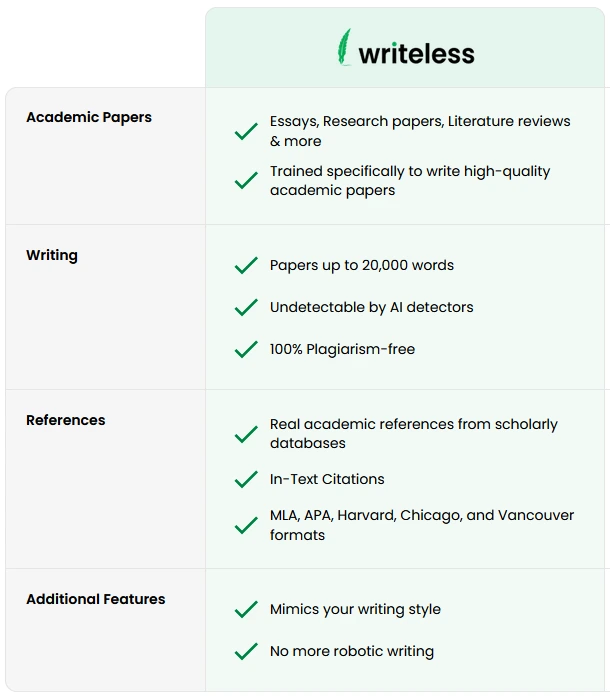
You won’t get a perfect paper from these tools, but Writeless AI includes a few features that can help you get started and stay organized. Here’s a quick look at its capacity:
Long essays
Can handle as much as 20,000 words- you can map out a big paper, though it’ll be rough and need a lot of work. Breaking it into sections made the process much smoother for me.
Automatic citations
It adds in-text references and a bibliography. That’s very convenient, but check the sources- they might not match what you actually say. Even so, it saved me a ton of time compared to doing it all manually.
Citation Styles
Writeless has support for APA, MLA, Harvard and Chicago- it saves a lot of formatting work. Switching between styles is way easier than doing it by hand.
Year Filters
You can focus on more recent sources if your topic needs it. This helped me keep my research relevant, especially on fast-changing subjects.
Style and length controls
Adjust tone and size, not argument quality. Tweaking these settings made the output fit my assignments better.
AI detection mode
Works as a bypasser, but the performance is inconsistent. It handled simple drafts okay, but anything complex still needed some hands-on editing.
These features are great for formatting and speed. You still need to think through your essay to make the actual arguments stronger, though.
Writeless AI Pricing & Plans
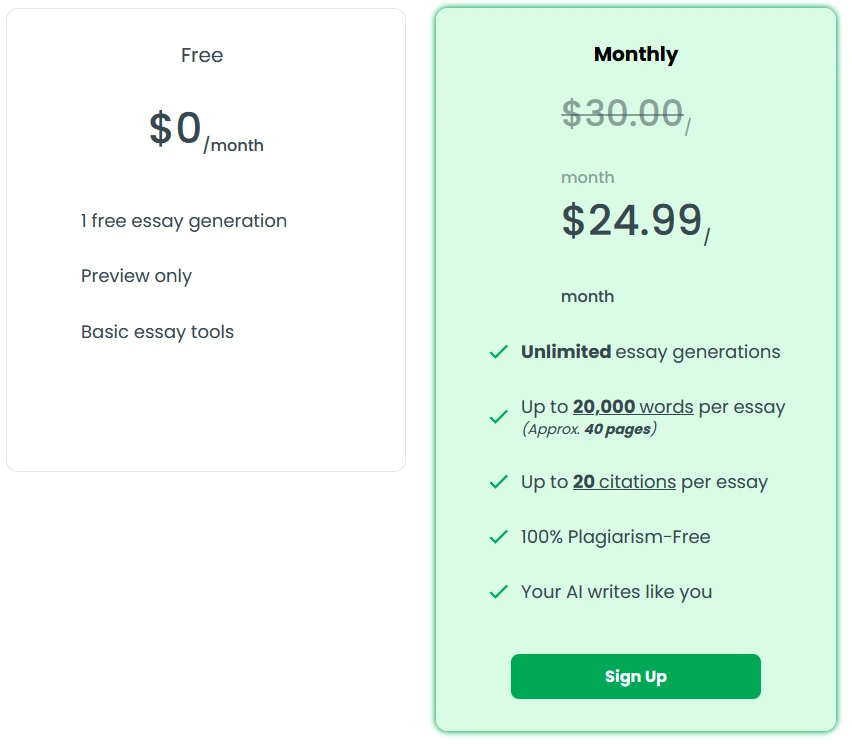
There’s a free plan, and then a few paid options that all give you the same features.
The free plan is just a teaser: you can see what the tool does, but you can’t export anything. The paid plans are much more functional, but the way they handle credits and refunds can be frustrating if you’re not careful.
Here are some extra details.
Free plan
- One essay preview
- No export or download
You can see how the tool writes, but you can’t really use it.
Paid plans
- $24.99/month (monthly)
- $17.99/month (quarterly)
- $9.99/month (yearly)
All paid plans let you generate unlimited essays, up to 20,000 words, and 20 citations per essay.
The cost is simple- there are strict rules around it, though. No refunds, credits don’t carry over, and support can be slow. If you subscribe, you need to be ready to use it enough to make it worth it.
How Good Is the Writing Quality Of Writeless AI?
Writing quality is important. Beyond grammar and readability, quality means argument depth, clarity, and flow. Writeless AI needs to show that it can keep ideas connected in long essays.
Structural Strengths
The tool can still make essays with introductions, body sections, and conclusions. All sentences are usually readable and grammatical- albeit a bit too much so, sometimes.
Substance Weaknesses
The content is often shallow:
- Simple arguments
- Weak synthesis
- Repetitive phrasing
- Template-like structure
- Semantic padding
Transitions are weak, and the logic is sometimes inconsistent. In academic writing, reasoning matters more than having sections with headings.
AI Detectability & Plagiarism Concerns
Detection and originality matter for academic work. Even if the AI is convenient, detection risk and unreliable citations create hazards.
Detection Reality
The “undetectable” mode is inconsistent. Some outputs are flagged over 60% as AI by GPTZero. Humanizer features sometimes help, sometimes do not. Detection varies by topic, essay length, and the detector. Manual rewriting is the only reliable way to reduce detection risk.
Citation Reliability
The text is rarely plagiarized, but citations can be inaccurate or irrelevant. Trusting them without checking can create academic problems.
Usability: Interface, Workflow, and Real Use
How a tool works in practice is as important as features. Writeless AI is fast and easy, but subscription rules limit usability. Convenience has to be weighed against these restrictions. Looking ahead, the landscape of ai performance review tools in 2026 will likely evolve to prioritize user experience and flexibility. With advancements in machine learning, these tools may offer more personalized insights that help organizations better evaluate employee performance. As companies seek to enhance productivity, finding a balance between innovative features and practical usability will be essential.
Positives
- Simple interface
- Fast generation
- Useful for brainstorming, structuring, and generating references
Negatives
- No export on free tier
- Rigid credit system
- No refunds
- Reports of lost credits and slow support
It is convenient for first drafts, but full essays or tight deadlines may be difficult.
Writeless AI Review Summary: Pros And Cons
AI works best in certain situations. Writeless AI is most helpful for starting papers or organizing research. Its limits show when deeper analysis or citation accuracy is needed.
Pros
- Helps create outlines and structure scaffolding
- Speeds up first drafts
- Useful for early literature review organization
- Assists in initial research planning
Cons
- Not suitable for submission-ready writing
- Produces weak arguments and analysis
- Inconsistent style across sections
- Limited reliability for citation-heavy or high-rigor disciplines
- Output often requires heavy editing to be usable
How Writeless AI Compares to Alternatives
Writeless AI sits in between general AI writing tools, reference managers, and academic editing software. It doesn’t do everything, but it seems to cover certain tasks more directly than some alternatives.
- Compared to General AI Writers: Writeless AI is better with citations and formatting. You don’t have to insert references manually, and the sections are more structured. But it can feel stiff, and phrasing is repetitive. You get a skeleton faster, but not deeper content.
- Compared to Reference Managers: Writeless AI can generate reference lists automatically, which reference managers don’t do on their own. Still, it doesn’t track sources or check their quality. You can’t rely on it for accurate sourcing without manual verification.
- Compared to Editing Tools: Editing software improves existing writing. Writeless AI produces it from scratch. If you need polished text or style corrections, you still need another tool after generating the draft.
It’s helpful for structure and basic citations, but it doesn’t replace other tools. You often end up combining it with something else to get a complete, accurate paper.
Who Should (and Shouldn’t) Use Writeless AI

It’s useful if you treat it as a starting point and accept that most of the work is still yours. It’s less useful if you expect finished work or certainty about sources.
Good fit for:
- Students making rough drafts
- Writers who plan to revise heavily
- Projects where structure is the main challenge
- People willing to check sources themselves
Poor fit for:
- Submission-ready work
- Citation-heavy fields
- People relying on AI detection avoidance
- Users who don’t want to deal with strict billing policies
It helps you prepare work, not finish it.
Final Verdict: Is Writeless AI Worth It?
Writeless AI gives you a draft and a clear outline. It saves time at the start and shows what a paper could look like.
It’s worth paying for if you’re ready to revise heavily and verify sources. Not for finished essays or reliable AI detection avoidance. considering walter’s ai review for 2026, it is essential to weigh the benefits of using AI tools against their limitations. Users should approach these resources with a critical mindset, ensuring that the final output meets academic integrity standards. As technology continues to evolve, staying informed about advancements will further enhance the writing process while maintaining quality.
Its value is narrow but real, as long as you use it the way it was meant to be used.