Cybercrime is evolving at an alarming pace. As artificial intelligence becomes more powerful and accessible, many security experts are asking the same urgent question: how can AI be used in phishing attacks?
Phishing has always relied on deception, urgency, and human error. But today’s AI-powered cybercrime tools allow attackers to automate, personalize, and scale scams in ways that were nearly impossible just a few years ago. Traditional phishing emails filled with grammar mistakes are being replaced with sophisticated, AI-generated scam messages that mimic real communication styles.
Understanding how AI changes phishing tactics is essential for individuals, businesses, and security teams. This article explores the methods attackers use, the risks AI introduces, real-world examples, and most importantly, how to defend against these emerging threats.
What Is AI-Powered Phishing?
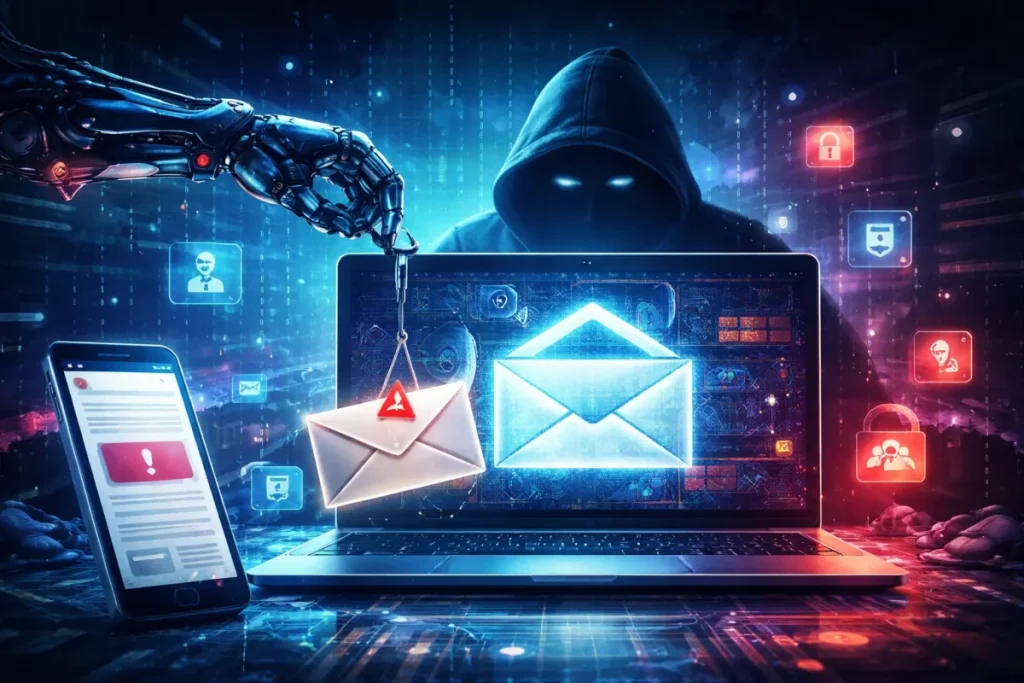
Phishing is a cyberattack method where criminals impersonate trusted entities to trick victims into revealing sensitive information such as passwords, financial data, or login credentials.
Evolution Into AI Phishing Techniques
Traditional phishing relied heavily on manual effort. Attackers crafted generic emails and sent them to thousands of recipients, hoping a small percentage would fall for the scam.
Today, AI phishing techniques have changed that model. Using machine learning phishing systems and large language models (LLMs), attackers can:
- Generate realistic, personalized emails in seconds
- Analyze stolen data to improve targeting
- Mimic specific individuals’ writing styles
- Adapt messages to evade spam filters
Manual vs. Automated Phishing
| Traditional Phishing | AI-Powered Phishing |
|---|---|
| Generic messages | Highly personalized emails |
| Manual crafting | Automated phishing emails |
| Easy-to-spot errors | Fluent, polished language |
| Limited targeting | Data-driven predictive targeting |
The difference is scale, precision, and realism.
Short Answer: How Can AI Be Used in Phishing Attacks?
AI can be used in phishing attacks by enabling criminals to generate highly personalized phishing emails, automate large-scale campaigns, mimic writing styles, create deepfake audio or video impersonations, bypass traditional spam filters, and analyze stolen data to improve targeting accuracy. Through machine learning phishing systems and generative AI tools, attackers can craft convincing messages that appear legitimate and adapt them dynamically to avoid detection. This makes AI-powered cybercrime more scalable, realistic, and difficult to detect compared to traditional phishing methods.
How Attackers Use AI in Phishing Campaigns
Understanding how can AI be used in phishing attacks requires examining the core techniques cybercriminals leverage today.
AI-Generated Scam Messages
Generative AI tools can create emails that sound natural, professional, and context-aware. This reduces common red flags such as poor grammar or awkward phrasing.
LLM Phishing Threats
Large Language Models (LLMs) can:
- Mimic corporate communication tone
- Translate scams into multiple languages instantly
- Adapt writing style to match a CEO, HR manager, or colleague
These LLM phishing threats significantly improve credibility and reduce suspicion.
Automated Phishing Emails at Scale
AI allows attackers to deploy automated phishing emails to thousands—or even millions—of targets with precision targeting.
Email Spoofing Automation
AI-powered tools can assist in:
- Automating email spoofing campaigns
- Personalizing subject lines
- Adjusting messaging based on recipient behavior
Combined with breached databases, attackers can tailor emails using job titles, purchase history, or social media data.
Deepfake & Voice Cloning Scams
One of the most concerning developments is deepfake phishing scams.
Voice Cloning Scams
AI can replicate a person’s voice using short audio samples. Criminals have used this tactic to impersonate executives in fraud schemes. According to the FBI, Business Email Compromise (BEC) and impersonation scams caused billions in losses annually (source: https://www.ic3.gov).
CEO Fraud Using Deepfakes
Deepfake video or audio can simulate executive instructions, making it appear as though a real leader is requesting urgent fund transfers. These attacks blend AI social engineering attacks with identity impersonation.
AI Social Engineering Attacks
AI enhances psychological manipulation by analyzing:
- Social media behavior
- Public data records
- Communication patterns
Using predictive analytics, attackers craft emotionally persuasive messages designed to trigger urgency or fear.
This evolution in AI social engineering attacks means criminals can exploit human behavior at scale.
Bypassing Spam Filters
Modern spam filters rely heavily on pattern recognition. AI helps attackers test and modify phishing emails dynamically.
Adaptive Content Generation
AI systems can:
- Reword suspicious phrases automatically
- Modify formatting to avoid detection
- Analyze which emails get blocked and adjust accordingly
This arms race between malicious AI tools and defensive AI fraud detection systems is ongoing.
Why AI Makes Phishing More Dangerous
So, why does AI-powered cybercrime present such a significant threat?
1. Increased Personalization
AI analyzes vast data sets, enabling hyper-personalized messages that feel authentic.
2. Faster Campaign Scaling
What once required weeks of preparation can now be done in minutes using automation.
3. Lower Skill Barrier
Previously, crafting convincing scams required strong language skills. AI removes that barrier.
4. Realistic Impersonation
Deepfake phishing scams make impersonation nearly indistinguishable from legitimate communication.
5. Fewer Red Flags
AI-generated scam messages eliminate spelling errors and unnatural phrasing.
According to cybersecurity agencies like CISA, AI-driven tactics are increasing the sophistication of phishing campaigns, requiring stronger defensive measures.
Real-World Examples of AI in Phishing
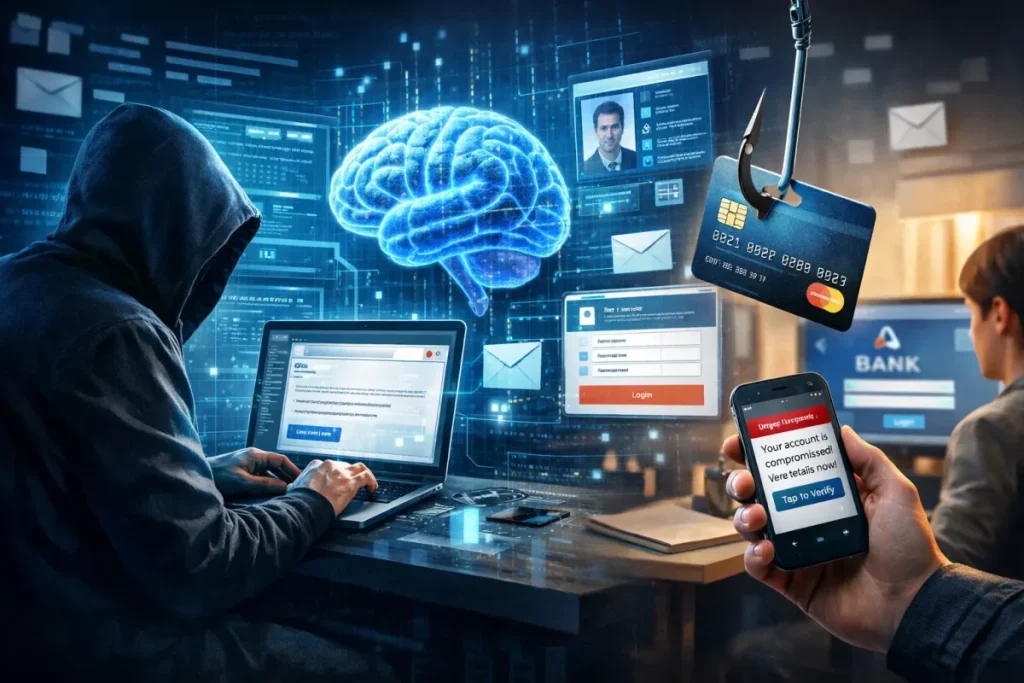
Business Email Compromise (BEC)
BEC remains one of the most costly cyber threats globally. AI enhances BEC by mimicking executive tone and automating communication threads.
Deepfake Executive Fraud
In documented cases, attackers used voice cloning scams to impersonate company executives, tricking employees into transferring funds.
AI Chatbot Scams
Fraudsters use AI chatbots on messaging platforms to simulate customer support interactions and steal credentials.
Automated SMS Phishing (Smishing)
AI-powered systems generate large volumes of realistic text messages that imitate banks, delivery services, or government agencies.
Each example shows how how can AI be used in phishing attacks is not theoretical—it’s already happening.
How to Detect AI-Generated Phishing Attempts
Despite advancements, AI phishing is not impossible to detect.
Behavioral Anomalies
Look for:
- Unusual timing of requests
- Unexpected urgency
- Changes in tone or communication style
Metadata Inconsistencies
Email headers and domain analysis can reveal spoofing attempts.
Emotional Triggers
AI social engineering attacks often rely on urgency, fear, or authority pressure.
Deepfake Detection Signals
Watch for:
- Slight audio distortion
- Unnatural pauses
- Inconsistent facial movements
AI Fraud Detection Tools
Modern security platforms use AI to:
- Monitor anomalies
- Detect abnormal login behavior
- Identify suspicious email patterns
Proactive monitoring is critical.
How Organizations Can Protect Against AI Phishing
Organizations must adopt layered security strategies.
Multi-Factor Authentication (MFA)
Even if credentials are stolen, MFA prevents unauthorized access.
Zero-Trust Architecture
Never automatically trust any request—verify continuously.
AI Fraud Detection Systems
Leverage machine learning anomaly detection tools to identify suspicious behavior early.
Email Authentication Protocols
Implement:
- DMARC
- SPF
- DKIM
These help reduce email spoofing automation risks.
Employee Awareness Training
Employees should learn how AI-generated scam messages operate.
For more cybersecurity strategies, see this guide.
Regular Security Audits
Routine testing and phishing simulations strengthen resilience.
The Role of AI in Fighting AI Phishing
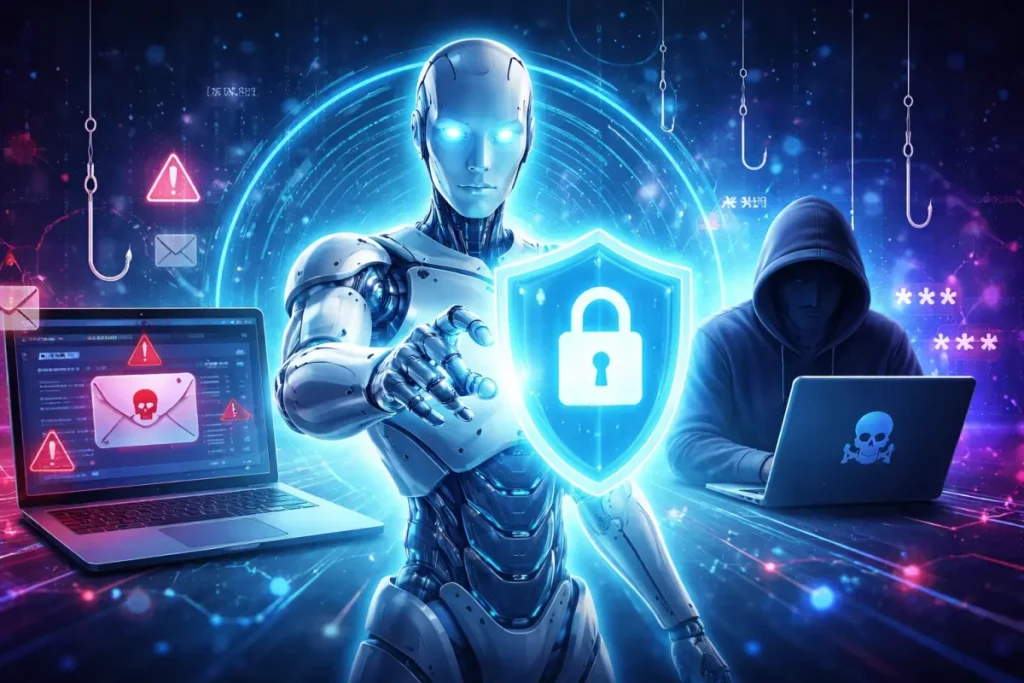
AI is not just a threat—it’s also a defense.
AI-Based Spam Filters
Advanced filters analyze language patterns and metadata in real time.
Behavioral Analytics
Machine learning models detect deviations from normal user behavior.
Threat Intelligence Automation
AI systems aggregate global threat data, identifying new phishing campaigns quickly.
Machine Learning Anomaly Detection
Security tools can flag:
- Suspicious login locations
- Unusual financial transactions
- Account privilege changes
While AI cybersecurity risks are growing, AI is also essential in combating malicious AI tools.
Ethical & Legal Concerns
AI-powered cybercrime raises complex ethical issues.
Regulation Challenges
Governments struggle to regulate generative AI without stifling innovation.
Accountability
Determining responsibility for misuse of AI systems remains legally challenging.
Privacy Implications
AI data analysis relies on vast amounts of personal information, raising concerns about misuse and data protection.
Balancing innovation and security is one of the biggest cybersecurity challenges of the decade.
FAQs About AI and Phishing Attacks
1. Is AI making phishing worse?
Yes, AI enhances personalization, automation, and impersonation capabilities, increasing phishing success rates.
2. Can AI completely bypass spam filters?
Not entirely. While AI can evade traditional filters, modern AI fraud detection systems continuously adapt to counter threats.
3. Are deepfake phishing attacks common?
They are still emerging but growing rapidly, particularly in high-value corporate fraud schemes.
4. How can businesses protect themselves?
Implement multi-factor authentication, employee training, AI fraud detection tools, and email authentication protocols.
5. Is AI-generated phishing hard to detect?
It can be more convincing than traditional phishing, but behavioral monitoring and verification procedures remain effective.
6. Will AI replace human hackers?
AI acts as an amplifier rather than a replacement. Human oversight still guides most sophisticated attacks.
Final Verdict – The Future of AI in Phishing Attacks
The question how can AI be used in phishing attacks is no longer speculative—it defines today’s cybersecurity landscape. AI-powered cybercrime enables criminals to automate deception, scale operations globally, and impersonate individuals with alarming realism.
However, the same technology driving these threats also powers advanced defense systems. Organizations that adopt AI-based detection, enforce strong authentication practices, and educate employees will be far better positioned to withstand these evolving risks.
The future of cybersecurity depends on proactive awareness, responsible AI development, and layered protection strategies. AI is neither inherently good nor bad—it’s a tool. The difference lies in how it’s used.
Staying informed is your strongest defense.