
Quick answer: Profound is likely the stronger fit for larger brands, agencies, and marketing teams that want a more complete AI search visibility platform. Hall AI is likely the better fit if you want a more focused GEO and AI visibility workflow with clear monitoring features around generative answers, website citations, and AI agent activity.
The simple version: choose Profound if you want a broader GenAI marketing intelligence platform. Choose Hall AI if you mainly want to understand how your website, brand, and competitors appear in AI-generated answers from tools like ChatGPT, Google AI Overviews, Perplexity, Gemini, Claude, Copilot, and DeepSeek.
This comparison looks at both tools from a practical GEO perspective: what they appear to do, who they are best for, how transparent their pricing is, and which one makes more sense depending on your team size and use case.
Profound vs Hall AI: Quick Comparison
| Category | Profound | Hall AI |
|---|---|---|
| Best for | Enterprise brands, agencies, larger SEO/content/PR teams | Marketers, agencies, and teams focused on AI visibility tracking |
| Main use case | Understanding, improving, and measuring brand visibility in AI search | Monitoring how your business and website appear in AI conversations |
| AI platforms mentioned | ChatGPT, Perplexity, Claude, Gemini, Grok, Microsoft Copilot, Meta AI, DeepSeek, Google AI Overviews | ChatGPT, AI Mode, AI Overviews, Perplexity, Gemini, Copilot, Claude, DeepSeek |
| Core strengths | Prompt volumes, answer engine insights, agents, agent analytics | Generative answer insights, website citation insights, agent analytics, conversational commerce |
| Pricing transparency | Pricing page exists, but public plan details are limited | Public plan structure is visible, but plans are contact-sales based |
| Better choice if… | You need a broader AI search and marketing intelligence platform | You want a more direct AI visibility and citation-monitoring workflow |
What Is GEO?
GEO stands for generative engine optimization. It is the process of improving how a brand, product, website, or expert source appears inside AI-generated answers. Instead of only asking, “Where do we rank in Google?”, GEO asks questions such as:
- Does ChatGPT mention our brand for relevant questions?
- Does Perplexity cite our website as a source?
- Do Google AI Overviews include our content?
- Are competitors recommended more often than us?
- Do AI answers describe our brand accurately?
- Which pages are being used as citations by AI systems?
That is why tools like Profound and Hall AI are becoming relevant. Traditional SEO tools track rankings, keywords, backlinks, and organic traffic. GEO tools try to measure something newer: visibility inside AI-generated answers.
At AI Everyday Tools, we look at AI tools from a practical user perspective: what the tool does, who it helps, what its limitations are, and where users should be cautious. You can also read more about our review process on our AI tool research methodology page.
What Is Profound?
Profound positions itself as a platform for improving brand visibility in AI search and answer engines. Its website describes the product around AI discovery, AI-generated answers, prompt demand, answer engine insights, marketing agents, and agent analytics.
Profound’s positioning is broader than a simple rank tracker. It appears designed for teams that want to understand how their brand shows up across AI platforms and then take action through content, PR, brand, and marketing workflows.
On its official site, Profound highlights visibility across AI systems such as Perplexity, ChatGPT, Claude, Gemini, Grok, Microsoft Copilot, Meta AI, DeepSeek, and Google AI Overviews. It also promotes features such as Prompt Volumes, Answer Engine Insights, Agents, and Agent Analytics.
What Is Hall AI?

Hall AI is an AI visibility platform focused on how businesses and websites appear in AI conversations. Its official site describes use cases around generative answer insights, website citation insights, agent analytics, and conversational commerce.
Compared with Profound, Hall AI feels more directly centered on AI visibility tracking and GEO/AEO monitoring. The platform highlights the ability to understand how a business appears in AI-generated answers, how often a website is cited, and how AI agents or crawlers interact with the site.
Hall AI mentions support for AI platforms including ChatGPT, AI Mode, AI Overviews, Perplexity, Gemini, Copilot, Claude, and DeepSeek. That makes it relevant for teams that want to monitor visibility across several answer engines instead of only checking Google search rankings.
Profound vs Hall AI: Feature Comparison
AI Search Visibility Tracking
Both tools are relevant if your main goal is to understand how your brand appears inside AI-generated answers. The difference is positioning.
Profound appears more like a broader GenAI marketing intelligence platform. It is not only about checking whether your brand appears in an answer. It also emphasizes prompt demand, answer insights, agents, and marketing workflows.
Hall AI appears more directly focused on AI visibility tracking. Its homepage emphasizes understanding and measuring how your business and website appear in AI conversations. For many marketers, that may be the more straightforward GEO use case.
Winner: Hall AI for a more direct AI visibility workflow; Profound for a broader AI search intelligence platform.
Brand Monitoring in AI Answers
Brand monitoring is one of the most important reasons to use a GEO tool. You want to know whether AI systems mention your company, whether the description is accurate, and whether competitors are being recommended instead.
Profound’s Answer Engine Insights are designed around seeing how AI represents your brand in conversations. This can be useful for larger companies, PR teams, and demand generation teams that care about positioning and reputation.
Hall AI also includes generative answer insights, including brand presence, sentiment, share of voice, and positioning. That makes it especially relevant for teams that want to compare how their brand appears against competitors in AI-generated answers.
Winner: Tie. Profound may be better for broader brand intelligence; Hall AI may be easier to understand for direct share-of-voice and answer visibility tracking.
Website Citation Insights
This is one area where Hall AI’s positioning is especially clear. Hall AI specifically promotes website citation insights, meaning you can see where AI systems reference your website or specific pages in AI conversations.
That matters because AI search visibility is not only about being mentioned as a brand. It is also about whether your content becomes a trusted source that AI tools cite or use in generated answers.
Profound also focuses on answer engine visibility and AI search performance, but Hall AI’s website makes the citation-monitoring angle especially explicit.
Winner: Hall AI, based on clearer public positioning around website citation insights.
Prompt Demand and Query Research
Profound has a clear advantage if prompt demand research is important to you. Its site highlights Prompt Volumes, which are meant to help teams see what people ask AI systems and align strategy with demand.
This is important because traditional keyword volume does not fully explain AI search behavior. People often ask AI tools longer, more conversational, and more specific questions than they type into Google.
For content teams, prompt demand can help answer questions like:
- Which questions do people ask AI tools in our category?
- Which topics trigger competitor mentions?
- Which prompts should we optimize content around?
- Where are we missing from AI-generated answers?
Winner: Profound, especially if prompt-volume research is a key requirement.
Agent Analytics
Both Profound and Hall AI mention agent analytics. This is an increasingly important part of GEO because AI systems and crawlers may visit your site differently from traditional search crawlers.
Profound says its Agent Analytics can track how a site is interpreted and crawled by systems such as ChatGPT, Gemini, Claude, Perplexity, and others.
Hall AI says its agent analytics help observe how AI agents and crawlers browse a website and connect that activity with AI conversation data.
Winner: Tie. Both tools appear to treat agent and crawler visibility as a serious feature area.
Content and Optimization Workflow
Profound appears stronger if you want a platform that connects insights with content and marketing execution. Its site emphasizes agents for marketing workflows, including AEO/SEO, content, demand, PR, and communications.
Hall AI appears more focused on visibility measurement, citation insights, and monitoring. That can still support content optimization, but its public positioning feels less like a full marketing execution platform and more like a focused AI visibility platform.
If you already have a content workflow and only need AI answer monitoring, Hall AI may be enough. If you want a broader AI search operations platform, Profound may be more suitable.
You can also combine manual research with lightweight internal tools. For example, our Content Optimization Score Tool and SEO Content Brief Generator can support basic content planning, although dedicated GEO platforms are much more advanced for AI visibility tracking.
Winner: Profound for broader workflow depth; Hall AI for focused monitoring.
Pricing: Which Tool Is More Transparent?
Pricing is one of the hardest parts of comparing GEO tools because many AI visibility platforms use demo-based or contact-sales pricing.
Profound has a pricing page, but at the time of review, the publicly visible page does not clearly show simple self-serve monthly pricing tiers. That suggests it may be more sales-led, especially for teams that need a full platform setup.
Hall AI is more transparent about plan structure. Its pricing page lists Starter, Business, and Enterprise plans, but the calls to action are still contact-sales based. The Starter plan mentions 20 projects, 500 tracked questions, 45,000 answers analyzed per month, daily data updates, 2 contributors, unlimited viewers, and unlimited AI agent analytics. The Business plan increases those limits and is positioned for larger enterprise teams.
Before choosing either tool, verify pricing directly on the official websites because GEO platforms are changing quickly and plan limits may change.
Winner: Hall AI for clearer visible plan structure. Neither tool should be chosen without checking current pricing and plan limits directly.
Who Should Choose Profound?
Profound is likely the better choice if you need more than a simple AI visibility tracker. It fits teams that want to connect AI answer visibility with strategy, content, brand positioning, PR, and marketing execution.
Choose Profound if you need:
- A broader GenAI marketing intelligence platform
- AI answer engine insights across multiple platforms
- Prompt volume and AI demand research
- Brand and competitor monitoring in AI-generated answers
- Agent analytics for AI crawlers and bots
- Content, PR, and AEO/SEO workflows
- A platform that may fit enterprise or larger agency needs
Profound is probably overkill if you are a small website owner who only wants a lightweight way to check whether ChatGPT or Perplexity mention your site. But if AI visibility is becoming a serious marketing channel for your brand, Profound is worth considering.
Who Should Choose Hall AI?
Hall AI is likely the better choice if your main goal is straightforward GEO monitoring: how your business appears in AI answers, which websites are cited, how your visibility compares with competitors, and how AI agents interact with your site.
Choose Hall AI if you need:
- Generative answer visibility tracking
- Website citation insights
- Share-of-voice and positioning insights
- AI agent and crawler analytics
- A clearer public plan structure
- A focused GEO/AEO monitoring platform
- A tool that appears easier to evaluate from its public website
Hall AI may be a better first option for marketers and agencies that want to understand AI visibility without committing immediately to a broader enterprise-style marketing intelligence platform.
Profound vs Hall AI: Pros and Cons
Profound Pros
- Broad AI search and answer engine visibility positioning
- Supports many major AI platforms
- Prompt volume and demand research appear to be a key strength
- Useful for SEO, AEO, content, PR, and brand teams
- Strong fit for enterprise brands and agencies
- Agent analytics included in the platform positioning
Profound Cons
- Public pricing details are limited
- May be more platform than smaller teams need
- Likely requires a sales conversation for serious evaluation
- Could be too complex if you only need basic AI answer monitoring
Hall AI Pros
- Clear focus on AI visibility and GEO/AEO monitoring
- Generative answer insights are easy to understand as a use case
- Website citation insights are clearly positioned
- Agent analytics are included in the product messaging
- Public pricing page shows plan structure and usage limits
- Good fit for marketers and agencies that want focused AI visibility tracking
Hall AI Cons
- Still contact-sales based
- May be less broad than Profound as a marketing intelligence platform
- May not offer the same depth around prompt demand research
- Users still need to verify current platform coverage and plan limits before buying
Which Tool Is Better for Small Websites?
For small websites, the honest answer is: you may not need either tool yet.
If your site is still early-stage, has limited organic traffic, and does not generate meaningful revenue yet, a dedicated GEO platform may be expensive compared with the value you get from it. You can start with manual checks:
- Ask ChatGPT, Perplexity, Gemini, Claude, and Google AI Overviews relevant industry questions.
- Check whether your brand or website appears.
- Check which competitors are mentioned.
- Look at which sources AI tools cite.
- Create better pages that answer those questions clearly.
- Build comparison, alternatives, and safety-focused content around real user intent.
Once AI search visibility becomes important enough to measure regularly, tools like Profound or Hall AI become more interesting. Until then, manual checks plus strong content strategy may be enough.
Which Tool Is Better for Agencies?
For agencies, both tools can make sense, but the best choice depends on how the agency sells GEO services.
Profound may be better for agencies that want a broader AI search intelligence and execution platform. It may fit better if the agency wants to build strategic reports, create AI search workflows, analyze prompt demand, and connect insights with content, PR, and brand strategy.
Hall AI may be better for agencies that want a more direct monitoring product around answer visibility, citations, share of voice, and agent analytics. Its visible plan structure may also make it easier to evaluate during the early research stage.
For most agencies, the real question is not only “Which tool has more features?” It is: Which tool helps us create a repeatable GEO service clients will understand and pay for?
Final Verdict: Profound vs Hall AI for GEO
Profound and Hall AI are both relevant GEO tools, but they appear to serve slightly different needs.
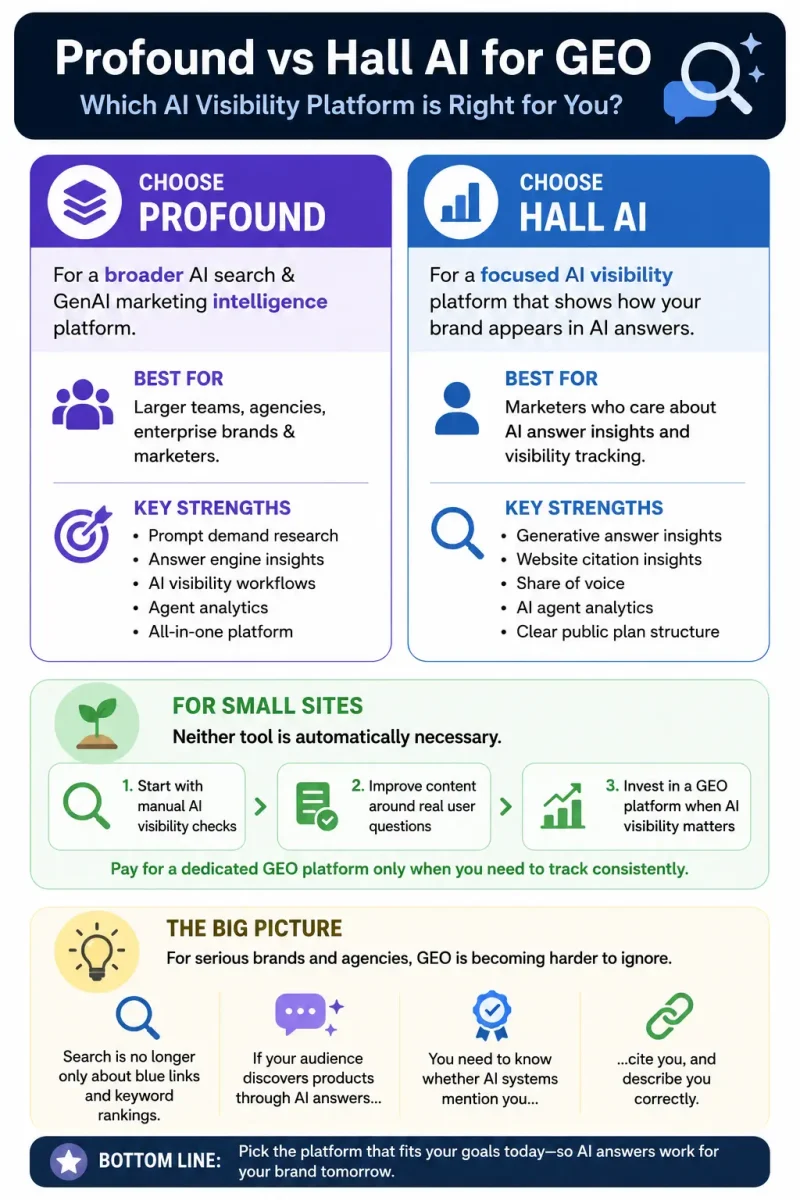
Choose Profound if you want a broader AI search and GenAI marketing intelligence platform. It is the more compelling option for larger teams, agencies, enterprise brands, and marketers who want prompt demand research, answer engine insights, AI visibility workflows, and agent analytics in one broader platform.
Choose Hall AI if you want a more focused AI visibility platform for tracking how your brand and website appear in AI-generated answers. It is especially interesting if you care about generative answer insights, website citation insights, share of voice, AI agent analytics, and a clearer public plan structure.
For small sites, neither tool is automatically necessary. Start with manual AI visibility checks, improve your content around real user questions, and only pay for a dedicated GEO platform once AI search visibility becomes important enough to track consistently.
For serious brands and agencies, however, GEO is becoming harder to ignore. Search is no longer only about blue links and keyword rankings. If your audience is discovering products through AI answers, you need to know whether those systems mention you, cite you, and describe you correctly.
FAQ
Is Profound better than Hall AI?
Profound may be better for larger teams that want a broader AI search and marketing intelligence platform. Hall AI may be better for teams that want a more focused way to monitor AI-generated answers, website citations, share of voice, and AI agent activity.
What is the main difference between Profound and Hall AI?
The main difference is positioning. Profound appears broader, with features around prompt volumes, answer engine insights, agents, and agent analytics. Hall AI appears more directly focused on AI visibility tracking, generative answer insights, website citation insights, and agent analytics.
Which tool is better for GEO?
For broad GEO strategy and AI search intelligence, Profound may be the stronger option. For direct monitoring of AI answers, citations, and visibility across AI platforms, Hall AI may be the simpler and more focused choice.
Do I need a GEO tool if I already use SEO tools?
Not always. Traditional SEO tools help with Google rankings, keyword research, backlinks, and organic traffic. GEO tools are different because they focus on how brands and websites appear inside AI-generated answers from tools like ChatGPT, Perplexity, Gemini, Claude, Copilot, and Google AI Overviews.
Is Hall AI cheaper than Profound?
That depends on the current plan and contract. Hall AI shows a clearer public plan structure, but its plans still use contact-sales calls to action. Profound also has a pricing page, but public pricing details are limited. Always check both official pricing pages before deciding.
Which tool is better for agencies?
Profound may be better for agencies that want a broader AI search intelligence and execution platform. Hall AI may be better for agencies that want a more focused GEO monitoring workflow around answers, citations, competitors, and agent analytics.