

Quick answer: Perplexity AI is a legitimate AI-powered answer engine — not a scam. It is one of the best-known AI search tools in 2026, with enterprise security claims including SOC 2 Type II, GDPR-related materials, and a public security page. But the safety story is more complicated than the marketing suggests. In 2026, Perplexity faced a proposed privacy lawsuit alleging that Meta and Google trackers received user data, including from Incognito sessions — allegations Perplexity has denied. Consumer users should also understand that Perplexity offers a training-data opt-out, but that privacy-sensitive settings may require manual review inside account settings.
For casual users who treat Perplexity as an internet-search alternative, the platform is reasonably safe with manageable trade-offs. For users entering sensitive professional, medical, financial, or legal queries, the picture is more cautious: Perplexity’s conversational interface invites high-context disclosures that traditional search engines do not, but it does not offer the encryption, anonymity, or data-handling guarantees that those disclosures arguably deserve. This review covers where Perplexity’s safety claims hold up, where the real risks sit, and how to use it without stepping into the gaps its design creates.
What Is Perplexity AI?
Perplexity AI is an AI-powered answer engine that combines large language models with web search to provide direct, sourced answers to user queries. Unlike traditional search engines that return ranked links, Perplexity synthesizes information from multiple sources and cites them inline. The platform launched in 2022 and has grown rapidly through 2024-2026, becoming one of the most visible AI search tools alongside ChatGPT’s web search and Google’s AI Overviews.


Perplexity is operated by Perplexity AI, Inc., a US-based company headquartered in San Francisco. The product is available through the perplexity.ai website, iOS and Android apps, desktop apps, and the Comet AI browser, which launched in 2025 and became broadly available for free in October 2025. Paid tiers give users access to additional models, higher limits, deeper research features, file tools, and enterprise controls depending on the plan.
What makes Perplexity meaningfully different from a traditional search engine is the conversational interface. Users tend to type queries the way they would ask a person — with full context, personal details, sensitive specifics — rather than the keyword-style queries they would enter into Google. That behavior shift is what creates Perplexity’s distinct safety profile: not because the platform is necessarily malicious, but because users often disclose more to it than they would to traditional search.
Perplexity AI Safety Snapshot
| Category | Verdict | What to Know |
|---|---|---|
| Legitimacy | Real, well-established | US-based AI search company with enterprise security materials and broad market visibility |
| Casual use | Reasonably safe | Good for general research, topic exploration, and information lookup |
| Sensitive queries | Use with caution | Conversational interface invites disclosures that traditional search does not |
| Privacy | Active concern | 2026 lawsuit alleges Meta/Google tracker activity, including in Incognito sessions; Perplexity denies the allegations |
| Training data use | Review settings | Consumer users should check whether AI data-use settings are enabled or disabled in account preferences |
| Incognito mode | Not anonymous | Incognito hides threads from visible history but should not be treated as server-level anonymity |
| Commercial use | Enterprise tiers are safer | Enterprise Pro and Enterprise Max include stronger contractual and admin protections than consumer plans |
| Best for | General research with privacy hygiene | Not ideal for highly sensitive personal, medical, financial, legal, or client-specific prompts |
Is Perplexity AI Safe? Quick Verdict by User Type
Safety questions about Perplexity AI need to be answered by use case. The platform is built for general information discovery, but users vary widely in what they enter and how sensitive that information is.
| User Type | Safety Verdict | Best Recommendation |
|---|---|---|
| Casual researchers | Reasonably safe | Good for general lookups; review privacy and data-use settings |
| Professionals and analysts | Use with awareness | Avoid entering client data, IP, or strategic specifics on consumer tiers |
| Privacy-sensitive users | Significant concerns | 2026 lawsuit allegations + Incognito limitations make caution appropriate |
| Students and educators | Reasonably safe | Useful for research support, but standard privacy limits still apply |
| Enterprise teams | Acceptable with proper setup | Enterprise tiers include stronger data-processing, admin, and audit controls |
| Users with medical/legal/financial queries | Use cautiously | Frame queries abstractly; never enter identifying personal details |
For casual researchers
Reasonably safe. If you use Perplexity as a Google-replacement for general research, fact-checking, recipe lookups, technical questions, or topic exploration, the platform is reasonably safe with the privacy trade-offs of any major AI service. The main practical step is to review your account settings, especially any AI data-use or retention controls, before entering information you would not want connected to your account.
Students using Perplexity for academic research should also be aware of how AI-assisted writing can interact with detection tools — see our guide on why papers get flagged as AI.
For privacy-sensitive users
Significant concerns in 2026. The 2026 lawsuit alleging that Meta and Google trackers received Perplexity user data, including from Incognito sessions, is one of the most serious Perplexity-related privacy stories this year. Perplexity has denied the allegations, and the case has not established that the claims are true. Until the issue is resolved, privacy-sensitive users should behave as if cross-platform tracking may occur, use a privacy-focused browser, and avoid entering identifying or sensitive details into prompts.
For enterprise and commercial use
Acceptable with the right tier. Perplexity Enterprise Pro and Enterprise Max include stronger protections than consumer plans, including enterprise security controls, admin features, and contractual commitments around training-data use. For teams handling client information, intellectual property, or regulated data, the consumer tiers are a poor fit. Enterprise contracts are the safer starting point because they provide protections and administrative controls that individual plans do not.
The 2026 Privacy Lawsuit — What’s Actually Alleged
This deserves a direct section because it is the most consequential privacy story around Perplexity in 2026 — and one of the easiest to misstate.
What the complaint alleges
In 2026, a proposed US class-action complaint was filed against Perplexity alleging that the platform allowed Meta and Google tracking technologies to receive user information, including data connected to prompt activity. Reporting on the complaint says the plaintiff alleged that tracking occurred even when users selected Incognito mode — a feature presented as preventing threads from being saved to visible history and making them expire after a limited period.
The complaint was filed on March 31, 2026 in the US District Court for the Northern District of California (case Doe v. Perplexity AI Inc., 3:26-cv-02803), naming Perplexity, Google, and Meta as defendants.
The complaint also reportedly argued that users may not have clearly understood how data could be shared before submitting queries. A core grievance is that users routinely share highly sensitive information with AI chatbots — mental and physical health concerns, sexual and romantic specifics, personal finances, and work-related details — without realizing that information may interact with analytics or advertising infrastructure.
What Perplexity has said
Perplexity has denied or disputed the lawsuit’s allegations. A Perplexity spokesperson initially told reporters the company had “not been served any lawsuit that matches this description” and could not verify the claims at the time (reported by Bay City News).
The company’s security page emphasizes its security posture and enterprise-focused safeguards, while its enterprise materials reference compliance and administrative controls for business customers. As of May 2026, users should treat the lawsuit as an unresolved allegation, not as a court-proven finding.
What this means in practical terms
For users, the lawsuit’s legal outcome matters less than the practical habit it highlights. AI chatbots invite disclosures users would never make to traditional search engines. Even if Perplexity ultimately defeats the claims, the safer assumption is simple: do not enter anything into Perplexity that you would be uncomfortable having processed by the platform, retained for a period of time, connected to your account, or potentially exposed through analytics, legal process, or future policy changes.
Privacy and Data Collection — What Perplexity Actually Collects
Beyond the active lawsuit, Perplexity’s standard data practices are described in its privacy policy and related help materials. The picture is broader than many users realize.
What Perplexity may collect from users
- Account information: Email address, profile details, authentication information, and other information provided during registration or account use.
- Query content: The text of prompts submitted to the service, including any personal context, identifying details, or sensitive information users include voluntarily.
- Search and thread history: Conversations may be saved to the user’s account unless deleted or created through privacy-specific modes that limit visible history.
- Usage data: Click patterns, session activity, feature usage, model preferences, feedback, and engagement metrics.
- Device and network data: IP address, browser type, device information, operating system, cookies, and similar technical identifiers.
- Location data: Approximate location from IP address and, where permissions are granted, more precise app-based location data.
- Analytics and tracking data: Like many web services, Perplexity may use analytics and tracking technologies. The 2026 lawsuit specifically focuses on alleged third-party tracking activity, though those allegations remain disputed.
The Incognito mode reality
Perplexity’s Incognito mode is one of the most misunderstood features on the platform. It should not be treated as anonymous browsing. Its practical purpose is closer to a visible-history control: Incognito threads are not saved to normal account history in the same way as standard threads. However, that does not necessarily mean the data is never processed, temporarily retained, reviewed for safety, or affected by technical logging.
Independent privacy guides have reported that Incognito-related data may still be retained server-side for a limited period for safety purposes, and the 2026 lawsuit alleges that third-party trackers operated even in Incognito sessions. Perplexity disputes the lawsuit’s claims, but the safer practical advice is clear: do not use Incognito mode as if it were the same as anonymity, end-to-end encryption, or a zero-retention privacy mode.
Training data use — check your settings
Consumer users should review whether their Perplexity account allows searches, responses, or related usage data to be used to improve Perplexity’s AI systems. The relevant control is commonly described as an AI data-use or AI data-retention setting inside account preferences. Turning this off may reduce future use of your data for improvement or training purposes, but it should not be assumed to retroactively remove data that has already been processed.
Enterprise plans are different. Perplexity’s enterprise materials state that Enterprise Pro and Enterprise Max include stronger contractual protections, including no training on enterprise customer data. For organizations, that distinction matters more than the feature difference between consumer and enterprise plans.
Government access and US jurisdiction
Perplexity is a US-based company, which means user data may be subject to US legal processes. Laws such as the CLOUD Act and ECPA can allow US authorities, under specific legal procedures, to seek access to certain data held by US-based providers, including in some cross-border contexts. For most users this is theoretical, but for journalists, activists, regulated professionals, or users in sensitive jurisdictions, it is worth understanding.
Other US-based AI platforms with similar jurisdiction profiles face comparable questions — our Candy AI 2026 safety review covers how this plays out for a different AI category.
Perplexity AI Pricing Plans

Perplexity’s pricing structure expanded significantly through 2025 and 2026. The most important distinction for the safety question is not only which tier offers the best features, but which tiers include contractual data-processing protections for sensitive use cases. Perplexity’s pricing structure expanded significantly through 2025 and 2026.
| Plan | Monthly Price | Annual-Billing Equivalent | Data Protection Note | Best For |
|---|---|---|---|---|
| Free | $0 | $0 | Consumer privacy settings apply | Casual lookups, limited usage |
| Pro | $20/month | About $17/month when billed annually | Review AI data-use settings manually | Most individual users |
| Max | $200/month | About $167/month when billed annually | Review AI data-use settings manually | Power users and advanced workflows |
| Education Pro | $10/month | Varies by eligibility | Consumer-style privacy settings generally apply | Verified students and educators |
| Enterprise Pro | $40/seat/month | About $34/seat/month when billed annually | No training on enterprise customer data, according to Perplexity’s enterprise materials | Teams needing admin and security controls |
| Enterprise Max | $325/seat/month | About $271/seat/month when billed annually | No training on enterprise customer data, according to Perplexity’s enterprise materials | Research-intensive organizations |
The most important takeaway for safety-focused users: consumer tiers are not the same as enterprise tiers for data protection. For organizational use where sensitive information matters, the jump from Pro to Enterprise Pro is not just about features — it adds contractual and administrative protections that consumer plans do not provide.
Commercial Use and Sensitive Data
This section matters for professionals using Perplexity for client work, research projects involving regulated data, or any context where the data entered into prompts has third-party consequences.
What enterprise tiers actually protect
Enterprise Pro and Enterprise Max are designed for organizational use and include stronger protections than individual accounts. See Perplexity’s Enterprise overview for current contractual details.
Perplexity’s enterprise materials reference admin controls, enterprise security features, and a commitment that enterprise customer data is not used for training. These protections matter for teams that need confidentiality, auditability, user management, and clearer contractual boundaries around data processing.
What enterprise tiers do not protect against
Enterprise contracts do not make Perplexity a zero-knowledge system. Perplexity still processes prompts on its servers, may integrate with external models or infrastructure depending on the product configuration, and remains subject to applicable legal processes. Enterprise is a meaningful improvement over consumer tiers for data sensitivity, but it is not the same as local-only AI, end-to-end encrypted research, or a system where the provider cannot technically access submitted content.
Practical advice for professional users
For client work, frame queries abstractly. Instead of “What’s the best approach for [specific client name] in [specific industry] facing [specific situation]?”, ask “What’s the best approach for a mid-market company in [industry] facing [generic situation]?”. The abstraction protects client confidentiality while still getting useful synthesis. For research involving identifiable individuals, regulated data, or trade secrets, use an enterprise contract — not consumer Perplexity.
The Comet Browser — Another Tracking Surface
In 2025, Perplexity launched Comet, an AI-integrated web browser that became broadly available for free in October 2025. The browser is positioned as a productivity tool — AI-powered search and real-time assistance across the web — but from a privacy perspective, it introduces a more comprehensive data surface than the standard Perplexity website. See Perplexity’s official Comet page for current feature scope.
Comet’s value proposition is that it can see enough of your browsing context to help you summarize pages, compare information, assist with tasks, and work across websites. That is useful, but it also means the browser has access to more context than a standalone answer engine. For privacy-sensitive users, using Comet as a primary browser is a meaningful expansion of Perplexity’s data access compared with using perplexity.ai through a separate browser.
For most users, Comet is a productivity choice rather than a pure safety tool. But if you are evaluating Perplexity’s overall privacy posture, it is more accurate to treat Comet as a separate, broader data surface — not simply as a browser version of the search engine.
Perplexity AI vs Other AI Search Tools — Honest Comparison
Perplexity competes in a category that barely existed a few years ago. The AI-powered answer engine space is now shaped by several major players, each with different safety profiles.
| Feature | Perplexity AI | ChatGPT Search | Google AI Overviews | Grok |
|---|---|---|---|---|
| Cost | $0–$325/seat | $0–$200/month | Free within Google Search | Free/paid access varies by X and xAI plans |
| Training/Data Controls | Available; check settings and plan | Available; depends on account type | Bundled with Google account and product settings | Available; depends on X/xAI settings |
| Major Privacy/Legal Scrutiny | 2026 tracker lawsuit allegations | Ongoing AI and data-related scrutiny | Ongoing search, AI, and advertising scrutiny | Ongoing platform and data-use scrutiny |
| Citations in Answers | Strong inline citations | Inline citations for search answers | Partial citations and source links | More variable source handling |
| Enterprise Tier | Yes, with stronger admin and data controls | Yes, through ChatGPT business/enterprise plans | Google Workspace ecosystem | More limited for traditional enterprise workflows |
| Best For | Research with citations | General conversation + research | Quick lookups inside Google | Real-time X/Twitter-adjacent context |
For more side-by-side breakdowns of AI tools across categories, browse our full AI tool comparisons hub.
Perplexity vs ChatGPT Search
ChatGPT Search and Perplexity occupy similar territory: AI-powered answer engines with citations and web access. Perplexity has a more search-native interface and often feels cleaner for research workflows, while ChatGPT has a stronger general assistant experience and broader creative, coding, file, and multimodal features. From a privacy perspective, both require users to understand account settings, training-data controls, and the difference between consumer and enterprise tiers.
Perplexity vs Grok
Grok is xAI’s answer engine and is closely connected to the X ecosystem. Its main differentiation is real-time access to X’s content stream and cultural/news velocity. From a safety perspective, Grok inherits a different data environment than Perplexity. Our Grok vs Perplexity comparison covers the workflow differences in detail. Both can be useful AI search tools, with Grok better suited to users already in the X ecosystem and Perplexity better for users prioritizing research workflows with cleaner citation structures.
Perplexity vs traditional search engines
This is the most important comparison many users overlook. Traditional search engines return ranked links — they see your query, but they usually do not invite long personal explanations. AI answer engines like Perplexity invite full-context disclosures: not just “diabetes symptoms” but “my mother has diabetes symptoms but is afraid to see a doctor — what should I do?”. The conversational interface fundamentally changes the data flow.
For privacy-focused alternatives, DuckDuckGo, Brave Search, or Kagi may offer stronger privacy positioning than Perplexity, depending on how you use them. The trade-off is real: better privacy usually means less personalized AI assistance, and stronger AI assistance usually means giving the system more context.
How to Use Perplexity AI More Safely
If Perplexity fits your workflow, these are the practical safer-use practices that matter most.
- Review AI data-use settings immediately. Check Account Settings and Preferences for controls related to AI data retention, training, or product improvement. Turn off anything you are not comfortable with before entering sensitive queries.
- Do not treat Incognito mode as anonymous. Incognito mode should be understood as a visible-history control, not as server-level anonymity, zero retention, or end-to-end encryption. The 2026 lawsuit additionally alleges third-party tracker activity in Incognito sessions, though those claims remain disputed.
- Frame sensitive queries abstractly. Instead of “I have [specific health condition] and live in [specific location] — what should I do?”, ask “What are general approaches for [generic condition]?”. The abstraction protects identifying details while still getting useful synthesis.
- Use Enterprise tiers for sensitive commercial work. If you handle client data, intellectual property, or regulated information, consumer tiers are a poor fit. Enterprise plans provide stronger contractual and administrative protections.
- Be cautious with the Comet browser. Comet can see more browsing context than standalone perplexity.ai use. If you use it, keep sensitive browsing, banking, medical research, client work, and private accounts in a separate browser.
- Adjust browser tracking settings. Use third-party cookie blocking, tracker-blocking extensions, and standard browser privacy controls to reduce cross-platform tracking exposure.
- Delete your query history periodically. Perplexity can store full search and thread history by default. Regular cleanup limits the amount of data tied to your account.
- For genuinely anonymous research, use privacy-focused alternatives. DuckDuckGo, Brave Search, Kagi, a privacy-focused browser, VPN, or Tor may be better fits depending on your threat model. Perplexity is a research tool, not an anonymity tool. DuckDuckGo, Brave Search, Kagi, a privacy-focused browser, VPN, or Tor may be better fits depending on your threat model.
For a complete overview of our AI tool safety analysis methodology and a comparison of all reviewed tools across image generators, AI companions, voice tools, and productivity apps, see our AI Tool Safety Reviews hub.
Final Verdict — Is Perplexity AI Safe in 2026?
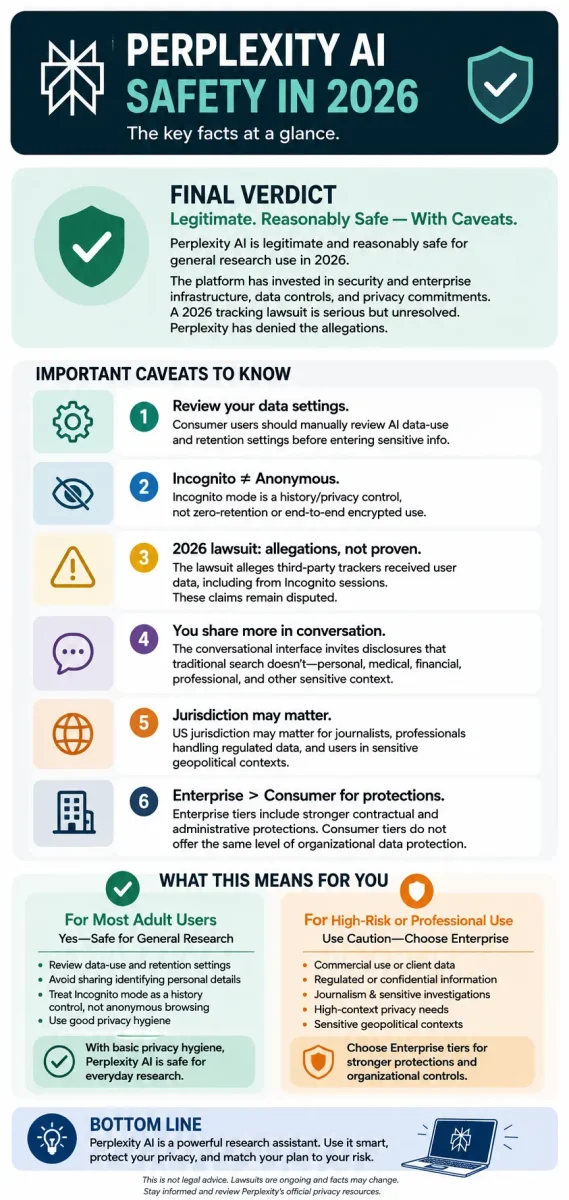
Perplexity AI is legitimate and reasonably safe for general research use, with meaningful caveats. The platform has invested in security and enterprise infrastructure, including SOC 2 Type II-related trust materials, enterprise data controls, and business-focused privacy commitments. The 2026 tracking lawsuit is serious but unresolved, and Perplexity has denied the allegations.
The honest qualifications are these:
- Consumer users should manually review AI data-use and retention settings before entering information they consider sensitive.
- Incognito mode is not anonymous. It is best understood as a history/privacy control, not as zero-retention or end-to-end encrypted use.
- The 2026 lawsuit alleges that third-party trackers received user data, including from Incognito sessions. Those claims remain disputed and should be treated as allegations, not proven findings.
- The conversational interface invites disclosures that traditional search does not. Users often share personal, medical, financial, and professional context that they would never type into a normal search box.
- US jurisdiction may matter for journalists, professionals handling regulated data, and users in sensitive geopolitical contexts.
- Enterprise tiers include stronger contractual and administrative protections. Consumer tiers do not offer the same level of organizational data protection.
For most adult users asking “is Perplexity AI safe,” the answer is yes for general research with basic privacy hygiene: review data-use settings, avoid identifying personal details in prompts, and treat Incognito mode as a history control rather than anonymous browsing. For commercial use, sensitive professional contexts, or users with high-context privacy needs, the answer is more cautious: use Enterprise tiers for organizational data, frame queries abstractly, and treat the platform as a research tool — not a confidential workspace.
For productivity use cases where Perplexity is one of several AI options, our roundup of AI tools for daily productivity covers complementary workflows.
Frequently Asked Questions
Is Perplexity AI legit or a scam?
Perplexity AI is legit. It is a real US-based AI company headquartered in San Francisco and one of the most visible AI search tools in 2026. The platform is not a scam. The realistic concerns about Perplexity are about data handling, privacy settings, the 2026 tracking lawsuit allegations, Incognito limitations, and the difference between consumer and enterprise data protections — not about whether the platform is fake or malicious.
Does Perplexity AI use my data for training?
Consumer users should assume they need to manually review Perplexity’s AI data-use or retention settings. Perplexity provides controls related to whether searches and responses may be used to improve its AI systems, while enterprise materials state that Enterprise Pro and Enterprise Max customer data is not used for training. Turning off a setting should not be assumed to retroactively remove data that has already been processed.
Is Perplexity AI Incognito mode private?
Incognito mode is more private than normal visible history, but it is not anonymous. It should be treated as a history-control feature, not as zero-retention, end-to-end encryption, or server-level anonymity. Independent privacy guides have reported that Incognito data may still be retained server-side for a limited period for safety purposes. The 2026 lawsuit also alleges that trackers operated even in Incognito sessions, though Perplexity denies the allegations.
What is the 2026 Perplexity lawsuit about?
A proposed US class-action complaint filed in 2026 alleges that Perplexity allowed Meta and Google tracking technologies to receive user information, including data connected to prompts and Incognito sessions. The complaint argues that users may share highly sensitive information with AI chatbots without realizing how that data can interact with analytics or advertising infrastructure. Perplexity has denied or disputed the allegations, and the claims should be treated as unresolved allegations rather than proven findings.
Is Perplexity AI safe for commercial or client work?
Consumer tiers are a poor fit for commercial work involving client data, intellectual property, trade secrets, or regulated information. Enterprise Pro and Enterprise Max offer stronger contractual and administrative protections, including enterprise data controls and no-training commitments in Perplexity’s enterprise materials. For client confidentiality, IP protection, or regulated data, Enterprise tiers are the safer starting point.
How does Perplexity AI compare to Google Search for privacy?
Both services collect data, but they encourage different user behavior. Traditional search usually invites short keyword queries, while AI answer engines invite full-context disclosures that can include personal, medical, financial, or professional details. For genuinely private search, privacy-focused alternatives such as DuckDuckGo, Brave Search, or Kagi may offer stronger privacy positioning, though with less AI-assisted synthesis than Perplexity.
Is Perplexity AI safe to use with a VPN?
A VPN can mask your IP address from Perplexity, but it does not stop account-based tracking, cookies, device fingerprinting, or information you voluntarily type into prompts. VPN use reduces one part of the tracking surface but does not make Perplexity anonymous. For genuinely anonymous research, combine privacy-focused search, a privacy-focused browser, careful prompt hygiene, and possibly Tor depending on your threat model.
What does Perplexity AI cost in 2026?
Perplexity’s 2026 pricing includes Free, Pro, Max, Education Pro, Enterprise Pro, and Enterprise Max tiers. Pro is commonly listed at $20/month, with a lower annual-billing equivalent. Max is commonly listed at $200/month. Enterprise Pro and Enterprise Max are listed at higher per-seat prices, with lower annual-billing equivalents. Pricing changes frequently, so check Perplexity’s official pricing page before purchasing.
Has Perplexity AI had a data breach?
As of May 2026, no widely reported public data breach has affected Perplexity AI specifically. The 2026 tracking lawsuit is a privacy allegation rather than a traditional breach allegation: the claim is about data allegedly being shared through tracking technologies, not about an unauthorized hacker breaking into Perplexity’s systems. Perplexity denies or disputes those allegations.
Privacy allegations and class-action filings have become a broader pattern across AI tool categories in 2025 and 2026 — see our Candy AI vs Janitor AI comparison for how similar concerns have shaped the AI companion category.
Is the Comet browser safer than using Perplexity.ai?
Not necessarily. The Comet browser, launched in 2025 and made broadly available for free in October 2025, is designed to provide AI assistance across the web. That means it can access more browsing context than standalone perplexity.ai use. For privacy-sensitive users, using Comet as a primary browser may expand Perplexity’s data surface compared with using the search engine through a separate browser.
About this review: Written by Daniel, applied AI specialist at AI Everyday Tools. This review is based on Perplexity AI’s official security, privacy, and enterprise documentation, current public reporting about the 2026 privacy lawsuit, independent privacy analyses, and current public information about AI search platform safety. Key platform details and pricing were checked in May 2026. AI platforms update their policies, pricing, and features frequently — confirm current details on the official Perplexity AI site before making decisions for sensitive or commercial use.