
Quick answer: Perchance AI is a real, functional, free browser-based AI tool — not a scam. Many Perchance generators run in your browser using community-built JavaScript, while AI features send anonymous requests to Perchance’s AI plugin servers. That means no sign-up is required for most features, and prompts are not tied to a central user profile in the way they are on many mainstream AI platforms. But Perchance also has weak content moderation, anonymous ownership, community-built generators that can embed unsafe behavior, ad-supported tracking on the page level, and commercial-use limitations that are easy to misunderstand. The safety answer depends heavily on what you generate, who you are, and what you mean by “safe.”
For casual creative use by adults, Perchance AI is reasonably safe — and meaningfully more private at the prompt-to-account level than many mainstream cloud AI tools. For commercial work, sensitive content, or use by minors, the picture is different. This review covers exactly where Perchance’s privacy advantages are real, where the safety trade-offs become serious, and how to use the platform without stepping into the trust gaps its design creates.
What Is Perchance AI?

Perchance is a browser-based platform that hosts community-built generators for AI text, AI images, AI chat, AI characters, stories, random prompts, and interactive tools. It originally became known as a flexible random-generator platform and later added AI plugins, turning it into a free, no-sign-up alternative to more polished AI services.
The operator’s public identity is not clearly disclosed, and Perchance uses a more indie-web style than corporate AI platforms such as Adobe, OpenAI, Canva, or Midjourney. The site’s legal and privacy pages describe the service as hosted in the United States and explain that users outside the U.S. may have their data transferred and processed there. That does not make Perchance unsafe, but it does mean users should understand that the platform is not backed by the same institutional surface as a large registered AI company.
What makes Perchance architecturally different is how generation works. Many non-AI generator mechanics run client-side in JavaScript inside your browser. AI features, however, still need model access, so AI plugin requests are routed through Perchance’s AI/plugin infrastructure. The important privacy distinction is that the operator has publicly stated these AI plugin requests are not associated with user accounts, even when a user is logged in. That design creates real privacy advantages — but it is not the same as full local AI generation or a zero-knowledge system.
The main AI surfaces on the platform include text-to-image generation, AI chat, character generators, story generators, and a growing collection of community-built variations. Most are accessible through direct URLs without registration. The platform has no standard subscription tier like Midjourney or Leonardo AI. It is free and ad-supported, which is unusual in the 2026 AI landscape but also explains some of the privacy trade-offs discussed below.
Perchance AI Safety Snapshot
| Category | Verdict | What to Know |
|---|---|---|
| Legitimacy | Real, not a scam | Long-running browser platform with active public use, but operator identity is not clearly public |
| Adult use | Reasonably safe | Good for casual creative use if you avoid personal data and illegal content |
| Kids/teens | Risky | NSFW filters can be disabled easily; no meaningful age verification |
| Privacy | Better than average in some ways | No mandatory account and anonymous AI plugin requests, but ads, cookies, and page-level tracking still exist |
| Commercial use | Allowed, but not enterprise-clean | Perchance claims no rights in your output, but it does not provide licensed-training-data guarantees or commercial indemnity |
| Content moderation | Weak compared with corporate tools | More permissive filters, community-built pages, and user-toggleable safety settings |
| Best for | Casual creative exploration | Useful for ideation, character concepts, RPG prompts, and low-stakes creative experiments |
Is Perchance AI Safe? Quick Verdict by User Type
Safety questions about Perchance need to be answered by use case. A generic “yes” or “no” answer usually hides the real trade-off: Perchance is unusually private in some ways and unusually permissive in others.
| User Type | Safety Verdict | Best Recommendation |
|---|---|---|
| Adult casual users | Reasonably safe | Good for low-stakes creative use, brainstorming, RPGs, and personal experimentation |
| Privacy-sensitive users | Better than average, not anonymous | Avoid personal data in prompts and use browser-level privacy protections |
| Minors | Not recommended unsupervised | Block or supervise because adult filters can be bypassed easily |
| Commercial users | Use cautiously | Use for ideation, then move production assets to a tool with cleaner licensing |
| NSFW users | Permissive but legally risky | Never generate real people, minors, non-consensual sexual content, or illegal material |
For adults using it casually
Reasonably safe and notably private in specific ways. If you are an adult using Perchance for creative experimentation, RPG-style storytelling, brainstorming visuals, or low-stakes character generation, the platform is one of the more privacy-friendly free AI tools available. There is no account requirement for most AI features, and AI plugin requests are described by the operator as not being tied to user accounts. That is a meaningful advantage over AI tools where prompts, billing data, account history, and generated outputs are all connected to a central user profile.
For minors and teenagers
Risky. Perchance does not require meaningful age verification beyond a simple over-18 confirmation for disabling safety filters. Community-built generators can include adult-themed content, and direct generator URLs can be shared easily through Discord, school chats, Reddit, or social platforms. The same lack of central account control that makes the platform private for adults makes it difficult to monitor for minors.
Parents should treat Perchance the same way they would treat an open browser-based AI image or AI chat platform: not automatically malicious, but not appropriate for unsupervised use by younger users.
For commercial and professional use
Allowed, but not enterprise-clean. Perchance’s terms are permissive in the sense that the platform says it claims no rights in the output you generate. That is different from saying the platform is commercially risk-free. The bigger issue is that Perchance does not provide the same commercial provenance, licensed-training-data assurance, enterprise documentation, or indemnity-style protection that tools like Adobe Firefly are designed around.
For client deliverables, brand assets, product packaging, ads, or any situation where someone may ask you to certify training-data legitimacy, Perchance is better treated as an ideation tool than a final production tool. Use it to explore ideas, then recreate or refine the asset in a tool with cleaner commercial documentation.
Privacy and Data — Where Perchance Genuinely Outperforms
This is where Perchance’s reputation as a more private AI tool partly holds up — but with caveats most quick reviews skip. Perchance is not private in every possible sense. It is specifically stronger at reducing prompt-to-account linkage, while still operating as an ad-supported website with server requests, cookies, and third-party advertising infrastructure.
What Perchance does well on privacy
- No mandatory account for most AI features. Many generators, including text-to-image and AI chat tools, can be used without sign-up. That means no email collection, no password reset surface, no payment profile, and no obvious account-level prompt history for casual use.
- Anonymous AI plugin requests according to the operator. The platform operator has publicly stated that AI plugin requests are not associated with user accounts, even for logged-in users. The account-linked data is mainly the generators a user builds, not every AI prompt they send through the tools.
- Client-side behavior for many generator mechanics. Perchance’s non-AI generator logic often runs in JavaScript in the browser. That is meaningfully different from tools where every interaction is tightly routed through a logged account system.
- Less profile-level data than paid AI platforms. Without a required account, payment method, subscription, and saved prompt history, there is less user-profile data to connect together than on many mainstream AI services.
Where Perchance’s privacy story has limits
- AI prompts still pass through AI/plugin infrastructure. Perchance’s AI features are not the same as running Stable Diffusion locally on your own machine. Even if requests are not tied to your account, prompts still have to be sent somewhere for AI generation to happen. Do not put personal, confidential, or identifying details into prompts.
- The page itself is ad-supported. Perchance’s privacy advantage is strongest at the prompt-to-account level, not at the page-tracking level. The privacy policy and site behavior still allow cookies, analytics, ad partners, and personalized advertising infrastructure. Users should not confuse anonymous AI plugin requests with full browsing anonymity.
- Aggregate safety statistics may be collected. The operator has publicly discussed aggregate management-server statistics used to monitor broad categories of AI generations, such as whether safety classification systems are working. That is not the same as attaching prompts to your identity, but it does mean Perchance is not a zero-knowledge system.
- Community generators can add their own risks. Because anyone can build a Perchance generator using JavaScript, a malicious or careless generator author can include code that captures inputs, logs prompts somewhere else, or embeds external tracking. This is not unique to Perchance, but the platform’s flexibility makes it a real consideration.
- Anonymous ownership reduces accountability. The operator’s public identity is not clearly disclosed, and the platform operates more like a smaller-scale, independently-run service than a corporate SaaS company. That is not illegal, and it does not make the tool a scam. But if something goes wrong, there is less institutional surface to engage with than at a large registered AI company.
- No published independent security audit. Perchance has not published SOC 2, ISO 27001, or similar third-party security audit documentation. Many consumer AI tools are in the same position, but it matters for privacy-sensitive or professional use cases.
Realistic privacy advice for Perchance
Treat Perchance the way the architecture actually works: your prompts are not tied to a standard account profile in the same way they are on many mainstream AI tools, but they are not invisible either. Do not paste personal identifying details into prompts. Do not run unfamiliar community generators with sensitive inputs. Use a privacy-respecting browser if tracking matters to you. For most adult creative use, Perchance’s privacy baseline is genuinely better than many mainstream alternatives — but it is not a zero-knowledge system and should not be treated like one.
Perchance’s privacy policy describes data collection and ad-supported behavior.
Content Moderation — The Honest Picture
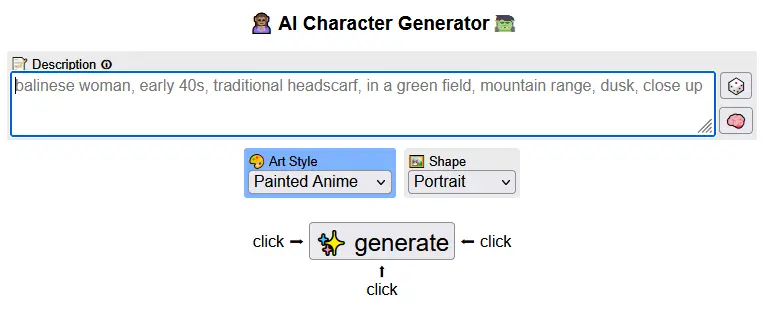
Perchance’s content moderation is where the platform’s design is most often misunderstood. The platform does have moderation and rules, but it does not behave like a heavily locked-down corporate AI tool.
How Perchance moderates content
Mainstream AI tools usually moderate at the prompt level. Your input is screened before generation runs, and many prompts are rejected outright. Perchance is more permissive. It relies more on page-level warnings, generator labeling, user safety settings, and terms-based restrictions than on the same level of strict prompt blocking you see in tools like DALL-E, Midjourney, or Adobe Firefly.
The image generator includes user-toggleable safety filters. By default, safety settings may be on, but users can disable them with an over-18 confirmation for limited periods or longer. Once disabled, Perchance can allow a much wider range of content than mainstream AI image generators.
What this means in practice
Multiple third-party reviews and user discussions describe Perchance as permissive, NSFW-friendly, or relatively unrestricted compared with mainstream image tools. That description is broadly fair — with important limits. Perchance’s terms still prohibit illegal content, and the law applies regardless of whether a generator blocks a prompt.
Users should never generate child sexual abuse material, sexualized images of minors, non-consensual intimate imagery, defamatory depictions of real people, harassment content, or material that violates local law. A weak filter is not permission. If a platform does not stop you from generating something illegal or abusive, the responsibility shifts more directly onto you.
Practically, this makes Perchance more permissive than DALL-E, Midjourney, Adobe Firefly, and many corporate AI tools. Whether that makes it “safer” or “less safe” depends entirely on your use case. For adults doing private creative exploration, permissiveness can be a feature. For minors, schools, professional teams, or brand-safe workflows, it is a risk.
Is Perchance AI Safe for Kids and Teens?
This question deserves a direct answer because Perchance is easy to access, free, and often discovered through shared generator links.
Perchance is not designed as a child-safe AI platform and is not appropriate for unsupervised use by anyone under 18. The platform’s NSFW filters can be disabled with a simple age-confirmation checkbox. Community generators can include adult-themed content. There is no built-in parental control mode, and there is no meaningful age verification system comparable to what parents might expect from a dedicated child-safe app.
For older teens, the conversation is more nuanced. Perchance can be genuinely useful for tabletop RPG generation, creative writing, character concepts, and casual art. The realistic risk is not that Perchance is uniquely dangerous, but that it has much weaker friction against adult content than most mainstream AI tools. Parents who would block PolyBuzz, Poly AI, or Janitor AI for similar reasons should consider Perchance part of the same broader AI-content safety category.
Practical parental controls for Perchance
- Network-level DNS filtering. Block
perchance.orgat the router using a DNS filter such as NextDNS, CleanBrowsing, or a router-level parental-control feature. This catches the platform across devices on the same network. - Device-level controls. iOS Screen Time, Google Family Link, and Windows Family Safety can block individual domains. Perchance does not require a dedicated app, so domain-level blocking is usually the simplest control.
- Watch for shared generator links. Perchance generators are URLs that can be shared without login. Teens may discover them through Discord servers, Reddit, school chats, or social platforms.
- Talk about AI content directly. AI image and AI chat tools are now part of general internet safety. The goal is not only blocking one site, but helping teens understand what kinds of AI content are unsafe, manipulative, illegal, or inappropriate.
Commercial Use and Licensing — Allowed, But Not Enterprise-Clean
This is where adults using Perchance for client work, social media monetization, or commercial deliverables need a careful answer. The risk is not that Perchance clearly forbids commercial use. The risk is that Perchance does not provide the same commercial certainty as tools built specifically for business use.
What Perchance says about output ownership
Perchance’s terms state that the platform claims no rights in the output you generate. In plain English, Perchance is not trying to own the images or text you create with its tools. That is a permissive starting point and makes Perchance more flexible than many users might assume.
Perchance’s terms of service state that the platform claims no rights in the output you generate.
Where the commercial-use risk remains
The uncertainty comes from what Perchance does not provide. It does not give the same kind of licensed-training-data commitment, provenance documentation, enterprise audit trail, or commercial indemnity that a brand, agency, or corporate legal team may want.
- Community generator licensing. When you use a community-built generator, you may be using someone else’s prompt scaffolding, settings, code, or embedded assumptions. The generator page may not clearly explain whether the author expects attribution or imposes additional conditions.
- Training-data provenance. Perchance AI image tools may rely on model ecosystems related to Stable Diffusion or similar open model infrastructure. The broader AI training-data legal landscape remains unsettled, and Perchance does not offer the licensed-content positioning that Adobe Firefly is built around.
- No commercial-use certification. If a client asks you to certify that an asset was generated using a tool with clean commercial documentation, Perchance does not give you the strongest answer. It may be fine for personal projects, but it is not ideal for high-stakes commercial deliverables.
Practical advice for commercial users
Use Perchance for ideation, moodboarding, rough concept exploration, character prompts, and low-stakes creative drafts. For client work, brand campaigns, paid products, ad creatives, or anything where legal certainty matters, recreate or finalize the asset in a tool with stronger commercial documentation, such as Adobe Firefly or a paid production-focused AI platform. Treat Perchance as a sketch tool, not a final asset pipeline, and the commercial risk becomes much easier to manage.
Perchance AI vs Other AI Image Generators — Honest Comparison
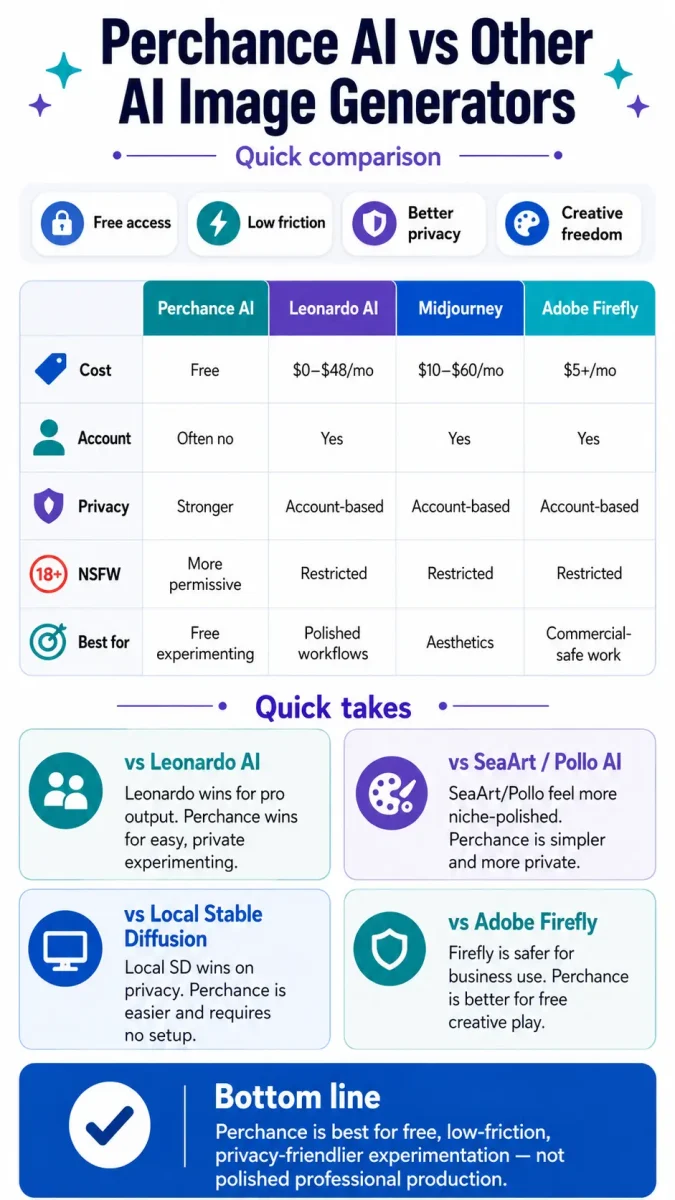
Perchance occupies a different position from mainstream AI image generators. It is not the most polished tool, and it is not the strongest commercial option. Its appeal is free access, low friction, permissive generation, and better prompt-to-account privacy.
| Feature | Perchance AI | Leonardo AI | Midjourney | Adobe Firefly |
|---|---|---|---|---|
| Cost | Free, ad-supported | $0–$48/month | $10–$60/month | $5+/month (Adobe plan) |
| Account Required | No for many features | Yes | Yes | Yes |
| Prompt-to-account privacy | Strong by default | Account-based | Account-based | Account-based |
| Ad/page tracking | Yes, ad-supported | Less central to model | Less central to model | Less central to model |
| NSFW flexibility | Permissive | Restricted | Restricted | Restricted |
| Commercial defensibility | Allowed, but not enterprise-clean | Better on paid tiers | Clearer for paid users | Strongest for licensed-content positioning |
| Output quality | Variable | High | Very polished | High, brand-safe |
| Best for | Casual, anonymous, free experimentation | Creators who want polished workflows | High-end aesthetics | Commercial-safe creative work |
Perchance AI vs Leonardo AI
Leonardo AI is the better choice if you need professional output, a polished interface, organized projects, and clearer paid-tier commercial terms. Perchance wins on low-friction access, no mandatory account for many features, and creative freedom for personal work. They are not truly competing for the same use case: Leonardo is closer to a production tool, while Perchance is better understood as a privacy-friendly creative playground with production limitations.
Perchance AI vs SeaArt and Pollo AI
SeaArt and Pollo AI are closer comparisons because they also sit in the community-driven, creative AI tool category. SeaArt has a stronger anime-style focus and a more polished visual interface. Pollo AI is more video-focused. Perchance’s advantage is lower friction and stronger prompt-to-account privacy, while its disadvantages are weaker polish, murkier community-generator structure, and fewer professional workflow features.
Perchance AI vs running Stable Diffusion locally
Running Stable Diffusion locally on your own hardware is still the strongest option for AI image privacy. Nothing leaves your device, no platform sees your prompts, and no account is involved. The trade-off is technical difficulty: you need suitable hardware, you maintain the install yourself, and you manage models and updates manually. For technical users, local generation wins on privacy. For everyone else, Perchance is a reasonable middle ground that requires no setup and offers better privacy than many account-based cloud tools.
Perchance AI vs Adobe Firefly
Perchance and Adobe Firefly sit at opposite ends of the spectrum. Adobe Firefly is designed for commercial defensibility, brand-safe workflows, and licensed-content positioning. Perchance is designed around free access, community generators, and creative flexibility. If you are creating business assets where training-data provenance matters, Firefly is the safer choice. If you want free, low-friction creative exploration without building a user profile, Perchance is more attractive.
How to Use Perchance AI More Safely
If Perchance fits your use case, these are the practical safer-use practices that matter most.
- Do not enter personal identifying details into prompts. Perchance’s privacy advantages matter most when your prompts do not identify you. Avoid real names, addresses, employer details, private documents, medical details, financial information, or anything that would be sensitive if logged or exposed.
- Be cautious with unfamiliar community generators. Generators built by other users can include JavaScript. Stick to well-known generators, avoid entering sensitive data, or review the generator code through the edit view before trusting it with anything private.
- Do not generate identifiable real people in harmful contexts. Perchance may not block prompts that other tools reject. That does not make those prompts legally or ethically safe. Avoid defamatory, sexualized, deceptive, or non-consensual depictions of real people.
- Treat Perchance outputs as sketches, not final production assets. For personal use, rough ideation, or casual sharing, the licensing risk is usually manageable. For client deliverables or commercial assets, move the final work to a tool with cleaner commercial documentation.
- Use a privacy-respecting browser. Firefox with sensible privacy settings, Brave, or a reputable tracker-blocking extension can reduce some ad-network and cookie exposure. Perchance’s privacy advantages are stronger when paired with browser-level privacy controls.
- Save important outputs locally. Perchance outputs and generator states may depend on browser behavior and page availability. Download anything you actually need to keep.
- Do not rely on Perchance for time-sensitive work. The platform is free, ad-supported, and run more like an indie web project than an enterprise service. There are no enterprise SLAs. Have a backup tool for important work.
- Block perchance.org at the network level if minors use the network. The simple NSFW age confirmation means default filters are not enough for younger users.
Final Verdict — Is Perchance AI Safe in 2026?
Perchance AI is a real, functional, free AI tool with an unusual privacy architecture for a consumer platform. The combination of no-account-required access for many features, anonymous AI plugin requests according to the operator, and client-side behavior for many generator mechanics gives Perchance a stronger prompt-to-account privacy posture than many mainstream AI tools.
The honest qualifications are these:
- Perchance is private in some ways, but not anonymous in every way. AI requests still pass through servers, and the site is ad-supported with cookies, analytics, and advertising infrastructure.
- Content moderation is weaker and more permissive than mainstream AI tools. That gives adults more creative freedom, but it also creates real risks around minors, NSFW content, and illegal or abusive generations.
- Commercial use is allowed in a broad sense, but not enterprise-clean. Perchance does not provide the same provenance documentation, licensed-training-data assurance, or commercial protection that tools like Adobe Firefly are designed to offer.
- Anonymous ownership reduces accountability. Nothing about that makes Perchance a scam, but it does mean users have less institutional recourse than with large AI companies.
- The platform is not appropriate for unsupervised use by minors. NSFW filters can be disabled easily, and there is no meaningful age verification.
For most adults asking “is Perchance AI safe,” the answer is yes for casual creative use — with better privacy than many users expect from a free AI tool. For commercial work, sensitive subjects, identifiable real people, or use by minors, the answer is more cautious: use Perchance narrowly, avoid personal data, and switch to a more controlled tool when the stakes are higher.
Frequently Asked Questions
Is Perchance AI legit or a scam?
Perchance is a legitimate, real platform. It is not a scam. The realistic concerns about Perchance are not that the site is fake, but that it has anonymous ownership, permissive content settings, ad-supported tracking, community-built generators, and weaker commercial documentation than enterprise AI tools. For casual adult creative use, it is generally reasonable to use. For sensitive or commercial work, use more caution.
Does Perchance AI store my prompts?
According to the platform operator’s public statements, AI plugin requests are not associated with Perchance user accounts, even when users are logged in. That is a meaningful privacy advantage. However, AI prompts still pass through AI/plugin servers and should not contain personal, confidential, or identifying information. Perchance is more private than many account-based AI tools, but it is not the same as running AI fully locally on your own device.
Can I use Perchance AI commercially?
Perchance says it claims no rights in the output you generate, so commercial use is not broadly forbidden by the platform itself. The limitation is that Perchance does not provide the same commercial provenance, licensed-training-data assurance, or enterprise documentation that tools like Adobe Firefly are designed to offer. Use Perchance for ideation and low-stakes creative work, then use a cleaner commercial tool for final client or brand assets.
Is Perchance AI safe for kids?
No, not for unsupervised use. Perchance’s NSFW filters can be disabled with a simple age-confirmation checkbox, community generators can include adult-themed content, and there is no parental control mode built into the platform. For children and younger teens, block perchance.org at the network or device level. For older teens, treat Perchance as part of the broader AI image and AI chat safety conversation.
Why is Perchance AI free?
Perchance is free because it is ad-supported. That is the trade-off behind the no-subscription, no-required-login model. The privacy upside is that many features do not require an account or payment profile. The privacy downside is that ads, cookies, analytics, and advertising partners may still operate at the page level. Users who care about tracking should use a privacy-focused browser and tracker-blocking tools.
Can community generators on Perchance access my data?
Potentially yes. Because anyone can build a Perchance generator using JavaScript, a malicious or careless generator author could include code that captures inputs, logs prompts elsewhere, or embeds external tracking. This does not mean every community generator is unsafe, but you should avoid entering sensitive information into unfamiliar generators. Use well-known generators or check the edit view before trusting a generator with anything private.
Does Perchance AI allow NSFW content?
Yes, Perchance is more permissive than many mainstream AI image tools. Its image generator includes user-toggleable safety filters that can be disabled with an over-18 confirmation. That does not make every generation legal or safe. Illegal content categories such as child sexual abuse material, sexualized minors, non-consensual intimate imagery, and abusive depictions of real people remain illegal or harmful regardless of the tool’s filters.
How does Perchance AI compare to Leonardo or Midjourney for safety?
Perchance has stronger prompt-to-account privacy because many features do not require an account and AI plugin requests are described as not tied to user profiles. Leonardo and Midjourney have stronger polished workflows, clearer paid-tier commercial terms, and more institutional accountability. Perchance is better for private, casual experimentation. Paid tools like Leonardo or Midjourney are better for professional production workflows.
Has Perchance AI been hacked or breached?
No major public data breach involving Perchance AI prompts has been widely reported as of May 2026. The platform’s minimal account requirements mean there is less user-profile data to leak than at many subscription AI tools. However, Perchance has not published independent security audit reports, and users should still avoid entering sensitive or identifying data into prompts.
Who owns Perchance AI?
The Perchance operator’s public identity is not clearly disclosed. The platform is run more like an indie web project than a large corporate AI product. This is not automatically unsafe and does not mean Perchance is a scam. The trade-off is accountability: there is less corporate surface to engage with if something goes wrong, which matters more for commercial or sensitive use than for casual creative experimentation.
About this review: Written by Daniel, applied AI specialist at AI Everyday Tools. This review was based on Perchance’s official Terms of Service, Privacy Policy, generator pages, public operator statements on Perchance-related forum/community discussions, third-party site reputation signals, and current public information about AI image-generator privacy, commercial licensing, and content moderation. Key platform details were checked in May 2026. Perchance can update its policies and generator behavior at any time, so confirm current details on the official site before using it for sensitive, commercial, or child-safety-related decisions.