
Quick answer: Talkie AI is a real, functional AI character chatbot — not a scam. It is published by SUBSUP PTE. LTD., a Singapore-based company, while public reporting has linked the product to MiniMax, a Shanghai-based AI company. Compared with adult-focused AI companion apps, Talkie has stricter safety rails: its community rules prohibit explicit sexual content, sexualized minors, harassment, graphic violence, and other restricted material.
But “SFW by design” does not mean “private” or “safe for kids by default.” Talkie’s privacy policy says the platform may collect account data, birthdate, profile details, voice and text messages, interests, usage data, device information, IP address, and general location data. The app also includes in-app purchases and loot-box-style mechanics, which matter when younger users are involved.
For adults using Talkie AI casually, the platform is reasonably safe with important privacy and spending trade-offs. For minors and teenagers, the answer is more cautious: Talkie should not be treated as safe for unsupervised use just because it blocks explicit NSFW content. This review explains where Talkie’s safety story holds up, where the real risks sit, and how to use it more safely.


What Is Talkie AI?

Talkie AI is a character-based AI chatbot platform where users can create, customize, discover, and chat with AI characters. The platform supports text-based roleplay, character creation, voice-style interactions, image-based features, and a card-like character discovery system.
Talkie is available through its website and mobile apps. On Apple’s App Store, the current app listing appears as Talkie Lab – AI Playground, with SUBSUP PTE. LTD. listed as the developer. Apple lists Talkie Lab as 18+ in the US App Store and as including in-app purchases. Some regional App Store listings also include messaging/chat and loot-box-related disclosures. These details are important because they show that Talkie is not just a simple chatbot — it is also an entertainment platform with engagement and monetization mechanics.
Talkie’s biggest difference from many AI companion platforms is its stronger safe-for-work positioning. Unlike Candy AI, which is built around adult AI companionship, or Janitor AI, which is often used with external models for less restricted roleplay, Talkie’s official community rules prohibit pornographic content, explicit sexual material, sexualized depictions of minors, graphic violence, and other restricted content. That makes Talkie meaningfully different from many companion apps — but it does not remove every safety concern.
Talkie AI Safety Snapshot
| Category | Verdict | What to Know |
|---|---|---|
| Legitimacy | Real, not a scam | Published by SUBSUP PTE. LTD.; publicly linked to MiniMax in reporting |
| Adult use | Reasonably safe | Good for casual SFW roleplay if users understand privacy and spending trade-offs |
| Kids and teens | Not safe unsupervised | SFW filters do not equal child-safe design; user-generated characters and chat risks remain |
| Privacy | Meaningful concerns | Collects account, profile, usage, device, location, and message-related data |
| NSFW content | Restricted | Official rules prohibit explicit sexual content and sexualized minor content |
| Monetization | Watch closely | In-app purchases, gems, passes, subscriptions, and loot-box-style mechanics may encourage spending |
| Best for | Casual adult SFW roleplay | Not ideal for strong privacy, unrestricted roleplay, or unsupervised minors |
Is Talkie AI Safe? Quick Verdict by User Type
Talkie AI is not equally safe for every user. The answer depends on age, privacy expectations, spending habits, and why someone wants to use an AI companion in the first place.
| User Type | Safety Verdict | Best Recommendation |
|---|---|---|
| Adult casual users | Reasonably safe | Use for SFW character chat, but avoid sharing personal details |
| Privacy-sensitive users | Use with caution | Avoid voice features and do not treat chats as private therapy or journaling |
| Minors and teenagers | Not safe unsupervised | Parents should use app-store controls, network filters, and direct conversation |
| Users seeking NSFW roleplay | Wrong platform | Talkie’s rules and filters are designed to restrict explicit content |
| Users prone to compulsive spending | Use with caution | Set hard limits before using gems, cards, passes, or subscriptions |
| Mental-health-vulnerable users | Use carefully | Do not use AI companions as a substitute for professional support |
For adults using Talkie casually
Talkie AI is reasonably safe for adults who want casual SFW roleplay, character conversations, creative storytelling, or light entertainment. Its content moderation is stricter than many AI companion platforms, and that can be a benefit if you do not want conversations drifting into explicit territory.
The main trade-offs are privacy and engagement design. Talkie is still a consumer AI app that processes user conversations on its servers, collects usage and device data, and monetizes through subscriptions and in-app purchases. Adults can use it safely if they treat it as entertainment rather than a private diary, therapy tool, or confidential messaging platform.
For minors and teenagers
Talkie AI should not be treated as safe for unsupervised minors. The common assumption is that a SFW chatbot is automatically child-safe. That assumption is too simple. Talkie may restrict explicit NSFW content, but the platform still includes AI companionship, user-generated characters, emotionally engaging conversations, in-app purchases, and data collection from users.
Parent-safety resources have raised concerns that Talkie can still expose younger users to age-inappropriate themes, especially because users can create and interact with a wide range of AI characters. Online safety authorities also warn that AI chatbots can produce inaccurate, harmful, or emotionally intense responses. For parents, the safest view is this: Talkie may be more moderated than some competitors, but it is not a child-safety product. Our review of PolyBuzz AI covers the same parental concerns from a different angle and offers additional context for families evaluating AI companion apps.
For privacy-sensitive users
Privacy-sensitive users should approach Talkie AI cautiously. Talkie’s privacy policy says it may collect account information, profile details, birthdate, messages and content, interests, usage information, device and network data, IP address, and general location. The policy also says advertising partners may receive certain website or app interaction data for interest-based advertising, although Talkie says it does not share the contents of user messages with advertising partners.
That distinction matters. Talkie is not necessarily selling your private chats to advertisers, but it is also not a private, end-to-end encrypted messaging app. If you would not want a conversation stored, processed, reviewed, or associated with your account activity, do not put that information into Talkie.
Who Actually Runs Talkie AI?
Understanding who runs Talkie AI matters because company structure affects privacy rights, data processing, legal jurisdiction, and accountability.
SUBSUP PTE. LTD. — the listed publisher
Talkie’s official privacy policy identifies SUBSUP PTE. LTD. as the company operating the Talkie mobile and web applications. Apple’s App Store listing also identifies SUBSUP PTE. LTD. as the developer of Talkie Lab. SUBSUP is based in Singapore, which means Talkie’s legal and privacy framework is not the same as a US-only or EU-only consumer app.
For users, this does not automatically make Talkie unsafe. But it does mean privacy-sensitive users should understand that Talkie operates under a different jurisdictional setup than US-based platforms like Character.AI or some other chatbot services.
MiniMax — the broader corporate context
Public reporting — including coverage by The Information and Reuters — has linked Talkie to MiniMax, a Shanghai-based AI company. A careful way to phrase this is that Talkie is published by SUBSUP PTE. LTD., while industry reporting has described the product as connected to or developed by MiniMax. Unless Talkie publishes a clearer ownership chart, users should avoid overclaiming the exact legal parent structure.
The practical point is simple: Talkie appears to sit in a Singapore-China corporate context, not a simple single-country setup. For most casual users, that may not matter much. For users concerned about cross-border data flows, government access requests, or enterprise-grade privacy guarantees, it matters more.
Privacy and Data Collection — What Talkie Actually Collects
Talkie AI’s privacy story is more complicated than its SFW branding suggests. The platform may restrict explicit content, but it still collects a meaningful amount of user data. Talkie’s official privacy policy is the authoritative source for current data practices, and users should review it directly before signing up.
What Talkie may collect
- Account information: such as email address, username, password-related information, and account details.
- Profile information: such as birthdate, gender-related fields, pronouns, work status, interests, and other profile details users provide.
- Messages and content: including text interactions, voice-related messages, uploaded content, generated content, and other material shared with the service.
- Usage data: such as characters used, interactions, session behavior, purchases, and feature activity.
- Device and network data: including IP address, browser type, device identifiers, operating system, cookies, and similar technical signals.
- Location information: generally inferred from device or network data, such as approximate location from IP address.
- Advertising-related data: Talkie says advertising companies may receive information such as links clicked, pages visited, IP address, advertising ID, and browser type for interest-based advertising and marketing purposes.
The most important practical takeaway is that Talkie can build a fairly detailed profile of an active user: what they like, what characters they interact with, how often they return, what topics they discuss, what device they use, and how they respond to engagement mechanics.
Are Talkie AI conversations private?
Talkie conversations should not be treated as private in the same way as encrypted messaging. The platform needs to process user inputs to generate AI responses, and its privacy policy includes messages and content among the types of information it may collect or process.
That does not mean every employee is reading every chat, and it does not mean Talkie shares message content with advertising partners. But users should assume that conversations are server-processed, account-associated, and potentially retained according to Talkie’s policies. For sensitive topics, that is enough reason to be cautious.
What about voice features?
Voice features deserve extra caution. Talkie’s privacy policy includes voice-related messages and content within the data it may process. Voice data can be more sensitive than ordinary text because it may reveal age, accent, identity signals, emotion, and other biometric-like characteristics.
If voice privacy matters to you, the safest choice is simple: use text chat only. Do not use voice features for sensitive conversations, and do not assume voice interactions are processed only on your device unless Talkie explicitly states that in current documentation.
Is Talkie AI Safe for Kids and Teens?
No — not for unsupervised use. Talkie AI may be safer than explicit adult companion apps, but that does not make it a child-safe platform.
There are four separate issues parents should understand: content exposure, emotional attachment, data collection, and spending mechanics.
1. SFW filters are not the same as child safety
Talkie’s official rules prohibit explicit sexual content and sexualized content involving minors. That is important and better than platforms that openly allow adult roleplay. However, child safety is broader than explicit NSFW blocking.
AI characters can still produce emotionally intense, confusing, manipulative, romantic, or age-inappropriate interactions without becoming explicitly pornographic. Because Talkie includes user-created characters and AI-generated conversations, parents should not assume every interaction will be age-appropriate.
2. AI companions can feel emotionally real
AI companion apps are designed to feel responsive, personal, and emotionally available. That is part of their appeal. But for children and vulnerable teenagers, it can also create unhealthy attachment patterns. The broader AI companion category has faced serious legal and regulatory scrutiny after lawsuits involving Character.AI and alleged harm to minors.
Most notably, Character.AI and Google agreed in January 2026 to settle multiple lawsuits brought by families in Florida, Colorado, New York, and Texas alleging chatbot-related harm to minors, including the Megan Garcia case tied to her son’s suicide.
Talkie itself has not been the same central public target as Character.AI in those lawsuits, but it belongs to the same broad category of character-based AI companion apps. Parents should treat that category risk seriously, not only the individual app’s branding. For a parental view of similar concerns in adjacent platforms, see our reviews of PolyBuzz AI and Poly AI.
3. Data collection matters more when minors are involved
Talkie may collect birthdate, profile details, messages, usage behavior, device data, and general location. For adults, that is a privacy trade-off. For minors, it is more sensitive because children and teenagers are less able to understand long-term data consequences.
Parents should assume that if a child uses Talkie, the platform may process both technical data and conversation-related data. That is reason enough not to allow unsupervised use.
4. In-app purchases and loot-box-style mechanics can encourage spending
Talkie’s app-store listings include in-app purchases, subscriptions, gems, passes, and loot-box-style mechanics. These systems can encourage repeated engagement and spending through scarcity, collection, rewards, and character unlocks.
For adults, this may simply be entertainment. For children and teenagers, it is a parental-control issue. Any app that combines emotionally engaging AI characters with purchasable items and loot-box-style mechanics deserves closer supervision.
Practical parental controls for Talkie AI
- Use app-store restrictions. Block app downloads or purchases through iOS Screen Time or Google Family Link.
- Disable in-app purchases. This matters because Talkie includes gems, passes, and subscription-style purchases.
- Block the website if needed. Parents can block talkie-ai.com through router-level controls, DNS filtering, or parental-control apps.
- Check for name variations. On Apple, the app may appear as Talkie Lab rather than only Talkie AI.
- Talk directly with teenagers. AI companions should be part of the same online-safety conversation as social media, private messaging, and gaming communities.
Does Talkie AI Allow NSFW Content?
No. Talkie AI is not designed as an explicit NSFW chatbot. Its community guidelines prohibit pornographic content, sexually explicit material, sexualized content involving minors, graphic violence, harassment, and other harmful categories.
In practice, users often report that Talkie’s filters interrupt conversations when they drift into restricted sexual or mature territory. That can be frustrating for users who want unrestricted roleplay, but it is a core part of Talkie’s positioning.
This is one of the clearest differences between Talkie and platforms like Candy AI or Janitor AI. Candy AI is built around adult AI companionship. Janitor AI is frequently used with external models for more flexible roleplay. Talkie is more aligned with SFW character interaction, even if some user-created scenarios may still feel romantic, suggestive, or emotionally intense.
For broader context on how different AI platforms handle NSFW boundaries — from strict moderation to user-toggleable filters — see our Perchance AI safety review, which covers an adjacent platform with a very different content approach.
Why Did Talkie AI Disappear from the App Store?
Talkie’s app-store history is one of the more unusual details around the platform. Public reporting and parent-safety coverage indicate that Talkie became unavailable on Apple’s App Store in late 2024 and later returned under the name Talkie Lab in 2025. The current Talkie Lab listing on the App Store still shows SUBSUP PTE. LTD. as the developer.
The exact reason for the removal, rebrand, and return has not been clearly explained in a detailed public statement from Talkie. At the time, some reporting referenced unspecified technical reasons, while parent-safety commentators connected the timing to broader scrutiny around AI companion apps and youth safety.
Users should not automatically assume the worst. App removals can happen for many reasons, including compliance, policy, technical, or review-process issues. But the lack of a clear explanation is relevant context for a safety review. A platform that collects sensitive user data and targets emotionally engaging AI interactions benefits from transparency, especially when its app-store presence changes.
The Card and Gacha System — Why Engagement Mechanics Matter
Talkie is not just a chatbot interface. It also uses character cards, unlocks, gems, passes, in-app purchases, and app-store-labeled loot-box-style mechanics. This matters because the safety of an AI companion is not only about what it says. It is also about how the app keeps users coming back.
Gacha and loot-box-style systems use randomness and collection psychology. Users may be encouraged to unlock rarer characters, collect specific variants, purchase gems, or return during limited events. These mechanics are common in mobile entertainment, but they become more sensitive when attached to AI companions that can feel personal or emotionally responsive.
For adults, the practical advice is to set a hard monthly spending limit before using Talkie’s paid features. For parents, the practical advice is stricter: disable in-app purchases for children and do not assume a SFW chatbot is harmless if it still includes monetized reward mechanics.
The Memory Problem — What Users Should Expect
One common complaint about AI character apps is memory. Characters may forget earlier parts of a conversation, lose continuity, repeat themselves, or fail to remember details that matter to a long-form roleplay.
This is not unique to Talkie. It reflects the technical limits of AI chat systems. Large language models work with limited context windows, and platforms decide how much previous conversation history to keep active, summarize, retrieve, or ignore.
The same memory limitations show up across the AI companion category — our guide on why Character.AI keeps repeating words explains the underlying mechanics and practical workarounds that also apply to Talkie.
Talkie markets evolving character experiences and extended-memory-style features, especially around more advanced or paid experiences. However, users should be cautious about assuming perfect long-term memory. Even when an AI companion appears to remember details, it may be retrieving fragments, summarizing prior context, or generating a plausible continuation rather than truly remembering in a human sense.
For short casual chats, this usually does not matter. For long roleplays, emotional companionship, or complex storytelling, memory limitations can become frustrating. If memory is the main reason you are considering a paid plan, test the free version first and upgrade only if the actual experience meets your expectations.
Talkie AI vs Other AI Companions — Honest Comparison
Talkie occupies a specific place in the AI companion category. It is more moderated than adult-focused platforms, more entertainment-driven than productivity chatbots, and more gamified than some direct competitors.
| Feature | Talkie AI | Candy AI | Janitor AI | Character.AI |
|---|---|---|---|---|
| NSFW content | Restricted by rules and filters | Core part of product | Often possible through external models | Restricted |
| Best use case | SFW character roleplay | Adult AI companionship | Flexible roleplay for power users | Broad SFW character chat |
| Privacy concern | Meaningful data collection | High due to adult content sensitivity | Depends on API/model setup | Meaningful data collection |
| Engagement design | Cards, gems, purchases, loot-box-style mechanics | Subscriptions and token-style monetization | Mostly chat/API-based | Chat-focused subscription model |
| Kids and teens | Not safe unsupervised | Not appropriate for minors | Not appropriate unsupervised | High scrutiny around minor safety |
| Corporate context | SUBSUP / publicly linked to MiniMax | EverAI / adult companion category | Janitor AI ecosystem | Character Technologies |
For more side-by-side breakdowns of AI tools across categories, browse our full AI tool comparisons hub.
Talkie AI vs Candy AI
Talkie and Candy AI serve very different audiences. Candy AI is designed for adult AI companionship and explicit content. Talkie is designed for SFW character chat with stricter moderation. If you want adult roleplay, Talkie is the wrong platform. If you want a more moderated AI companion, Talkie is the safer fit between the two.
Talkie AI vs Janitor AI
Janitor AI is more flexible but also more complex. It often depends on external language models and user-provided API setups, which can create additional privacy, cost, and technical risks. Talkie is easier to use and more controlled, but less flexible. The safer choice depends on what you value: simplicity and moderation, or control and customization.
Talkie AI vs Character.AI
Character.AI is the closest mainstream comparison because both platforms focus on SFW character conversations. Character.AI has a longer public track record and stronger brand recognition, but it has also faced major legal and regulatory scrutiny around teen safety and mental-health-related chatbot interactions.
A US federal judge in May 2025 allowed the bulk of the Garcia v. Character Technologies claims to proceed, rejecting the company’s First Amendment defense, before the case was settled in early 2026.
Talkie has not faced the same level of high-profile public litigation as Character.AI, but it operates in the same general category: emotionally engaging AI companions. From a safety perspective, users should not evaluate only one app. They should understand the category risk.
For users specifically weighing two of the most discussed adult AI companion platforms, our Candy AI vs Janitor AI comparison covers NSFW handling, privacy risk, pricing, and setup complexity side by side.
How to Use Talkie AI More Safely
If you decide to use Talkie AI, these practical steps reduce the biggest risks.
- Use a separate email address. Do not connect your main personal or work email to AI companion apps if you can avoid it.
- Do not share identifying personal details. Avoid real names, addresses, workplace details, school details, phone numbers, private family information, or anything that could identify you.
- Be careful with voice features. If voice privacy matters, use text chat only.
- Set a spending limit before you start. Decide your monthly maximum for gems, subscriptions, passes, or character-related purchases before using the app.
- Disable in-app purchases for minors. Parents should use device-level restrictions rather than trusting a child to self-manage purchases.
- Do not use Talkie as therapy. AI companions can feel emotionally supportive, but they are not trained mental-health professionals and should not be used in crisis situations.
- Adjust ad-tracking settings. Use iOS App Tracking Transparency, Android ad settings, browser privacy settings, and cookie controls where available.
- Delete your account if you stop using it. Do not leave old AI companion accounts active indefinitely if you no longer need them.
For a complete overview of our AI tool safety analysis methodology and a comparison of all reviewed tools across image generators, AI companions, voice tools, and productivity apps, see our AI Tool Safety Reviews hub.
Final Verdict — Is Talkie AI Safe in 2026?
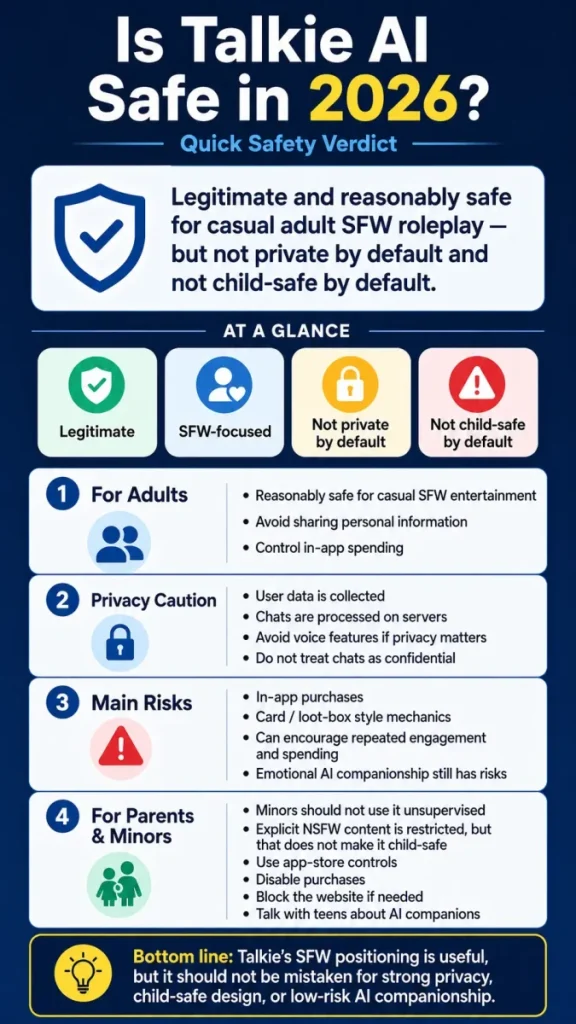
Talkie AI is legitimate and reasonably safe for casual adult users who want SFW character roleplay with stronger content restrictions than many AI companion apps. It is not a scam, and its official rules make it meaningfully different from adult-focused platforms like Candy AI or more flexible roleplay ecosystems like Janitor AI.
But Talkie is not private by default, not child-safe by default, and not free from engagement-design concerns. The platform collects meaningful user data, processes conversations on its servers, includes voice-related features, offers in-app purchases, and uses card/loot-box-style mechanics that can encourage repeated engagement and spending.
The safest summary is this:
- For adults: Talkie AI is reasonably safe for casual SFW entertainment if you avoid sharing personal information and control spending.
- For privacy-sensitive users: use caution, avoid voice features, and do not treat chats as confidential.
- For minors: Talkie AI should not be used unsupervised, even though explicit NSFW content is restricted.
- For parents: use app-store controls, disable purchases, block the website if needed, and talk directly with teens about AI companions.
Talkie’s SFW positioning is real and useful. It just should not be mistaken for strong privacy, child-safe design, or low-risk emotional AI companionship.
Frequently Asked Questions
Is Talkie AI legit or a scam?
Talkie AI is legit. It is a real AI character chatbot platform published by SUBSUP PTE. LTD. and available through official web and mobile channels. The realistic concerns are not that Talkie is fake or malicious, but that it collects meaningful user data, includes in-app purchases, and may not be appropriate for minors without supervision.
Is Talkie AI safe to use?
Talkie AI is reasonably safe for adults using it casually for SFW character chat. It is less suitable for users who need strong privacy, unrestricted roleplay, or a child-safe AI experience. Users should avoid sharing personal information, be careful with voice features, and set spending limits for paid features.
Is Talkie AI safe for kids?
Not for unsupervised use. Talkie restricts explicit NSFW content, but that does not make it child-safe. The app includes AI companion conversations, user-created characters, data collection, in-app purchases, and loot-box-style engagement mechanics. Parents should use app-store restrictions, disable purchases, and treat Talkie as part of the broader AI companion safety conversation.
Does Talkie AI allow NSFW content?
No. Talkie’s official community guidelines prohibit pornographic content, sexually explicit material, sexualized content involving minors, graphic violence, harassment, and other restricted content. In practice, Talkie is much more restrictive than adult AI companion platforms.
Who owns Talkie AI?
Talkie is published by SUBSUP PTE. LTD., a Singapore-based company. Public reporting has also linked Talkie to MiniMax, a Shanghai-based AI company. Because the exact corporate structure is not always clearly presented to users, the safest wording is that Talkie is operated/published by SUBSUP and publicly connected to MiniMax through industry reporting.
Is Talkie AI private?
Talkie AI should not be treated as private in the same way as encrypted messaging. Its privacy policy says it may collect account details, profile information, messages and content, usage data, device data, IP address, and general location information. Talkie says it does not share message contents with advertising partners, but the platform still processes conversations on its servers.
Does Talkie AI store voice data?
Talkie’s privacy policy includes voice-related messages and content among the data it may process. Users should assume voice interactions are server-processed unless Talkie clearly states otherwise in current documentation. If voice privacy matters, use text chat only.
Why did Talkie AI disappear from the App Store?
Talkie became unavailable on Apple’s App Store in late 2024 and later returned under the name Talkie Lab in 2025, according to public reporting and parent-safety coverage. Talkie has not provided a detailed public explanation that fully clarifies the removal, rebrand, and return. The app-store history is not proof of danger, but it is relevant context for a safety review.
What is the Talkie AI card or gacha system?
Talkie uses character cards, gems, passes, subscriptions, and loot-box-style mechanics. These systems can encourage repeated engagement and spending through collection, rarity, unlocks, and rewards. Adults should set spending limits, and parents should disable in-app purchases for minors.
Is Talkie AI better than Character.AI?
Talkie and Character.AI are both SFW-oriented character chatbot platforms. Talkie feels more gamified through cards and in-app purchases, while Character.AI has broader brand recognition and a longer public track record. Character.AI has faced significant legal and regulatory scrutiny around minor safety, but Talkie belongs to the same broader AI companion category. Neither should be treated as safe for unsupervised minors.
About this review: This review follows our AI tool review methodology and is based on Talkie AI’s official privacy policy, community guidelines, public app-store listings, online safety resources, parent-safety coverage, and public reporting about the AI companion app category.
Platform details were checked in May 2026. AI companion apps frequently update their policies, pricing, safety features, and app-store listings, so users should confirm current details on Talkie’s official website and app-store pages before relying on the platform for sensitive use.