
✔ Quick Answer
Viggle AI is safe to use as a meme and animation tool, but it carries meaningful privacy trade-offs. The platform is technically legitimate — backed by Andreessen Horowitz, incorporated in Canada, and virus-free — but its terms of service grant broad rights to your uploaded content, uploaded images are used to train AI models, and the platform has been documented as a vector for deepfake misuse and extremist content.
For casual meme creation with fictional characters: low risk.
For photos of yourself, your children, or anything sensitive: the risk is not worth it.
What Is Viggle AI?
Viggle AI is an AI-powered motion transfer and animation platform developed by WarpEngine Canada Inc., a Toronto-based startup founded in 2022 by CEO Hang Chu — formerly a principal research scientist at Autodesk’s machine learning lab and Nvidia. The platform launched publicly in March 2024, went viral within weeks, and attracted over 4 million users within its first five months, building the second-largest AI-focused community on Discord behind Midjourney.
In August 2024, Viggle raised $19 million in Series A funding led by Andreessen Horowitz (a16z). As of early 2026, the platform reports over 40 million users globally.
The core use case is simple: you upload a static image of any character — real or fictional — select a motion reference or template, and Viggle’s proprietary JST-1 model animates that character into a short video. The result is a dancing, lip-syncing, or moving version of your uploaded image, often indistinguishable from professional animation at first glance.
The platform is available as a browser-based web app, a Discord bot, and as native mobile apps for iOS and Android. A free tier allows five relaxed-mode video generations per day with watermarks and 15-day storage. Paid plans starting at $4.99/month remove watermarks and add more credits.
How Viggle AI Works — The Technical Foundation
Understanding the technology is essential for evaluating safety, because it determines exactly what data Viggle processes and retains.
The JST-1 Model
JST-1 is Viggle AI’s proprietary video-3D foundation model, described as the first of its kind with genuine understanding of physics. It enables realistic, natural-looking character movements by understanding 3D space and physical motion dynamics. Unlike standard text-to-video tools that generate pixels from scratch, Viggle uses motion transfer: you supply the character, you supply the motion reference, and JST-1 merges them.
In addition to JST-1, Viggle integrates pre-trained models from open-source libraries, notably Stable Diffusion, to enhance image conditioning within the video generation pipeline.
Training Data Controversy
Viggle’s use of publicly available YouTube videos as training data for the JST-1 model has drawn criticism. The company acknowledged using YouTube content for training purposes, which raised questions about compliance with YouTube’s terms of service and whether content creators had given informed consent. The AI Algorithmic and Automation Incidents and Controversies (AIAAIC) database documented this as a notable incident.
This is not unique to Viggle — most large AI models were trained on scraped internet data — but it is an important transparency signal when evaluating any company’s attitude toward data ethics.
Is Viggle AI Safe? The 5 Dimensions That Matter
“Safe” means different things depending on what you’re worried about. Here is a breakdown across the five dimensions that matter most.
1. Technical Safety (Viruses, Malware, Account Security)
✔ Verdict: Generally safe
Viggle AI uses SSL encryption protecting user data during transmission. The website uses HTTPS, the mobile app is available through official app stores, and there are no documented reports of the platform distributing malware. The company’s registered address — 1910-10 Capreol Crt, Toronto, ON, Canada — is publicly listed in its app store listings, a standard legitimacy signal.
Key limitation: Viggle does not currently offer two-factor authentication (2FA). Account security depends entirely on password strength. Always use a unique, strong password not shared with any other service.
⚠ Warning about fake apps and clone sites: There are unofficial websites and apps impersonating Viggle AI. Only access the platform at viggle.ai or via the official Discord server at discord.gg/viggle. Third-party sites claiming to offer “Viggle AI access” may harvest your login credentials or API keys.
2. Privacy & Data Handling
⚠ Verdict: Significant trade-offs — read carefully before uploading photos of real people
This is the area with the most important findings. Viggle’s privacy policy, published at viggle.ai/privacy-policy, contains several provisions every user should understand.
What Viggle collects: When you use Viggle’s services, they collect images and videos you upload, as well as the videos or other content you create or generate. They extract data from uploaded images and videos — such as features and patterns — needed to generate the animated output you’ve requested.
What Viggle claims it does NOT store: Viggle states the extracted feature data cannot be used to identify you, is used solely to generate the video, and is not retained after your video is generated. Viggle also states it does not store users’ face data nor share user-related face data with third parties.
What Viggle does retain — the critical clause: Viggle will save a copy of your uploaded image or video in your library which you can review or delete at any time. They also use the images you provide (excluding extracted data) and generated content to improve their services, including to train and improve their AI models and software.
In plain terms: Your uploaded images are stored in your account library and used to train Viggle’s AI models. The company says feature extraction data is not retained — but the original uploaded image is, and that image is used for model training.
What happens when you delete content? Deleting content from your library removes it from your visible account. Independent analysis suggests deleted content may remain in Viggle’s backend database used for model training. Viggle’s privacy policy does not specify a clear, verifiable deletion timeline for training data once it has been incorporated into model improvements.
Targeted advertising: Viggle may share a hashed version of your email address with social media networks and other third-party platforms to serve targeted advertisements, if you have agreed to receive marketing communications.
The practical rule: Do not upload photos of yourself, your children, or any real person you know. Use Viggle with fictional characters, cartoons, or images you don’t mind being permanently associated with a commercial AI training dataset.
3. Terms of Service — What Rights Do You Grant?
⚠ Verdict: Broad content license — read before uploading
By uploading content, users grant Viggle and its licensees, successors, and assigns a fully paid-up, perpetual, irrevocable, worldwide, royalty-free, non-exclusive and fully sublicensable right to use, license, distribute, reproduce, modify, adapt, translate, publicly perform, publicly display, import, sell, offer for sale, derive revenue from, and otherwise exploit and disclose to third parties the content in any form, media, or technology, whether now known or hereafter developed.
Key word: perpetual and irrevocable. Once you upload content, this license does not expire when you delete the file from your library.
The terms also state that users will not have any claim — including claims based upon invasion of privacy, defamation, or right of publicity — arising out of any use, alteration, blurring, distortion or use in connection with Viggle-generated content.
For memes using a celebrity image or a game character: this is largely irrelevant. For photos of yourself or people you know personally: these clauses mean you have given up substantial rights.
Copyright and watermarks: Viggle’s terms prohibit users from removing watermarks, labels, or other legal or proprietary notices included in the Viggle platform or its generated animations.
4. Content Safety & Moderation
⚠ Verdict: Meaningful gaps — documented misuse at scale
This is the dimension where Viggle has the most publicly documented problems in 2026.
Extremist exploitation: In February 2026, the Global Network on Extremism and Technology (GNET) published a report titled “An ‘Ode to Violence’: Extremist Exploitation of Viggle AI”, documenting how extremist groups across multiple online ecosystems — extreme right, True Crime Community, and Salafi-jihadi — used Viggle to produce videos of famous mass attackers dancing while highlighting the number of their victims. Content related to notorious attackers was readily identified in the Viggle app’s public feed.
Teacher “slander” videos: Wired reported in March 2026 that teenagers were using Viggle AI to insert photos of their teachers into compromising scenarios without consent. The platform’s face-animation capabilities made these non-consensual deepfake videos fast and accessible to anyone with a smartphone.
Why this matters: The platform’s public community feed — visible to all users in “Trending,” “Explore,” and “Followed” sections — contains content created by all users globally. Anyone using Viggle, especially minors, can be exposed to this material. The moderation speed has not matched the platform’s growth.
Viggle’s terms prohibit uploading defamatory content or content that violates third-party privacy or publicity rights. The gap between what the terms prohibit and what appears in the public feed reflects a moderation challenge common to all fast-growing platforms — but one that Viggle has not yet demonstrably closed.
5. Legal & Regulatory Compliance
⚠ Verdict: Canadian law jurisdiction, GDPR rights acknowledged, no enterprise certifications
Viggle AI operates under Canadian law (WarpEngine Canada Inc.). The privacy policy references GDPR rights for EU users, including: right of access, right to correction, right to restrict processing, right to object to processing, and right to data portability.
No SOC 2 or ISO 27001 certification is publicly documented. This is normal for a startup of Viggle’s size and age, but it means there is no independent third-party verification of their security claims.
Age requirements: Viggle’s terms require users to have reached the legal age of majority in their jurisdiction. This makes Viggle formally an adult platform — but the viral content it produces is heavily distributed on TikTok and Instagram, where younger users frequently encounter it.
Deepfake laws: The legality of using Viggle to animate someone’s face without their consent varies by jurisdiction. Several US states have passed deepfake legislation; the EU AI Act addresses synthetic media disclosure requirements. Viggle’s terms prohibit non-consensual use but cannot enforce this on uploaded content before it is processed.
Viggle AI Safety vs. Competitors
| Feature | Viggle AI | CapCut | Pika Labs | HeyGen |
|---|---|---|---|---|
| Face data retention | No (claimed) | No | No | Explicit consent required |
| Training data use | ⚠ Yes (uploaded images) | Limited | Limited | No (commercial plans) |
| 2FA available | ❌ No | ✔ Yes | ✔ Yes | ✔ Yes |
| Content moderation | ⚠ Gaps documented | Stronger | Moderate | Strong |
| Enterprise certifications | ❌ None | ✔ SOC 2 | Partial | ✔ SOC 2 |
| Deepfake guardrails | ⚠ Weak | Moderate | Moderate | Strong (consent-based) |
| Free tier data use | Training enabled | Limited | Limited | N/A (paid) |
| Viral meme quality | ✔ Best-in-class | Good | Good | Professional |
Viggle’s main differentiator — its JST-1 physics-based motion model — produces significantly more natural-looking character movement than most competitors. That quality advantage comes with weaker data governance than tools like HeyGen that require explicit consent before animating a person’s likeness.
Who Is Viggle AI Safe For?
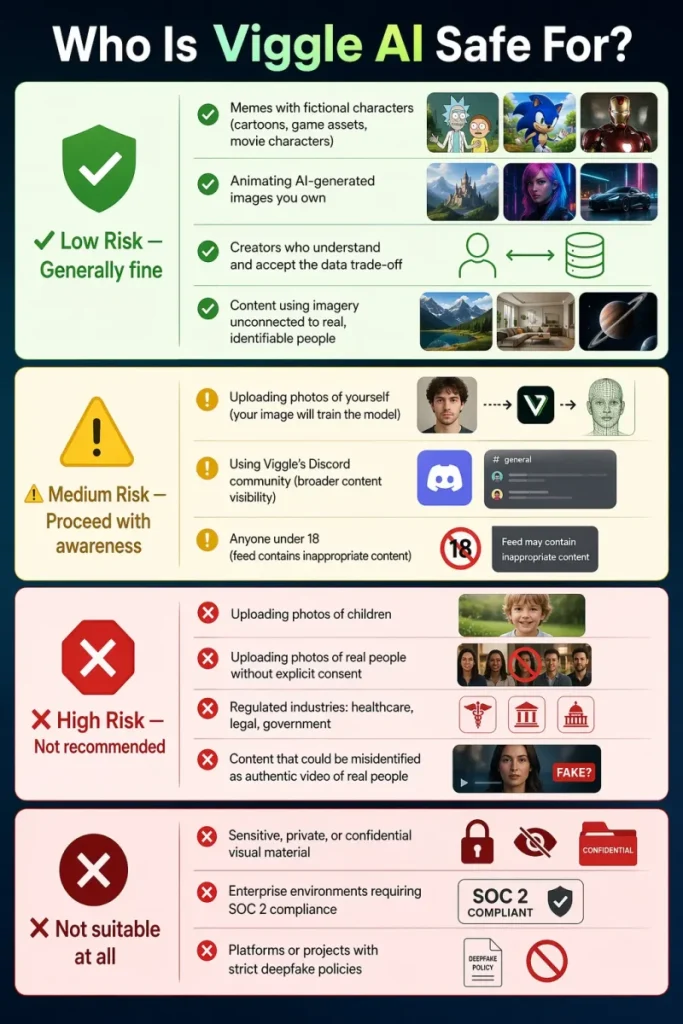
✔ Low Risk — Generally fine
- Memes with fictional characters (cartoons, game assets, movie characters)
- Animating AI-generated images you own
- Creators who understand and accept the data trade-off
- Content using imagery unconnected to real, identifiable people
⚠ Medium Risk — Proceed with awareness
- Uploading photos of yourself (your image will train the model)
- Using Viggle’s Discord community (broader content visibility)
- Anyone under 18 (feed contains inappropriate content)
❌ High Risk — Not recommended
- Uploading photos of children
- Uploading photos of real people without explicit consent
- Regulated industries: healthcare, legal, government
- Content that could be misidentified as authentic video of real people
❌ Not suitable at all
- Sensitive, private, or confidential visual material
- Enterprise environments requiring SOC 2 compliance
- Platforms or projects with strict deepfake policies
For users also evaluating mainstream AI image and video generators, our Krea AI vs Leonardo AI comparison covers the two most-asked-about platforms with real-time generation and Veo 3 access.
How to Use Viggle AI Safely — Practical Checklist
Before you start
- Use a dedicated email address not tied to your primary accounts
- Create a strong, unique password — Viggle has no 2FA to fall back on
- Read the current privacy policy and terms of service at viggle.ai before uploading anything
What to upload
- Fictional characters, cartoons, game assets, AI-generated images
- Avoid real faces — yours or anyone else’s
- Never upload photos of children under any circumstances
Account hygiene
- Regularly review and delete your library at viggle.ai
- Do not connect Viggle to other social accounts unless necessary
- Avoid using Viggle on public or shared Wi-Fi networks
Content you create
- Creating deepfake-style videos of real people without their consent may violate local laws, regardless of Viggle’s own terms
- If you animate real people’s likenesses, obtain explicit written consent first
- Do not remove Viggle watermarks on the free tier — this is prohibited by the terms of service
If you want to delete your data
- Delete your library via your account settings at viggle.ai
- Email support@viggle.ai to request full account and data deletion
- Understand that data already incorporated into model training may not be fully reversible
Frequently Asked Questions
Is Viggle AI safe to download?
Yes. The official app available on Google Play and the Apple App Store is safe from malware. Only download from viggle.ai or official app stores — never from third-party APK sites or unofficial clone websites.
Does Viggle AI store your face data?
Viggle states it does not store users’ face data or share user-related face data with third parties. However, the original uploaded image — which may contain your face — is stored in your account library and used to train Viggle’s AI models. These are two different things, and both are true simultaneously.
Can Viggle AI be used to create deepfakes?
Yes, technically. The tool animates any uploaded image, including real people’s faces, without requiring the uploader to have consent from the person depicted. This is prohibited in Viggle’s terms of service but is not technically prevented. Viggle’s ability to place any person’s likeness into any video scenario raises concerns about deepfake creation, misinformation, and non-consensual content.
Is Viggle AI safe for kids?
No. The platform requires users to be of legal majority age. The public community feed has documented content glorifying violence, featuring inappropriate material, and has been used for extremist propaganda. Parents should be aware that Viggle-generated content circulates widely on TikTok and other platforms accessible to minors.
Is Viggle AI a scam?
No. Viggle AI is a legitimate company — WarpEngine Canada Inc. — backed by Andreessen Horowitz with a documented funding history, a registered corporate address in Toronto, active mobile apps on major app stores, and over 40 million users. It is not a scam, but it is a platform with real privacy trade-offs that many users don’t fully understand before signing up.
Does deleting my content remove it from Viggle’s servers?
Deleting content from your library removes it from your visible account. Independent analysis suggests deleted content may remain in Viggle’s backend database used for model training. Viggle’s privacy policy does not provide a clear, verifiable commitment about training data deletion timelines once content has been incorporated into model improvements.
Is Viggle AI GDPR compliant?
Viggle acknowledges GDPR rights for EU users in its privacy policy, including rights of access, correction, deletion, and data portability. However, the company has no published SOC 2 or ISO 27001 certification, so there is no independent third-party verification of these claims. EU users wishing to exercise their deletion rights should contact Viggle directly in writing.
Does Viggle AI share data with advertisers?
Viggle may share a hashed version of your email address with social media platforms and third-party advertising services for targeted ad delivery, if you have opted into marketing communications. Viggle states it does not sell raw personal data to advertisers, but the hashed email sharing means your identity can still be matched to advertising profiles across platforms.
Is Viggle AI safe to use with personal photos?
No. Personal photos — especially photos of yourself, family members, or children — should not be uploaded to Viggle AI. Under the terms of service, uploaded content is licensed to Viggle on a perpetual, irrevocable basis and is used to train the platform’s AI models. There is no reliable mechanism to ensure this data is fully deleted once uploaded and incorporated into training.
What is the Viggle AI subscription model?
Viggle operates a freemium model. The free tier allows five relaxed-mode video generations per day with Viggle watermarks and 15-day content storage. Paid plans starting at $4.99/month remove watermarks, increase generation credits, add priority processing, and enable 1080p HD exports. Monthly credits do not roll over; separately purchased top-up credits can carry over.
Can Viggle AI be used in regulated industries?
No. Viggle AI is not suitable for use in regulated industries such as healthcare, legal, or government. The platform has no SOC 2 or ISO 27001 certification, no enterprise data processing agreements, and no HIPAA compliance. Any content involving sensitive information or personal data of clients, patients, or subjects should not be processed through Viggle.
Is Viggle AI safe to use for casual creators and niche communities?
Viggle AI’s safety depends on how you use it. For casual creators and niche communities, it generally offers useful ai tools for edit, clip, and image-to-video workflows, but you should review its privacy policy and disclosure practices before uploading sensitive content. Community discussions and reviewer reports can reveal censorship tendencies or a barrier to entry for certain creators, so check forums like reddit and in-app reviews for real-time feedback.
Does Viggle AI collect personal data and what does its privacy policy say?
Viggle AI collects usage data typical of ai video generators and edit tools (account details, device info, clip metadata). Its privacy policy should disclose what is stored, how long, and whether third parties receive data. Look specifically for terms about ip, breach notification, opt-out options, and whether content is used to train models or shared with partners—if those are absent, treat them as red flags.
Can Viggle AI create watermark-free outputs or movie scene–style reels?
Some plans or features of Viggle AI may produce watermark-free content, while free tiers often include branding. If you need watermark-free movie scene edits, check the best free vs paid comparisons, and whether the tool supports image-to-video or lip-sync avatar creation for reel and viral dance clips without visible branding.
How does Viggle AI handle content ownership, IP, and reviewer responsibilities?
Ownership and ip policies vary by platform. Viggle AI should state whether you retain copyrights to created content or grant the service a license to use it (for training or promotion). Reviewers and moderators may enforce community guidelines, which can affect censorship or removal of content. Always export originals and keep records if you anticipate disputes.
Are there privacy or security risks like data breach or younger audiences exposure?
Risks include potential data breach, accidental exposure of minors, and model outputs reflecting biased content (brainrot or meme culture issues). If your audience includes younger audiences, enable privacy controls, parental consent features, and opt-out mechanisms when available. Check for breach response procedures and whether Viggle AI redacts personal identifiers from clips before sharing.
How does Viggle AI compare to other best ai video generators and toolkits?
Comparison to competitors depends on features: real-time editing, lip-sync avatar creation, meme culture adaptability, and a smooth workflow for clip-to-reel production. Compare barrier to entry, cost (best free tiers), watermark-free options, and whether it integrates with toolkits like invideo. Community reviewer feedback and reddit threads can help identify strengths and weaknesses for specific use cases.
Can I opt out of data collection or model training with Viggle AI?
Opt-out policies differ. Some services provide explicit opt-out settings for training data; others require contacting support. Look for an opt-out option in privacy policy or user settings, and if unavailable, ask support for data deletion or exclusion from model training. Keep records of requests to support remediation after a breach or misuse.
Does Viggle AI support workflows for creators who want to animate avatars, lip-sync, or create viral dance reels?
Yes, many ai video platforms support animate features, lip-sync, and tools to produce viral dance or reel content using image-to-video or clip editing. Evaluate Viggle AI’s workflow tools, export options, and whether they integrate with your publishing platforms. For creators focused on meme culture or movie scene edits, confirm output quality and whether there’s a watermark or content restrictions that could hinder virality.
How should a reviewer assess whether Viggle AI is the best free option for content creation?
A reviewer should test features (edit quality, generator speed, watermark-free exports), evaluate privacy policy and disclosure clarity, scan community discussions for censorship or ip issues, and compare barrier to entry versus alternatives. Include practical tests like image-to-video conversion, avatar animation, and end-to-end workflow timing to determine if it meets your needs.
What steps can I take if I suspect a privacy breach or misuse of my content by Viggle AI?
If you suspect a breach, immediately document the incident, change account passwords, contact Viggle AI support and request breach details and takedown if needed, and review the privacy policy for breach procedures. Consider reporting to relevant authorities if sensitive data or minors are involved, and inform your community through transparent disclosure while you investigate.
Is Viggle AI safe to use?
Viggle AI is generally safe for casual creative use, but it carries higher privacy risks than text-only AI tools because it processes photos and videos of real people. Risks include data retention of biometric facial data, potential misuse of generated content for deepfakes, and Viggle’s involvement in any data breach affecting Discord (where it primarily operates).
Can Viggle AI create deepfakes?
Technically yes — Viggle AI can map faces and movements onto generated characters in ways that could be used for deepfake content. Viggle’s terms of service prohibit malicious deepfake creation and impersonation, but enforcement is reactive rather than preventive. Users uploading photos of others without consent are violating terms and potentially laws in many jurisdictions.
Does Viggle AI keep my photos and videos private?
Viggle AI’s privacy policy allows them to retain uploaded content and use it to improve their services. The platform doesn’t publicly share your uploads, but they do exist on Viggle’s servers. For sensitive content, this carries risk if Viggle ever experiences a data breach.
How does Viggle AI protect against misuse?
Viggle AI has stated content moderation policies and prohibits non-consensual intimate imagery, deepfakes of public figures, and clearly malicious content. However, like most AI platforms, prevention is limited and enforcement is reactive. Users have responsibility to use the tool ethically and obtain consent before using others’ likenesses.
Can I get sued for using Viggle AI?
Yes, in specific circumstances. Using someone’s likeness without consent for commercial purposes, creating deepfake content for harassment, or generating defamatory content can all create legal liability. Many U.S. states have specific laws against AI-generated impersonation and revenge content. Always use Viggle AI ethically.
Is Viggle AI free?
Viggle AI offers a free tier with limited daily generations through Discord. Paid plans expand generation limits and unlock additional features. Free users still must comply with content policies and accept terms governing data use.
Final Verdict
Viggle AI is technically safe in the narrow sense — it won’t give your device malware, it’s a real company, and it has legitimate backing. But “technically safe” and “safe for your data” are different standards, and the distinction matters here.
For memes with fictional characters: Viggle is an excellent, low-risk tool. The data trade-off is minimal when the content is a cartoon character or game asset.
For photos of real people — including yourself: The privacy trade-off is real. Your image will train Viggle’s commercial AI model under a perpetual, irrevocable license. Deleted images may persist in the training dataset. You waive significant rights under the terms of service.
For younger users and parents: The platform is adult-only by its own terms, and the community feed contains content that is not appropriate for children. The tool’s viral output is widely distributed on platforms where minors are active.
For enterprise or regulated use: Viggle has no independent security certifications and is not designed for compliance-sensitive environments.
The core trade-off, stated plainly: Viggle AI is free because you — or more specifically, your uploaded content — are part of the product. That is a trade millions of users have decided is worth making for a funny meme. Make sure it is a trade you are making consciously.
For voice-focused AI safety considerations rather than video, see also our review of Dubbing AI, which covers the same deepfake-adjacent privacy and identity concerns from a real-time voice changer angle. Voice cloning has become a parallel risk area to AI video manipulation in 2026, with similar legal frameworks now applying.
If you also use AI voice tools for narration or business content alongside likeness-based video tools, our Murf AI safety review covers the enterprise compliance side of the AI voice category.
For a complete overview of our AI tool safety analysis methodology and a comparison of all reviewed tools, see our AI Tool Safety Reviews hub.
Sources & Evidence
- Viggle AI official privacy policy — viggle.ai/privacy-policy
- Viggle AI terms of use — viggle.ai/terms-of-use
- GNET Report: “An ‘Ode to Violence’: Extremist Exploitation of Viggle AI” — gnet-research.org, February 26, 2026
- Wired / Futurism: “Teens Are Using AI to Create ‘Slander’ Videos of Their Teachers” — March 2026
- SiliconAngle: “Viggle AI raises $19M in funding for its AI video generator” — August 2024
- AI Wiki: Viggle AI entry — aiwiki.ai/wiki/viggle_ai
- ToolJunction: Viggle AI Review 2026 — tooljunction.io
- Software Curio: “Viggle AI Review 2026: The Viral Tool That Raises Serious Privacy Questions”
- Nudge Security: VIGGLE vendor risk assessment — nudgesecurity.com
- AIAAIC database — documented YouTube training data incident
- Viggle AI about page — viggle.ai/about-us
- Google Play Store listing — WarpEngine Canada Inc.
This analysis is based on independent review of Viggle AI’s published privacy policy, terms of service, funding announcements, and third-party research including reports from the Global Network on Extremism and Technology (GNET), the AIAAIC database, and reporting by Wired and SiliconAngle. No affiliation with Viggle AI or WarpEngine Canada Inc. Last reviewed: April 2026.